

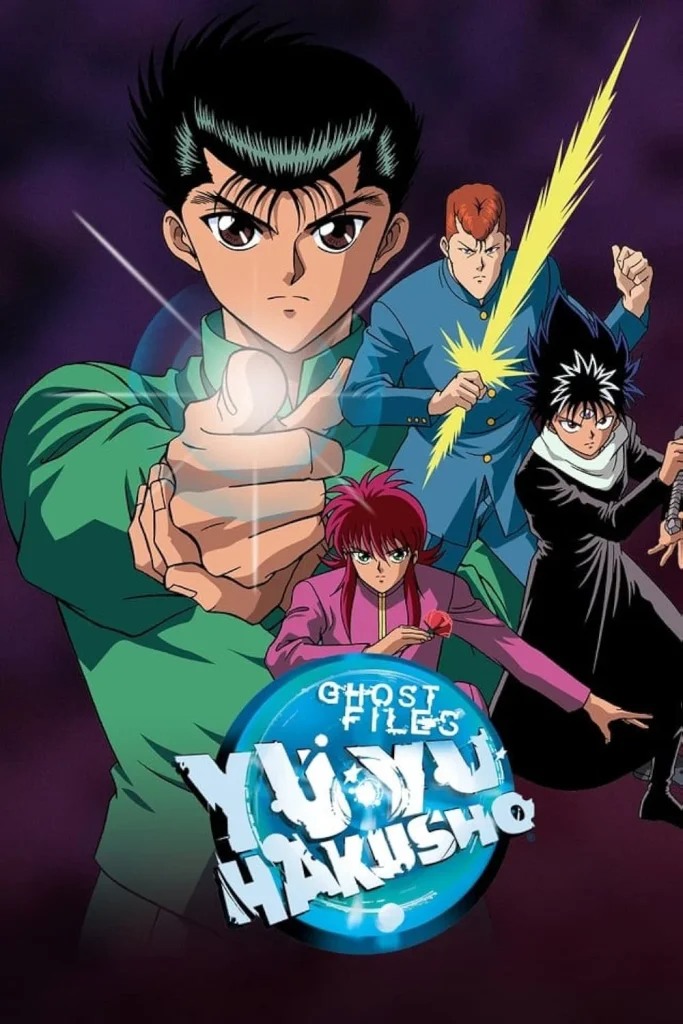
Overview
Yu Yu Hakusho is the series that helped define an entire era of shonen storytelling. Created by Yoshihiro Togashi, the manga began development in late 1990 and drew from his fascination with the occult, horror cinema, and Buddhist cosmology. It ran in Weekly Shonen Jump from December 1990 through July 1994 and was eventually collected into 19 volumes spanning 175 chapters. Alongside Dragon Ball and Slam Dunk, it's remembered as one of the three pillars of Shonen Jump's 1990s golden era, and its anime adaptation pushed Studio Pierrot's animation and fight choreography to a level that influenced the studio's later work, most notably on Naruto.
Synopsis
Yusuke Urameshi starts out as a fourteen-year-old delinquent with a short fuse, a bad reputation, and no real plan for his life. Everything changes the moment he pushes a small child out of the path of an oncoming car and dies in the process. His death catches the afterlife completely off guard. Nobody in the Spirit World expected a troublemaker like Yusuke to sacrifice himself for someone else, and because his death fell outside the natural order, Koenma, the Spirit World's young overseer, gives him an unusual offer: pass a set of trials and earn his way back to life.
Yusuke succeeds and is brought back, but not to his old routine. He's handed the title of Spirit Detective, responsible for investigating cases involving demons and supernatural threats slipping into the human world. Along the way he's joined by his former rival Kazuma Kuwabara, the elegant and calculating former demon Kurama, and the sharp-tongued fire demon Hiei. Together they carry the story through four major arcs, starting with street-level spirit-world cases and building toward the Dark Tournament, the Chapter Black saga, and finally the Three Kings arc, each one raising the stakes and deepening the emotional core of the series. The Dark Tournament in particular is often cited as one of the best tournament arcs anime has ever produced. Underneath the escalating battles, the series is really about Yusuke's slow transformation from an aimless troublemaker into someone who chooses to protect others.
Trailer
Characters and Voice Actors
Yuusuke Urameshi
Main character- Japanese: Justin Cook
- Japanese: Darren Pleavin
- English: Justin Cook
- English: Darren Pleavin
Kazuma Kuwabara
Main character- Japanese: Christopher Sabat
- Japanese: Russell Wait
- English: Christopher Sabat
- English: Russell Wait
Kurama
Main character- Japanese: John Burgmeier
- Japanese: Kate Bristol
- Japanese: Candice Moore
- English: John Burgmeier
- English: Kate Bristol
- English: Candice Moore
Hiei
Main character- Japanese: Chuck Huber
- Japanese: Dave Bridges
- English: Chuck Huber
- English: Dave Bridges
Keiko Yukimura
Supporting character- Japanese: Laura Bailey
- Japanese: Andrea Kwan
- English: Laura Bailey
- English: Andrea Kwan
Botan
Supporting character- Japanese: Cynthia Cranz
- Japanese: Sarah Hauser
- English: Cynthia Cranz
- English: Sarah Hauser
Genkai
Supporting character- Japanese: Linda Young
- Japanese: Andrea Kwan
- Japanese: Candice Moore
- English: Linda Young
- English: Andrea Kwan
- English: Candice Moore
Yukina
Supporting character- Japanese: Jessica Dismuke
- Japanese: Candice Moore
- English: Jessica Dismuke
- English: Candice Moore
Koenma
Supporting character- Japanese: Sean Michael Teague
- Japanese: Candice Moore
- English: Sean Michael Teague
- English: Candice Moore
Touya
Supporting character- Japanese: Daniel Katsük
- English: Daniel Katsük
Jin
Supporting character- Japanese: Jerry Jewell
- English: Jerry Jewell
Yomi
Supporting character- Japanese: Rick Robertson
- Japanese: Victor Lee
- English: Rick Robertson
- English: Victor Lee
Karasu
Supporting character- Japanese: Kyle Hebert
- English: Kyle Hebert
Shinobu Sensui
Supporting character- Japanese: Robert McCollum
- English: Robert McCollum
Shura
Supporting character- Japanese: Aaron Dismuke
- English: Aaron Dismuke
Shishiwakamaru
Supporting character- Japanese: Christopher Bevins
- English: Christopher Bevins
Toguro Otouto
Supporting character- Japanese: Dameon Clarke
- English: Dameon Clarke
Bui
Supporting character- Japanese: Vic Mignogna
- English: Vic Mignogna
Rinku
Supporting character- Japanese: Kimberly Grant
- English: Kimberly Grant
Suzaku
Supporting character- Japanese: Jerry Jewell
- English: Jerry Jewell
Chuu
Supporting character- Japanese: Kent Williams
- English: Kent Williams
Shizuru Kuwabara
Supporting character- Japanese: Kasey Buckley
- Japanese: Andrea Kwan
- English: Kasey Buckley
- English: Andrea Kwan
Atsuko Urameshi
Supporting character- Japanese: Meredith McCoy
- English: Meredith McCoy
Takenaka
Supporting character- Japanese: Brice Armstrong
- English: Brice Armstrong
Sawamura
Supporting character- Japanese: Mike McFarland
- English: Mike McFarland
Production and Staff
Production Background
Yu Yu Hakusho's manga came entirely from the hand of Yoshihiro Togashi, who serialized it in Shueisha's Weekly Shonen Jump from December 1990 through July 1994. The television adaptation followed close behind, running for 112 episodes across four seasons under director Noriyuki Abe, with Fuji Television, Yomiko Advertising, and Studio Pierrot sharing production duties. It aired on Fuji TV from October 10, 1992 to January 7, 1995. Funimation brought the series to North America in 2001, one of its earliest major licenses outside the Dragon Ball franchise, and the English dub later found a long home on Cartoon Network's Toonami and Adult Swim blocks between 2002 and 2006. Beyond the TV run, the franchise produced two theatrical films: a short thirty-minute feature sometimes called The Golden Seal, released July 10, 1993, and a fuller ninety-five-minute follow-up known as Poltergeist Report or Bonds of Fire, released April 9, 1994. The production also left a lasting mark on the animation industry itself, with several animators who worked on its fight sequences going on to define much of Studio Pierrot's visual style in later years, including a direct line of influence into some of Naruto's most celebrated action episodes. That legacy was reflected in the numbers too, with the manga surpassing 50 million copies sold domestically and winning the Shogakukan Manga Award in 1993, while the anime claimed the Animage Anime Grand Prix for best anime in both 1994 and 1995.
Franchise Context
Netflix released a live-action adaptation in December 2023, compressing close to 70 episodes' worth of anime story into just five episodes. The project was helmed by director Tatsuro Mishima with producer Kazutaka Sakamoto, who also worked on Alice in Borderland. It performed remarkably well, becoming the top-performing Japanese title on Netflix that year with roughly 17 million viewers. Even so, no second season has been greenlit as of this writing, and the show's tightly self-contained structure may be part of the reason. Lead actor Takumi Kitamura has spoken publicly about wanting to continue the story, specifically mentioning excitement about adapting the Genkai storyline if Netflix moves forward.
Outside of that live-action run, there hasn't been a new mainline anime series or full franchise reboot announced. A pair of short OVAs released in 2018 tied to the franchise's 25th anniversary remain the most recent animated additions beyond the original run. That makes this a strong candidate for evergreen reference content rather than breaking-news coverage, unless Netflix renewal news changes that.
Watch Order
Newcomers deciding how to approach the franchise are generally best served by starting with the manga, since its nineteen volumes and 175 chapters represent the most complete and faithful version of Togashi's original story. From there, the 1992 television anime is considered the definitive adaptation, carrying viewers through the Spirit Detective arc, the Dark Tournament, the Chapter Black saga, and finally the Three Kings arc across its four seasons and 112 episodes. The two theatrical films sit outside the main continuity and are treated as optional extras rather than essential viewing: the shorter Golden Seal film is a lighter, non-canon detour, while Poltergeist Report, also known as Bonds of Fire, is usually slotted in by fans after finishing the Dark Tournament arc for those who want more before continuing the main story. The 2023 Netflix live-action series stands apart from all of this as a separate, heavily condensed retelling rather than a direct continuation of either the manga or the original anime, making it a reasonable entry point for viewers who want the broad strokes of the story in a few hours but not a substitute for the source material. Readers chasing the most faithful version of the ending in particular should go back to the manga, since the television anime softened some of the original's violence and language along the way.
Community Verdict
Quick reader and viewer signals from the Volluble community.
Would you recommend this to a first-time anime viewer?
Did the ending satisfy you?
Would you watch it again?
Related Titles
Sources
0 Comments
Be the first to comment.