
Overview
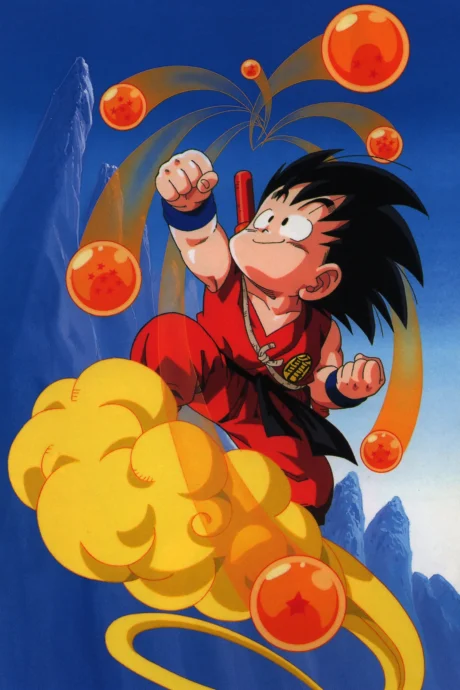
This 1986 television series is where the animated side of the Dragon Ball phenomenon began, translating Akira Toriyama's early manga chapters into a weekly adventure that ran for 153 episodes. Its importance sits in that translation: it took a gag-driven road story and stretched it into serialized television, giving viewers a long-form look at how a scrappy, superhuman boy grows from a woodland loner into a dedicated martial artist. For the history of shounen action animation, this is a foundational text, one whose comic timing, escalating tournaments, and appetite for the next challenge echo through countless later productions.
As an experience, it moves in two distinct gears. Early stretches favor travel, slapstick, and oddball encounters, with a small cast wandering in search of magical artifacts. Later stretches tighten into structured competition, where training pays off in staged one-on-one bouts and the stakes climb steadily. The result is a deliberately unhurried watch: episodic, frequently silly, and willing to let a fight breathe across multiple installments. Viewers who enjoy a slow-building ensemble and a tone that shifts from parody to sincerity will get the most from it.
Approachability is helped by a finished run that never demands prior knowledge of the wider franchise, plus a full English dub and streaming availability on Hulu, Crunchyroll, and Bilibili TV. It suits newcomers curious about the roots of a landmark series, fans of classic adventure comedy, and anyone drawn to tournament arcs as a structure. Its content leans strong in places, so it is best treated as mainstream mature rather than children's programming. Those accustomed to brisk modern pacing may need to settle into its older rhythm, but the reward is a clear view of where a long-running legacy took shape.
Synopsis
Goku is a boy with a monkey tail who lives by himself in the mountains, far from any town and unaware of much beyond hunting and fighting. His routine ends when a girl named Bulma arrives searching for the seven Dragon Balls, magical objects said to summon a wish-granting dragon for whoever brings them together. Goku owns one of the balls and will not give it up, so the two strike a bargain and set out on a journey across the world to find the rest.
Their travels bring them into contact with a growing circle of allies, among them the turtle hermit Muten Roshi, the shapeshifting Oolong, the desert bandit Yamcha and his companion Puar, and a fellow student named Kuririn. Under Muten Roshi's instruction, Goku and Kuririn train as martial artists and enter the World Martial Arts Tournament, where Goku measures himself against skilled opponents and begins to define the kind of fighter he wants to become.
The series follows Goku from childhood adventures into increasingly serious confrontations, as rival martial artists, ambitious organizations, and powerful enemies test the strength and resolve he has built through training. His cheerful appetite for a good fight, his loyalty to his friends, and his steady drive to improve keep him moving forward as each new challenge raises the stakes.
Trailer
Should You Watch It?
Watch it if you enjoy
- Watch if you want the earliest animated Dragon Ball entry, following Goku's childhood adventures from Akira Toriyama's manga.
- Watch if you enjoy a slow-building shounen mix of travel, slapstick comedy, martial-arts training, and World Martial Arts Tournament bouts.
- Watch if you value foundational anime history: this 1986 Toei series helped translate a gag-driven road story into long-form weekly adventure.
It may not suit you if
- May not suit viewers who prefer tightly paced modern action, since the series is deliberately unhurried and lets fights breathe across episodes.
- May not suit those who want immediate high stakes; early stretches emphasize episodic travel, oddball encounters, and comedy.
- May not suit if you dislike tournament-centered martial arts or strong fantasy combat content.
This automatic starting point balances the series length, pacing, time commitment, and available AniList community signals. Editors can override it when firsthand knowledge suggests a better entry point.
Why It Connects With Audiences
Why people love it
- It is a foundational shounen action text, adapting Toriyama's opening 194 manga chapters into 153 TV episodes.
- The series is valued for comic timing, escalating tournament structure, and Goku's growth from woodland loner to dedicated martial artist.
- Its ensemble and tone shift from parody to sincerity give viewers a long-form, varied adventure.
Common criticisms
- The deliberately unhurried pace and multi-episode fights can feel slow to some viewers.
- Early gag-driven travel arcs may feel uneven next to the later tournament-focused action.
- Its 153-episode length is a notable commitment for newcomers.
Volluble DNA
A quick profile of the title’s dominant storytelling ingredients.
Characters and Voice Actors25 characters
Gokuu Son
Main character- English: Barbara Goodson
- Japanese: Masako Nozawa
- English: Jeffrey Watson
- English: Saffron Henderson
- English: Sean Schemmel
- English: Stephanie Nadolny
- English: Zoe Slusar
- English: Andrea Kwan
- English: Dave Bridges
Bulma
Main character- English: Wendee Lee
- Japanese: Hiromi Tsuru
- English: Tiffany Vollmer
- English: Lalainia Lindbjerg
- English: Claudia Thompson
- English: Leda Davies
Kuririn
Main character- Japanese: Mayumi Tanaka
- English: Sonny Strait
- English: Laurie Steele
- English: Mike Thiessen
Yamcha
Main character- English: Christopher Sabat
- Japanese: Tooru Furuya
- English: Ted Cole
- English: Darren Pleavin
- English: Scott Evans
- English: Victor Atelevich
- English: Kerrigan Mahan
Muten Roushi
Main character- English: Mike McFarland
- Japanese: Jouji Yanami
- English: Ian James Corlett
- English: Michael Donovan
- Japanese: Kouhei Miyauchi
- English: Dave Bridges
- English: Dean Galloway
- English: Clifton Wells
Pu’ar
Supporting character- Japanese: Naoko Watanabe
- English: Monika Antonelli
- English: Dave Bridges
- English: Kathy Morse
- English: Cheryl Chase
- English: Chris Simms
Piccolo
Supporting character- English: Christopher Sabat
- Japanese: Toshio Furukawa
- English: Mike Shepherd
Gyuumaou
Supporting character- English: Kyle Hebert
- Japanese: Daisuke Gouri
- English: Dave Pettitt
- English: Dave Ward
Suno
Supporting character- Japanese: Naoko Watanabe
- English: Carol Hope
- English: Susan Huber
Upa
Supporting character- Japanese: Mitsuko Horie
- English: Susan Huber
- English: Brett Bauer
Yajirobe
Supporting character- Japanese: Mayumi Tanaka
- English: Mike McFarland
- English: Lucas Gilbertson
Jinzouningen 8-gou
Supporting character- English: Mike McFarland
- Japanese: Shouzou Iizuka
- English: Jeremiah Yurk
Bora
Supporting character- Japanese: Banjou Ginga
- English: Dameon Clarke
- English: Lucas Gilbertson
Chi-Chi
Supporting character- English: Laura Bailey
- English: Carol-Anne Day
- English: Katie Rowan
- English: Cynthia Cranz
- Japanese: Mayumi Shou
- English: Andrea Kwan
- English: Andrea Libman
Briefs Hakase
Supporting character- Japanese: Jouji Yanami
- English: Chris Forbis
- English: Corby Proctor
Gohan Son
Supporting character- Japanese: Osamu Saka
- English: Christopher Sabat
- English: Michael Donovan
Lunch
Supporting character- English: Meredith McCoy
- Japanese: Mami Koyama
- English: Onalea Gilbertson
Bulma no Mama
Supporting character- English: Cynthia Cranz
- Japanese: Mariko Mukai
Oolong
Supporting character- Japanese: Tesshou Genda
- English: Bradford Jackson
- Japanese: Naoki Tatsuta
- English: Dave Mallow
- English: Alec Willows
- English: Corby Proctor
Tenkaichi Budokai Announcer
Supporting character- Japanese: Kenji Utsumi
- English: Eric Vale
Baba Uranai
Supporting character- English: Linda Young
- Japanese: Junpei Takiguchi
- English: Corby Proctor
Umigame
Supporting character- English: Christopher Sabat
- Japanese: Daisuke Gouri
- English: Dan Woren
- English: Dave Pettitt
- English: Doug Parker
Tama
Supporting character- Japanese: TARAKO
- English: Barry Watson
Akkuman
Supporting character- English: Justin Cook
- Japanese: Michihiro Ikemizu
Sanzoku Kuma
Supporting character- English: Dameon Clarke
- Japanese: Takahiko Sakaguma
Production and Staff20 credits
View all 8 additional credits
Production Background
This 1986 television series was produced by Toei Animation and broadcast on Fuji Television and its FNS affiliates, running for 153 episodes from February 26, 1986 to April 19, 1989, with each episode averaging about 25 minutes. It is the first animated television series in the Dragon Ball franchise, adapting the opening 194 chapters of Akira Toriyama's manga, which had been serialized in Weekly Shōnen Jump since 1984.
Because the adaptation began while Toriyama's manga was still running, the series worked through the early arcs of the story, following Goku's childhood adventures, his training under Muten-Roshi, and the World Martial Arts Tournament. Toei Animation also produced theatrical animated films alongside the show, among them Curse of the Blood Rubies in 1986, Sleeping Princess in Devil's Castle in 1987, and Mystical Adventure in 1988.
The series was broadcast in 81 countries and later reached English-speaking viewers through an English dub. It remains available for streaming on Hulu, Crunchyroll, and Bilibili TV.
Franchise Context
This entry covers the 1986 Dragon Ball television series, the first animated television series in the wider Dragon Ball franchise. It is not the origin point of the property itself: Akira Toriyama's manga was already running in Weekly Shonen Jump when the anime began, so the show arrived as a screen adaptation of an existing work rather than as the franchise's debut.
Within the franchise, the series stands as the beginning of the animated story. It adapts the opening portion of the manga, following Goku from childhood adventures through martial arts tournaments, and it precedes the later television series that carry the narrative forward. The theatrical features released during the same period, among them Curse of the Blood Rubies, Sleeping Princess in Devil's Castle, and Mystical Adventure, sit alongside it as companion films rather than as substitutes for the series.
For anyone approaching the franchise, this is the earliest animated entry and the natural starting point for the anime continuity. Later installments build on its characters and events, which makes it a foundational chapter rather than a spin-off, sequel, or alternate version. The manga remains the original source, and this page documents only the television series itself, not the franchise as a whole.
Franchise Path
- Start here: the first animated Dragon Ball TV series, adapting the opening 194 manga chapters and launching the animated story.
- Follow the later Dragon Ball TV series that carry Goku’s narrative forward after this 153-episode run.
- The manga by Akira Toriyama is the original source; this anime is its screen adaptation, not the franchise’s debut.
- Companion theatrical films from the same early era sit alongside the series rather than replacing it.
After You Finish
Continue with
- After the 153-episode finale, continue with the later Dragon Ball anime TV series that carry the story forward.
- This 1986 series is complete on its own; no additional episodes are needed to finish its adapted arc.
- Stay within the Dragon Ball franchise for the next narrative step; the companion films are side stories, not continuations.
Community Verdict
Quick reader and viewer signals from the Volluble community.
Would you recommend this?
Did the ending satisfy you?
Would you watch it again?
0 Comments
Be the first to comment.