
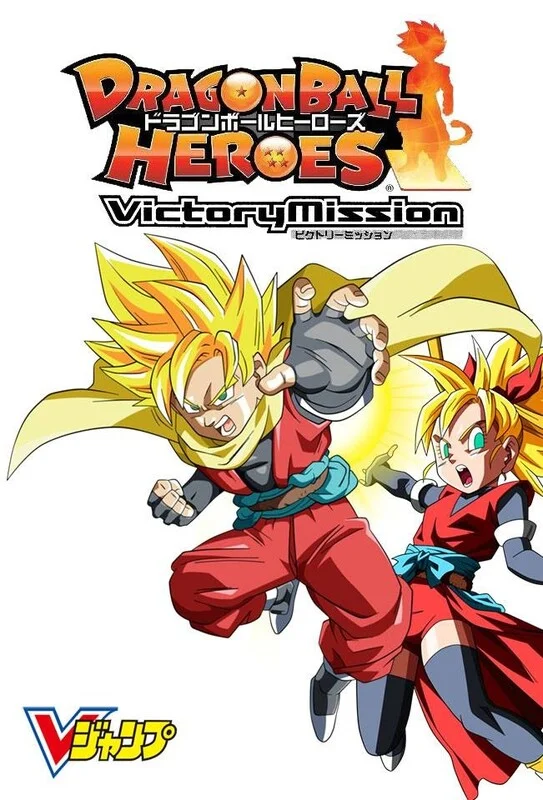
Overview
Dragon Ball Heroes: Victory Mission is a manga companion to the Dragon Ball Heroes arcade card game, running from 2012 to 2015 across 35 chapters before it was cancelled. Rather than retelling the battles of the main Dragon Ball storyline, it follows a player named Beat who steps into the game world itself, turning the arcade cabinet into a setting and the card battles into the drama. That premise makes it a distinctive artifact of the card game era, a title built to advertise and extend a game rather than to stand alongside the franchise's core sagas.
The experience here is brisk and game-like. Readers should expect escalating matchups, roster cameos, and a playful isekai structure in which the rules of the card game shape the stakes. Comedy, action, and fantasy blend easily because the story never has to justify its own crossover logic, and the time manipulation theme lets it pull characters and scenarios from across Dragon Ball history without much setup. It reads less like a sweeping epic and more like a serialized celebration of the card game's possibilities.
This is an approachable pickup for newcomers and younger readers precisely because it demands little prior continuity knowledge. Anyone curious about the arcade game's world, or about how Dragon Ball was adapted into a card-battle format during this period, will find a compact and low-commitment read. The trade-off is that it ends abruptly, with 35 chapters and a cancelled status leaving threads unresolved, so it is best appreciated as a slice of a specific moment rather than a complete narrative arc.
Synopsis
Dragon Ball Heroes: Victory Mission is a manga about Beat, a boy who is drawn into the world of the Dragon Ball Heroes arcade game. The setup leans into isekai and card battle themes: Beat must engage with a game-like reality where cards and summoned fighters decide the outcome of conflicts. His personal journey and growing involvement in this arcade realm form the core of the story.
As Beat takes part in battles, he meets opponents and allies who test his strategy and resolve. The series blends action, adventure, comedy, and fantasy, using time manipulation as an additional element within its game-centered conflicts. The primary tension comes from Beat's efforts to succeed in the arcade game's challenges while navigating the strange rules of the world he has entered.
Should You Read It?
Read it if you enjoy
- Read if you enjoy card-battle isekai where an arcade game world supplies the rules and stakes.
- Read if you want a light Dragon Ball spin-off with roster cameos, time manipulation, and game-like escalation.
- Read if you are curious about the Dragon Ball Heroes card-game era or want an approachable tie-in manga.
It may not suit you if
- May not suit readers seeking mainline Dragon Ball continuity, canonical sagas, or a replacement for core series.
- May not suit those who dislike tie-in manga built to advertise and extend a card game.
- May not suit readers who prefer complete, volume-collected runs; this serial ended cancelled at 35 chapters with no volumes recorded.
This automatic starting point balances the series length, pacing, time commitment, and available Volluble research data. Editors can override it when firsthand knowledge suggests a better entry point.
Why It Connects With Audiences
Why people love it
- Its playful premise—Beat entering the Dragon Ball arcade game—turns the cabinet into a setting and card battles into drama.
- Time manipulation and broad roster cameos let it pull from Dragon Ball history without heavy setup.
- The action, adventure, comedy, and fantasy mix makes for a brisk, game-like read.
Common criticisms
- Some may find the crossover logic too easygoing, with matchups and cameos outweighing deeper character stakes.
- As a card-game companion, it can read more like a serialized celebration or promotion than a standalone epic.
- Its cancelled status and 35-chapter, no-volume publication may leave the run feeling incomplete to some readers.
Volluble DNA
A quick profile of the title’s dominant storytelling ingredients.
Manga Staff1 credits
Production Background
Dragon Ball Heroes: Victory Mission is a manga adaptation tied to the Dragon Ball Heroes trading card arcade game, which debuted in Japan on November 11, 2010. The saved record identifies the manga's source material as a video game, and its narrative centers on Beat, a boy who enters the Dragon Ball arcade game. This setup connects the manga directly to the card-battle premise of its source rather than to a standalone story.
The series began on September 21, 2012, and ended on November 19, 2015. It is listed with a cancelled status, 35 chapters, and no volumes recorded in the saved data. In the broader publication context, Dragon Ball Heroes manga adaptations have been published by Shueisha, placing Victory Mission within that tie-in manga line.
Franchise Context
Dragon Ball Heroes: Victory Mission is a manga spin-off within the larger Dragon Ball franchise. It is tied to the Dragon Ball Heroes arcade card game rather than to the mainline Dragon Ball manga or anime. The game launched in Japan in 2010 and later received the Super Dragon Ball Heroes update in 2016, but this manga belongs to the earlier Dragon Ball Heroes era and adapts its game world into a serialized story.
The series began in 2012 and ended in 2015 after 35 chapters, and its publication status is listed as cancelled. It centers on Beat, a boy who enters the Dragon Ball arcade game, making it a game-based narrative rather than a direct continuation of established Dragon Ball storylines. It is one of several manga adaptations connected to Dragon Ball Heroes, so it should be understood as a companion work in the franchise rather than as the franchise's central storyline.
For readers approaching the broader Dragon Ball universe, Victory Mission is an alternate spin-off branch that assumes familiarity with the franchise and its card-battle premise. It is not a remake or a mainline entry, and it does not replace the original Dragon Ball manga, Dragon Ball anime, or Dragon Ball Super. Its place in the franchise is as a short-lived, game-linked manga that expands the Dragon Ball Heroes corner of the property.
Franchise Path
- Franchise path: Start with the original Dragon Ball manga or anime for core roster context.
- Then read Dragon Ball Heroes: Victory Mission as a card-game isekai side branch.
After You Finish
Continue with
- No direct sequel: the manga was cancelled after 35 chapters, so this arcade-era story stands complete.
- For more, try other Dragon Ball Heroes manga tie-ins from Shueisha if you want similar game-world Dragon Ball tales.
Community Verdict
Quick reader and viewer signals from the Volluble community.
Would you recommend this?
Did the ending satisfy you?
Would you read it again?
Report an issue
Spot something wrong on this page? Tell us what needs attention.
0 Comments
Be the first to comment.