
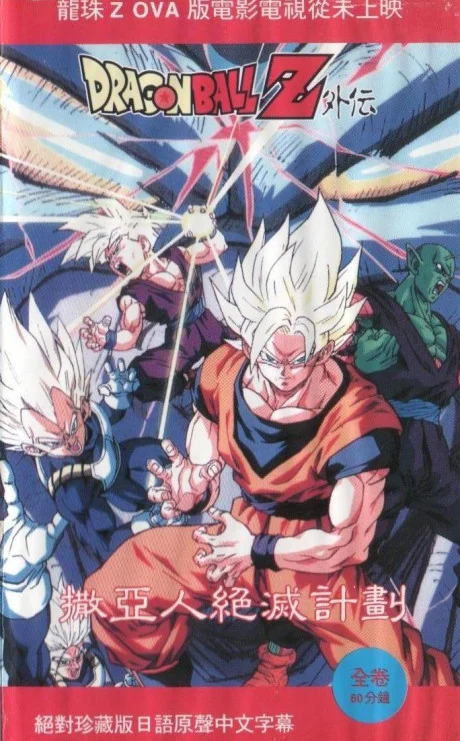
Overview
Dragon Ball Z: Plan to Eradicate the Saiyans is a two-part original video animation from 1993, positioned as a side story rather than a chapter of the television continuity. It came out of a card-battle role-playing game for the Family Computer, with the animated parts issued in two instalments connected to strategy guide material. That origin is part of why the work matters: it is an early, unusually direct example of this franchise treating a game-first storyline as a stage for full-scale action and giving it a life beyond the console.
What the OVA offers is a compact, deadline-driven adventure. A survivor of the race the Saiyans once wiped out sets a revenge scheme in motion, forcing the heroes to work against a fixed countdown while a threat aimed at all life on the planet escalates. At roughly half an hour per part, the pacing stays brisk and the tone moves between martial arts spectacle, transformation showpieces and light comedy, with the science fiction machinery doing the heavy lifting behind the conflict.
Approachability is one of its real strengths. Two short parts, a premise explained within the runtime and a small central cast mean viewers can follow it without deep familiarity with the surrounding series, and anyone curious about the franchise's less central corners will find a tidy sample of its 1990s style. Those who prefer long serialized arcs may find it slight, and readers should note that a later remake exists as a separate alternative treatment of the same premise.
Synopsis
Dragon Ball Z: Plan to Eradicate the Saiyans is a two-part original video animation side story. Dr. Raichii, a survivor of the Tsufurujin race, seeks revenge against the Saiyans who wiped out his people. His targets are the remaining Saiyans, Goku and Vegeta, along with the other defenders of Earth.
Raichii unleashes machines that spread a deadly gas called Destron, threatening all life on the planet. With the world under siege, Goku, Vegeta, and the Z warriors race to locate Raichii and stop his scheme before time runs out.
Central to the conflict are Goku and Vegeta, whose Saiyan heritage makes them both the focus of Raichii's vengeance and the strongest line of defense. The OVA presents a compact, high-stakes mission built around martial arts action and a planet-wide threat.
Trailer
Should You Watch It?
Watch it if you enjoy
- Watch if you want a compact, self-contained Dragon Ball Z side story with Goku, Vegeta and the Z warriors on a 72-hour mission.
- Watch if you enjoy martial arts action, transformation showpieces and light comedy in a short OVA format.
- Watch if you are curious about an early game-first anime tie-in that was later reused and remade in 2010.
It may not suit you if
- May not suit viewers looking for a mainline Dragon Ball Z arc, theatrical-scale film or long-form character development.
- May not suit those who dislike game tie-in plotting, strategy-guide origins or villain revenge schemes as the central drive.
- May not suit viewers who prefer a fully standalone story with no connection to a larger franchise branch.
This automatic starting point balances the series length, pacing, time commitment, and available Volluble research data. Editors can override it when firsthand knowledge suggests a better entry point.
Why It Connects With Audiences
Why people love it
- The 72-hour countdown gives the two-part OVA a brisk, high-stakes mission structure.
- Goku and Vegeta are personally tied to Dr. Raichii's revenge because of their Saiyan heritage, adding focus to the conflict.
- Its origin as a 1993 card RPG adaptation and its later 2010 remake make it a notable cross-media curiosity.
- Short runtimes and a small central cast make the premise easy to follow for returning Dragon Ball Z viewers.
Common criticisms
- As a side story, it can feel supplemental rather than essential to the main Dragon Ball Z progression.
- Its strategy-guide supplement release and game-first origin may make the narrative feel tied to promotional material.
- The planet-wide Destron threat may feel compressed across only two roughly 30-minute parts.
- The revenge-driven villain and race-eradication backstory may seem familiar within the wider Dragon Ball Z formula.
Volluble DNA
A quick profile of the title’s dominant storytelling ingredients.
Characters and Voice Actors18 characters
Gokuu Son
Main character- Japanese: Masako Nozawa
Vegeta
Main character- Japanese: Ryou Horikawa
Piccolo
Main character- Japanese: Toshio Furukawa
Gohan Son
Main character- Japanese: Masako Nozawa
Trunks
Main character- Japanese: Takeshi Kusao
Bulma
Supporting character- Japanese: Hiromi Tsuru
Chi-Chi
Supporting character- Japanese: Naoko Watanabe
Briefs Hakase
Supporting character- Japanese: Jouji Yanami
Freeza
Supporting character- Japanese: Ryuusei Nakao
Kita no Kaiou
Supporting character- Japanese: Jouji Yanami
Mr. Popo
Supporting character- Japanese: Toku Nishio
Dende
Supporting character- Japanese: Tomiko Suzuki
Cooler
Supporting character- Japanese: Ryuusei Nakao
Slug
Supporting character- Japanese: Yuusaku Yara
Turles
Supporting character- Japanese: Masako Nozawa
Narrator
Supporting character- Japanese: Jouji Yanami
Raichi
Supporting character- Japanese: Shinji Ogawa
Hatchiyack
Supporting character- Japanese: Yuusaku Yara
Production and Staff26 credits
View all 14 additional credits
Production Background
This OVA grew out of a 1993 card battle role playing game of the same name. Tose developed the game and Bandai published it for the Family Computer, with play driven by randomly generated playing cards. The title performed well, moving roughly 300,000 copies, and that success led to an animated adaptation released the same year.
The OVA was produced as two episodes of about 30 minutes each and arrived in Japan on July 23, 1993. Its release format was unusual for an anime of its era: the two parts were distributed as strategy guide supplements rather than as a conventional standalone video release, which kept the animated version closely tied to the game and its printed guide materials. Within the Dragon Ball Z lineup, the record classifies the work as a side story.
The production had a longer afterlife than its initial guide bundled release suggests. Footage from the OVA was reused in a 1994 Playdia video game, and the anime was later remade in full in 2010. Those later uses mark the work as a distinct branch of the Dragon Ball Z animated catalogue, one that began as a game tie in and was subsequently rebuilt for a new format.
Franchise Context
Dragon Ball Z: Plan to Eradicate the Saiyans is a side story entry within the larger Dragon Ball Z franchise rather than a numbered arc of the main television series or one of its theatrical films. It sits alongside the core Goku and Vegeta storyline as a self contained adventure, which is why the catalog records it with a side story relationship to the wider franchise instead of placing it in the main progression of Dragon Ball Z episodes.
The OVA grew out of a video game rather than the manga. Dragon Ball Z Side Story: Plan to Eradicate the Saiyans began as a 1993 card battle role playing game for the Family Computer, developed by Tose and published by Bandai, and the animated version followed the same year. The two OVA parts were originally distributed as accompaniments to strategy guides, so this entry belongs to a cross media branch of the franchise in which game and animation were produced in tandem. The same branch continued when footage from the OVA was reused in a 1994 Playdia video game, and the animated story was later remade in full in 2010.
For viewers navigating the franchise, this entry functions as an alternate or supplementary version of Dragon Ball Z rather than a starting point or a required continuation. It assumes familiarity with Goku, Vegeta, and the Saiyan backstory, and its events stand apart from the canon of the main series. The broader franchise hub covers the primary Dragon Ball and Dragon Ball Z works, while this page documents only the 1993 two part OVA and its place among the spin off material.
Franchise Path
- This OVA is a Dragon Ball Z side-story branch, separate from the main TV continuity; follow the core Dragon Ball Z series for the primary franchise path.
- Its game-first branch continued with a 1994 Playdia footage reuse and a full 2010 remake, but those are supplementary, not required steps.
After You Finish
Continue with
- No direct sequel to this two-part OVA; its Destron threat resolves within the runtime.
- For more same-franchise material, continue with the main Dragon Ball Z TV series or theatrical films, which follow separate arcs.
Community Verdict
Quick reader and viewer signals from the Volluble community.
Would you recommend this?
Did the ending satisfy you?
Would you watch it again?
Report an issue
Spot something wrong on this page? Tell us what needs attention.
0 Comments
Be the first to comment.