
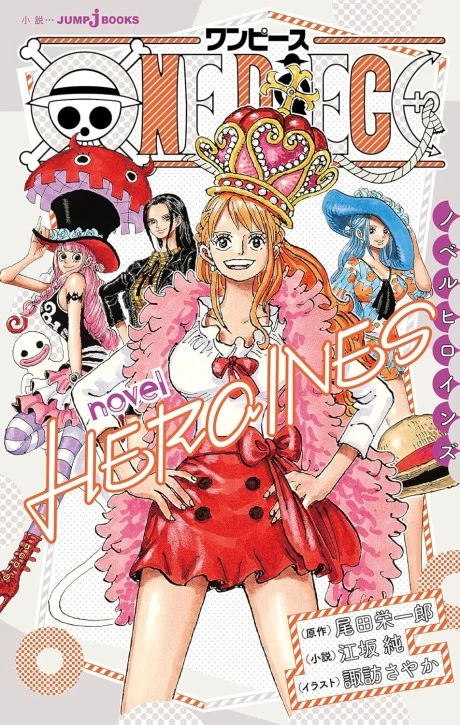
Overview
One Piece: Heroines is a prose short story collection that borrows the cast and setting of a famously sprawling pirate adventure while trading its epic scale for something quieter and more intimate. Each piece stands on its own, following a different woman from that world through a small incident that reveals how she thinks, what she wants, or how she treats the people around her. Readers who know the wider series will recognize the faces; readers who do not can still follow along, since every story supplies enough context to stand alone.
The value of this work lies in its focus. Where the main narrative often races toward the next island or the next fight, these chapters slow down and let character drive the page. A fashion show, a translation job, a misdelivered letter, a disagreement over a bottle of wine: the setups are modest, but they give familiar figures room to be funny, reflective, or unexpectedly vulnerable. The prose format also sets it apart from the comics, offering a different rhythm and a chance to sit inside a character's perspective rather than watch from outside.
Because the content stays mild and the chapters are brief, this makes a comfortable entry point for readers curious about the world but intimidated by its length, and a pleasant detour for longtime fans who want more time with particular heroines. Anyone who prefers slice-of-life character moments over continuous action will get the most from it, while readers seeking large-scale battles should look elsewhere. Approach it as a set of small portraits rather than a required chapter of a larger saga.
Synopsis
One Piece: Heroines is a light novel collection of short prose stories set within the wider world of One Piece, told apart from the main voyage and built around the women who populate it. Each chapter stands on its own, following a different heroine through a small adventure or quiet encounter, so the book can be read in any order without prior knowledge of the surrounding narrative. The tone leans toward character study and everyday incident rather than large-scale battles.
Among the featured figures are Nami, whose involvement in a fashion show shifts how she thinks about style and self-presentation, and Nico Robin, who lends her skills to Koala and Sabo as they work at deciphering an ancient tablet. Princess Vivi finds herself at the center of a stir caused by an unsigned love letter, while Perona locks horns with Zoro and Mihawk over a single bottle of wine. A second volume widens the circle with Boa Hancock reflecting on matters of the heart, Tashigi facing questions about her own path, Reiju recalling her brother Sanji's devotion to cooking, and a young Uta discovering her voice, plus a closing piece in which Nami and Robin share a moment of rest at sea.
The conflicts throughout are personal rather than world-shaking: pride, doubt, nostalgia, rivalry, and the awkwardness of being seen. What links the stories is the way each heroine is given room to be the center of her own scene, with the men and legends of the setting drifting to the edges. It is a companion volume for readers already fond of these characters, offering lighter, self-contained glimpses rather than a continuous plot.
Should You Read It?
Read it if you enjoy
- You enjoy character-focused vignettes that trade epic scale for quiet, intimate moments with familiar figures.
- You are a One Piece fan eager for stories spotlighting the franchise's female cast outside the main voyage.
- You appreciate standalone prose chapters that can be read in any order without prior arc knowledge.
- You want a mild, accessible side story that explores small incidents and personal perspectives.
It may not suit you if
- You prefer large-scale battles and continuous plot progression typical of the main One Piece narrative.
- You seek a direct continuation of the main story or significant new lore about the world.
- You dislike anthology formats or short stories lacking an overarching narrative thread.
- You are new to One Piece and looking for a primary entry point rather than optional side material.
This automatic starting point balances the series length, pacing, time commitment, and available Volluble research data. Editors can override it when firsthand knowledge suggests a better entry point.
Why It Connects With Audiences
Why people love it
- The short-story format gives each heroine room to be funny, reflective, or unexpectedly vulnerable.
- Prose storytelling offers a different rhythm from the manga, letting readers sit inside a character's perspective.
- The rotating cast of women like Nami, Robin, and Vivi provides varied small adventures and interactions.
- Self-contained chapters make it easy to dip in and out, with each piece supplying enough context to stand alone.
Common criticisms
- Some readers may find the stakes too low or the everyday incidents too mundane compared to the main series.
- The anthology structure means no overarching plot or substantial character development across the ten chapters.
- Familiarity with the parent series is assumed for full appreciation, so newcomers might feel out of step.
- The prose style or translation may not appeal to those accustomed to the visual pacing of manga.
Volluble DNA
A quick profile of the title’s dominant storytelling ingredients.
Characters28 characters
Nami
Main characterRobin Nico
Main characterVivi Nefertari
Main characterPerona
Main characterHancock Boa
Main characterZeus
Supporting characterTashigi
Main characterReiju Vinsmoke
Main characterSanji
Background characterUta
Main characterLuffy Monkey
Background characterMiucha
Supporting characterSabo
Supporting characterKoala
Supporting characterKohza
Supporting characterCobra Nefertari
Supporting characterPell
Supporting characterChaka
Supporting characterZoro Roronoa
Supporting characterDracule Mihawk
Supporting characterSmoker
Supporting characterMarguerite
Supporting characterSweet Pea
Supporting characterAphelandra
Supporting characterGloriosa
Supporting characterHack
Supporting characterLebno
Supporting characterBellemere
Background characterManga Staff4 credits
View all 1 additional credits
Production Background
One Piece: Heroines is a prose spin-off of Eiichiro Oda's One Piece, built as a set of standalone short stories that shift attention to female characters from the wider series. The catalog lists it as a finished two-volume work of ten chapters released in 2019, and classifies it as a light novel whose source material is the original manga. Instead of advancing the main narrative, the collection hands each story to a different heroine and follows a small adventure or encounter of her own.
The writing is credited to Jun Esaka, with illustrations by Sayaka Suwa. Source material describes the series launching under Shueisha's Jump J-Books imprint, the publisher's light novel label, and VIZ Media is listed among the work's English-language outlets. That pairing places the project within Shueisha's prose publishing line while also giving it a route to readers outside Japan.
Production context for this individual work centers on its anthology format: the vignettes are self-contained and rotate through characters such as Nami, Robin, Vivi, Perona, Boa Hancock, Tashigi, and Reiju, with a bonus story that pairs Nami and Robin. An anime television special adapting the first chapter is noted as premiering on July 5, 2026, carrying one story from this collection into animation while the remaining pieces stay in prose.
Franchise Context
One Piece: Heroines is a prose spin-off inside the One Piece franchise rather than a chapter of Eiichiro Oda's main manga. Written by Jun Esaka and illustrated by Sayaka Suwa, it was issued under Shueisha's Jump J-Books imprint, collected in two volumes and ten chapters, and catalogued as ONE PIECE novel HEROINES. Its role is supplemental: the stories share the parent series' world and cast while running alongside the central storyline instead of continuing it.
As a collection of stand-alone short stories, the work is neither the beginning of One Piece nor a direct sequel. Each piece assumes some familiarity with the main narrative and its characters, which makes it a companion volume for readers already invested in the franchise. Its female-focused framing separates it from the main manga's arc-driven structure, and it stands apart from other One Piece print spin-offs by working in prose rather than comics.
A later anime special adapted the opening story, extending the material beyond the page while remaining a side project within the larger franchise. Newcomers should treat it as an optional detour rather than an entry point, while longtime readers can place it alongside the parent series as an alternate, character-centered view of the same world.
Where This Fits in One Piece
A spoiler-light guide to where this exact work fits within the broader One Piece franchise.
-
Step 1
Start with the main One Piece manga or anime to meet the cast and understand the world, since this book assumes familiarity with its female characters.
-
Step 2
Read One Piece: Heroines as a standalone prose spin-off, not as a replacement for the main story; its ten short stories can be read in any order.
-
Step 3
Treat this as optional side material set alongside the main narrative, with no required placement between specific arcs.
-
Step 4
Continue with the rest of the parent franchise afterward, or return to the main story if you paused it for these vignettes.
Franchise Path
- Begin with the main One Piece manga or anime to meet the cast and world; Heroines assumes familiarity with these characters.
- Read One Piece: Heroines as an optional prose side story within the same franchise; its ten stand-alone chapters can be read in any order.
- Return to the main One Piece narrative afterward; this collection does not continue the central plot.
After You Finish
Continue with
- No direct sequel continues this collection; it is a complete two-volume, ten-chapter work.
- After finishing, continue with the main One Piece manga or anime for the central voyage.
- The anime TV special adapting the first chapter offers a screen version of Nami's story within the same franchise.
Community Verdict
Quick reader and viewer signals from the Volluble community.
Would you recommend this?
Did the ending satisfy you?
Would you read it again?
Sources2 sources
Report an issue
Spot something wrong on this page? Tell us what needs attention.
0 Comments
Be the first to comment.