
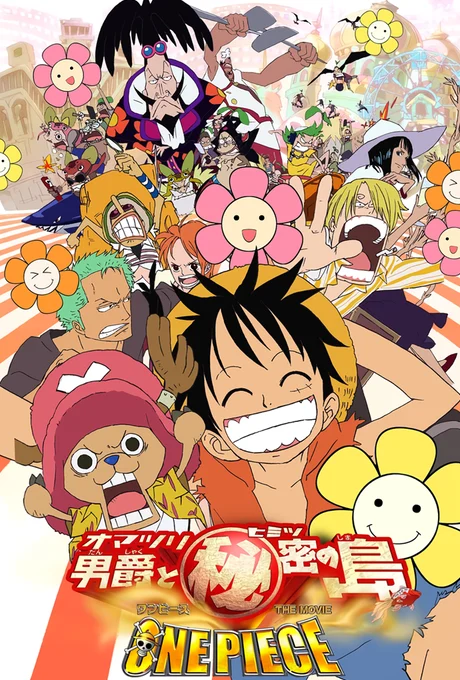
Overview
One Piece: Baron Omatsuri and the Secret Island matters because it is one of the rare entries written directly for the screen rather than adapted from the manga, giving its creators room to push the tone somewhere the ongoing story seldom goes. It also arrives at a telling point in the career of director Mamoru Hosoda, whose later films would carry forward the emotional seriousness and visual invention on display here. Within the film lineup it is often singled out for how far it is willing to darken the mood.
The experience is a slow-building trap. A cheerful invitation and playful contests give way to suspicion, strained loyalties, and a creeping sense that the island itself is working against the crew. The film favors atmosphere and psychological pressure over constant action, and its compact runtime keeps the tension tight. Viewers who enjoy quiet dread, mystery structure, and unsettling imagery will get more from it than those expecting a straightforward celebratory adventure.
Because it is a self-contained original story, it is approachable for viewers with only passing familiarity with the cast, though the emotional weight lands harder for those who know the group well. Younger or more sensitive viewers may find the darker turns and the hostility between allies difficult to sit with. It suits anyone curious about how far an established adventure property can bend toward tragedy and unease.
Synopsis
The Straw Hat Pirates find an advertisement for a leisure island on the Grand Line, run by the mysterious Baron Omatsuri. Captain Monkey D. Luffy decides it is the perfect chance for the crew to unwind, so they set sail for the island. Upon arrival, however, they learn that relaxation comes at a price: they must compete in a series of contests that demand teamwork and unity before they can enjoy the resort.
As the challenges unfold, a strange atmosphere settles over the island, and tensions begin to fracture the crew's usual camaraderie. While the group struggles with the baron's trials, Nico Robin, Tony Tony Chopper, and Luffy each separately probe the island's secrets and the true nature of their host. The film balances adventure and comedy with a noticeably darker tone as the mystery deepens.
Trailer
Should You Watch It?
Watch it if you enjoy
- Watch if you want a self-contained One Piece theatrical adventure that assumes only baseline familiarity with the Straw Hat crew and the Grand Line.
- Watch if you appreciate a slow-building mystery with atmosphere, psychological pressure, and a darker mood than many One Piece films.
- Watch if you are interested in Mamoru Hosoda's early directorial work and the visual/emotional seriousness later associated with his films.
It may not suit you if
- May not suit viewers expecting nonstop action or a straightforward celebratory island adventure.
- May not suit those who dislike seeing the crew's camaraderie strained by suspicion and tense contests.
- May not suit viewers seeking a story that advances the main One Piece continuity; this is an optional standalone side story.
The primary starting work is a movie, so the full film is the natural Volluble Test Drive. This gives you the complete story instead of applying an episodic trial to a feature-length work.
Why It Connects With Audiences
Why people love it
- Often noted for its slow-building trap structure, in which playful contests give way to suspicion and quiet dread.
- Noted for Mamoru Hosoda's direction, which brings unusual emotional seriousness and visual invention to the film lineup.
- Works as an accessible original story while still rewarding familiarity with the Straw Hat crew's usual dynamic.
Common criticisms
- Sometimes regarded as nonessential because it is an original side story that does not advance the main serialized narrative.
- May be criticized for favoring atmosphere and psychological pressure over the constant action some viewers expect from One Piece.
- Its darker, more unsettling tone can feel like a departure from the franchise's typically celebratory adventure style.
Volluble DNA
A quick profile of the title’s dominant storytelling ingredients.
Characters and Voice Actors12 characters
Luffy Monkey
Main character- Japanese: Mayumi Tanaka
Robin Nico
Main character- Japanese: Yuriko Yamaguchi
Zoro Roronoa
Main character- Japanese: Kazuya Nakai
Sanji
Main character- Japanese: Hiroaki Hirata
Chopper Tony Tony
Main character- Japanese: Ikue Ootani
Nami
Main character- Japanese: Akemi Okamura
Usopp
Main character- Japanese: Kappei Yamaguchi
Baron Omatsuri
Main character- Japanese: Akio Ootsuka
Muchigoro
Supporting character- Japanese: Takeshi Kusao
Rick
Supporting character- Japanese: Daisuke Sakaguchi
Daisy
Supporting character- Japanese: Anzu Nagai
DJ Gappa
Supporting characterProduction and Staff25 credits
View all 13 additional credits
Production Background
One Piece: Baron Omatsuri and the Secret Island, known in Japanese as ONE PIECE THE MOVIE オマツリ男爵と秘密の島, is a 2005 anime film directed by Mamoru Hosoda and produced by Toei Animation. It is an anime movie entry in the One Piece film series, with a runtime of 91 minutes and a finished release status. The supplied record classifies its source material as original.
The film premiered in Japan on March 5, 2005, and was released to DVD on July 21, 2005. Its production came from Toei Animation, with Mamoru Hosoda serving as director. The movie is the sixth animated feature film in the One Piece film series, though its story and production context are specific to this individual work.
This entry has a reputation for a more serious tone and unsettling subject matter than many other One Piece films. Director Mamoru Hosoda later founded Studio Chizu, where he continued to create acclaimed films in a similar style.
Franchise Context
This entry is the sixth animated theatrical feature in the One Piece franchise, released in Japanese theaters on March 5, 2005, after a run of earlier films tied to the television series. It was produced by Toei Animation and directed by Mamoru Hosoda. It exists alongside Eiichiro Oda's ongoing manga and the long-running anime adaptation, but it stands as a self-contained theatrical work rather than a continuation of either one.
Its story was written for the screen instead of being adapted from a published manga arc, placing it in the same stand-alone tradition as the other One Piece movies: an original adventure with the Straw Hat crew that does not advance the main serialized narrative. Within the franchise it is a side story set on the Grand Line, not a remake, not a spin-off built around new leads, and not an alternate retelling of existing material.
The film is also frequently noted as one of the darker installments in the series, a quality tied more to its director's authorship than to its place in the chronology. For anyone mapping the franchise, it functions as an optional theatrical chapter that can be viewed on its own, separate from the progression of the core story.
Where This Fits in One Piece
A spoiler-light guide to where this exact work fits within the broader One Piece franchise.
-
Step 1
Begin with the main One Piece anime or manga until the Straw Hat crew and the Grand Line setting are familiar, since this film assumes that baseline knowledge.
-
Step 2
Treat One Piece: Baron Omatsuri and the Secret Island as a standalone original-story movie, making it optional side content rather than a required step in the main continuity.
-
Step 3
Watch it as a self-contained feature at any point after that familiarity, and do not expect it to replace or summarize the larger One Piece franchise.
-
Step 4
Afterward, continue the main One Piece series or move on to other One Piece feature films, since this movie does not set up later main-story events.
Franchise Path
- Start with the main One Piece anime or manga to know the Straw Hat crew and Grand Line setting, then watch this film as an optional standalone theatrical side story.
- It sits outside the serialized main continuity, so no prior One Piece film is required before viewing.
After You Finish
Continue with
- After finishing, continue the main One Piece anime or manga; this film does not advance the core serialized story.
- For more theatrical side adventures in the same franchise, move on to other One Piece films such as One Piece Film: Strong World or One Piece Film: Z.
Community Verdict
Quick reader and viewer signals from the Volluble community.
Would you recommend this?
Did the ending satisfy you?
Would you watch it again?
Report an issue
Spot something wrong on this page? Tell us what needs attention.
0 Comments
Be the first to comment.