
Synopsis
Turn A Gundam is set thousands of years after a technological golden age, when the people of Earth have long since forgotten the space wars of their ancestors and live in quiet, pre-industrial communities. That peace is broken by the return of the Moonrace, descendants of humans who fled to the Moon and preserved their advanced technology. Convinced that Earth is rightfully theirs, the Moonrace begin a campaign to reclaim the planet, setting the two branches of humanity on a collision course.
The story follows Loran Cehack, a young Moonrace citizen who was sent to Earth as an advance scout and settles into life in a rural town, where he becomes close to the Heim family and their daughters Sochie and Kihel. When hostilities erupt, Loran discovers a buried relic of an older era, the Turn A Gundam, and becomes its pilot. Though he is a Moonrace by birth, his years among the people of Earth leave him caught between the world he came from and the world he has come to call home.
The central conflict grows out of that divide, as Loran tries to prevent the escalating war between the Moonrace and Earth's scattered militias. Around him stand figures with competing visions for the future, including the ambitious Earth politician Guin Sard Lineford, the loyal Moonrace officer Harry Ord, and the Moonrace queen Dianna Soreil, whose plans for the planet carry their own weight. Loran's efforts to bridge the two sides shape a story about understanding, responsibility, and the possibility of reconciliation.
Should You Read It?
Read it if you enjoy
- If you want to explore Turn A Gundam through its 1999 TV anime or the five-volume prose novel, both share the far-future Moonrace premise.
- If you want a far-future mecha story where Earth has forgotten past space wars and the returning Moonrace seeks to reclaim the planet.
- If you appreciate a Gundam entry told through Loran Cehack, a Moonrace scout caught between his birth world and his adopted Earth home.
- If you're curious about Yoshiyuki Tomino's 20th-anniversary Gundam series, conceived to affirmatively accept all prior Gundam works.
It may not suit you if
- Viewers who prefer clear-cut heroes and villains may find the story's bridge-building focus and competing visions harder to align with.
- Those seeking a brisk, action-first mecha narrative may find the pre-industrial Earth setting and political negotiation central to the premise.
- If you want a Gundam entry detached from franchise history, note this was made as a 20th-anniversary work meant to affirm prior series.
- Viewers uninterested in large casts and divided loyalties may find Loran's position between Moonrace and Earth less immediately satisfying.
This automatic starting point balances the series length, pacing, time commitment, and available Volluble research data. Editors can override it when firsthand knowledge suggests a better entry point.
Why It Connects With Audiences
Why people love it
- Tomino directed this anniversary Gundam series as a way to affirmatively accept all previous Gundam entries, reflected in the turned-A title.
- Loran Cehack's dual Moonrace and Earth ties create a bridge between two long-separated branches of humanity rather than a simple conquest tale.
- The premise contrasts a pre-industrial Earth with the Moonrace's preserved high technology, giving the mecha conflict a lost-civilization backdrop.
- The story blends politics, coming-of-age, ensemble drama, and real-robot warfare within a war of the worlds.
Common criticisms
- Some viewers may find the large ensemble and competing visions for the future make the central conflict harder to track.
- The pre-industrial Earth backdrop and political negotiation may feel distant from viewers expecting constant mecha action.
- As a 20th-anniversary Gundam entry, it may rely on familiarity with franchise conventions to fully appreciate its reflective intent.
- Loran's divided allegiance may frustrate viewers who prefer a protagonist with a single, unambiguous side.
Volluble DNA
A quick profile of the title’s dominant storytelling ingredients.
Manga Staff4 credits
Production Background
Turn A Gundam was produced by Sunrise and broadcast in Japan starting in 1999, airing through 2000 on Fuji Television and other channels. It was created to mark the Gundam Big Bang 20th Anniversary and stands as the eighth installment in the franchise. The series was directed by Yoshiyuki Tomino, the principal creator of the Gundam franchise, who had already written and directed many earlier Gundam productions.
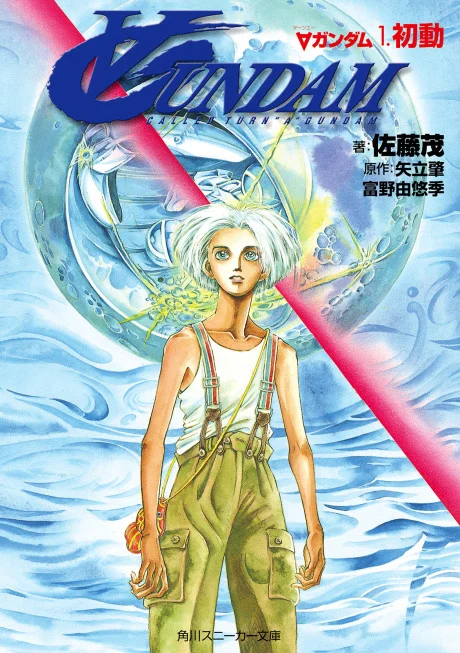
Tomino conceived this entry as a way of affirmatively accepting all of the Gundam series that came before it, an intent reflected in the title's turned A, a mathematical symbol representing universal quantification. Alongside the broadcast, a prose version of the story was published as a five-volume novel, running from October 1999 to March 2000. This print edition follows the same far-future setting in which Earth's inhabitants have reverted to a pre-industrial existence while the technologically advanced lunar settlers known as the Moonrace plan to reclaim their homeworld.
The television series was later compiled in 2002 into two feature-length films, Turn A Gundam I: Earth Light and Turn A Gundam II: Moonlight Butterfly, giving the production a second life in theaters after its original run.
Franchise Path
- Turn A Gundam is the eighth Gundam installment and a 20th-anniversary capstone; approach it after some familiarity with earlier Gundam works.
- Tomino intended it to affirm all prior Gundam series, so it functions as a franchise-wide reflection rather than a direct sequel to one timeline.
- The 2002 films Turn A Gundam I: Earth Light and Turn A Gundam II: Moonlight Butterfly recompile the TV story; treat them as a same-franchise alternate path.
After You Finish
Continue with
- No direct sequel follows Loran's story; within Gundam, continue with other Tomino-directed entries or earlier franchise works that Turn A reflects on.
- For the same arc in feature form, the 2002 compilation films Turn A Gundam I: Earth Light and II: Moonlight Butterfly retell the series.
Community Verdict
Quick reader and viewer signals from the Volluble community.
Would you recommend this?
Did the ending satisfy you?
Would you read it again?
Sources2 sources
Report an issue
Spot something wrong on this page? Tell us what needs attention.
0 Comments
Be the first to comment.