
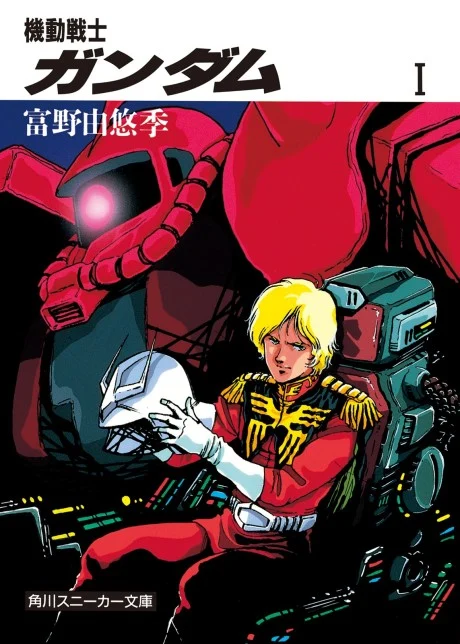
Overview
This three volume novel series is Yoshiyuki Tomino's own prose retelling of the story he directed for television in 1979, begun while the broadcast run was still underway and finished in 1981. Freed from episode length and weekly pacing, the author treats the same war as a slower, more sober military narrative, with denser political texture and a bleaker emotional register. Readers who know this saga only through animation will find a version that deliberately diverges from the screen telling rather than transcribing it, which is precisely what makes the trilogy worth holding separately in mind from the broadcast work.
The experience it offers is closer to a wartime novel than a robot serial: large casts, strained command structures, civilians caught inside a conflict they did not choose, and a persistent sense of loss running underneath the action. The mechanical designs and tactical set pieces still carry the real robot appeal the franchise is known for, but the emphasis falls on interiority and consequence. Its tone is severe and its pace is patient, so it asks for attention rather than offering quick momentum.
Approachability is best judged by appetite rather than prior knowledge. Newcomers comfortable with mature military science fiction can begin here and meet the conflict in a form built for adult readers, while long time followers of the saga may value it most as an alternate telling by its original creator. Either way, this individual trilogy stands on its own as a distinct literary treatment, not a summary of the larger franchise around it.
Synopsis
This three-volume novel series retells the opening conflict of the Universal Century, a future era in which humanity has spread into orbiting space colonies. After the distant colony cluster Side 3 declares itself the Principality of Zeon and wages war against the Earth Federation, a surprise attack and a devastating colony drop leave the Earth Sphere reeling. The story follows the Federation's newest weapon, the prototype mobile suit known as the Gundam, and the ragtag crew that must keep it out of enemy hands as the fighting spreads from space to Earth.
At the center is Amuro Ray, a teenage civilian with a talent for machinery who is thrust into the cockpit of the Gundam when Zeon forces attack the colony where he lives. He is joined aboard the assault carrier White Base by other young survivors, including Fraw Bow, Kai Shiden, Hayato Kobayashi, and the enigmatic Sayla Mass, while the ship's young officer Bright Noa struggles to hold the group together. Opposing them is Char Aznable, a masked Zeon ace whose skill and reputation make him a constant threat.
Written by Gundam creator Yoshiyuki Tomino and first published while the original anime was still airing, the novels revisit that premise in denser, more adult prose and expand on the politics, tactics, and inner lives of the cast. The trilogy stands as its own telling of the One Year War's early campaigns rather than a simple transcript of the broadcast episodes, giving readers a version of the Gundam story shaped directly by its creator.
Should You Read It?
Read it if you enjoy
- Read this if you want Yoshiyuki Tomino's own prose retelling of the 1979 Gundam conflict, begun while the TV anime was still airing.
- Read it if you are curious about a more adult, detailed take on the Universal Century's opening war, with denser political texture.
- Read it if you accept major story changes and want a parallel version rather than a faithful novelization of the broadcast series.
- Read it if you enjoy wartime military fiction with large casts, strained command structures, and civilians caught in conflict.
It may not suit you if
- You may not want this if you are seeking a close, scene-for-scene adaptation of the 1979 anime; the novels deliberately diverge.
- You may not want this if you prefer quick robot-serial momentum, since the prose is patient, severe, and focused on consequence.
- You may not want this if you need a required main-continuity step; it is best treated as an optional companion retelling.
- You may not want this if you know the franchise only through animation and dislike dense politics or a bleak emotional register.
This automatic starting point balances the series length, pacing, time commitment, and available Volluble research data. Editors can override it when firsthand knowledge suggests a better entry point.
Why It Connects With Audiences
Why people love it
- Readers may value it as Tomino's firsthand reworking, allowing a more sophisticated and detailed version of his original story.
- It can deepen the One Year War with political texture, interiority, and a persistent sense of loss beneath the action.
- It may appeal for preserving real robot strengths: mechanical designs, tactical set pieces, and mobile suit combat.
- Its major departures from the anime give veteran fans a distinct alternate account rather than a simple transcription.
Common criticisms
- Some readers may find the deliberate divergences from the TV anime frustrating if they expect a faithful adaptation.
- The severe tone and patient pacing can feel slow or heavy to those wanting the momentum of a robot serial.
- Because it is a parallel retelling rather than a mainline continuation, it can seem optional to continuity-focused fans.
- Newcomers without the anime's baseline may struggle with the large cast and dense wartime politics.
Volluble DNA
A quick profile of the title’s dominant storytelling ingredients.
Characters28 characters
Amuro Ray
Main characterChar Aznable
Main characterSayla Mass
Main characterBright Noa
Supporting characterHayato Kobayashi
Supporting characterHaro
Supporting characterKai Shiden
Supporting characterFrau Bow
Supporting characterRyu Jose
Supporting characterMirai Yashima
Supporting characterSleggar Law
Supporting characterKatz Hawin
Supporting characterLalah Sune
Supporting characterRamba Ral
Supporting characterDegwin Sodo Zabi
Supporting characterM’Quve
Supporting characterGihren Zabi
Supporting characterJob John
Supporting characterDozle Zabi
Supporting characterKikka Kitamoto
Supporting characterLetz Cofan
Supporting characterMatilda Ajan
Supporting characterJohann Abraham Revil
Supporting characterGarma Zabi
Supporting characterKycilia Zabi
Supporting characterMarker Clan
Supporting characterCrowley Hamon
Supporting characterWoody Malden
Supporting characterManga Staff4 credits
View all 1 additional credits
Production Background
The novel trilogy Mobile Suit Gundam: Awakening, Escalation, Confrontation was written by Yoshiyuki Tomino, the creator and director of the original Mobile Suit Gundam television anime. Tomino began the books in 1979 while that series was still airing, and they stand as the first novelizations of the Gundam anime. The opening volume was released on November 30, 1979, and the third closed out the run on March 16, 1981, after the television broadcast had ended.
Published in Japan as three volumes and 23 chapters, the trilogy was Tomino's chance to retell his story with more sophistication and detail and in a more adult register than the television version allowed. The books also depart from the anime in several major ways, which gives this work a distinct identity among early Gundam prose releases rather than simply mirroring the broadcast.
The source anime was produced by Nippon Sunrise and premiered on Nagoya Broadcasting Network and affiliated ANN stations on April 7, 1979, running 43 episodes until its cancellation. Character designs for that series were handled by Yoshikazu Yasuhiko, with Kunio Okawara designing the robots, including the RX-78-2 Gundam. The novels grew directly out of that production and carried Tomino's own authorship of the material from screen to page.
Franchise Context
This three-volume novel series stands at the head of the Gundam franchise's print history. Yoshiyuki Tomino, who created and directed the original 1979 television series, wrote these books himself, and the first volume appeared while the anime was still broadcasting. It is best understood as an alternate version of that founding story rather than a sequel or a side story: the same war between the Principality of Zeon and the Earth Federation, reframed for a prose readership.
Because it reworks the television narrative from within, it belongs beside the original series rather than after it. Later novels, manga, and animated sequels build outward from the Universal Century setting the show established, while this entry returns to that setting's first telling and reshapes it. Readers arriving from the wider franchise should treat it as a parallel entry point rather than a continuation, and the three books complete their own account.
Where This Fits in Gundam
A spoiler-light guide to where this exact work fits within the broader Gundam franchise.
-
Step 1
Start with the 1979 Mobile Suit Gundam television anime, because this three-volume novel retells the original Universal Century 0079 war rather than launching a separate mainline series.
-
Step 2
Read this novel trilogy after you know the anime's baseline events if you want Yoshiyuki Tomino's alternate, more adult and detailed version; it is optional and makes major story changes, so it is not required for main continuity.
-
Step 3
For the ongoing Universal Century saga, move from the original anime into its later sequel and spinoff works; keep this novel as a companion retelling rather than the necessary next chapter.
Franchise Path
- Start with the 1979 Mobile Suit Gundam TV anime for the baseline Universal Century 0079 war.
- Read this novel trilogy as Tomino's alternate, more adult prose retelling of that same conflict.
- For mainline continuation, proceed to Mobile Suit Zeta Gundam and the wider Universal Century saga.
After You Finish
Continue with
- No direct novel sequel exists; continue with the 1979 Mobile Suit Gundam TV anime or its compilation films for the screen version.
- Then move to Mobile Suit Zeta Gundam for the next mainline Universal Century chapter.
Community Verdict
Quick reader and viewer signals from the Volluble community.
Would you recommend this?
Did the ending satisfy you?
Would you read it again?
Report an issue
Spot something wrong on this page? Tell us what needs attention.
0 Comments
Be the first to comment.