
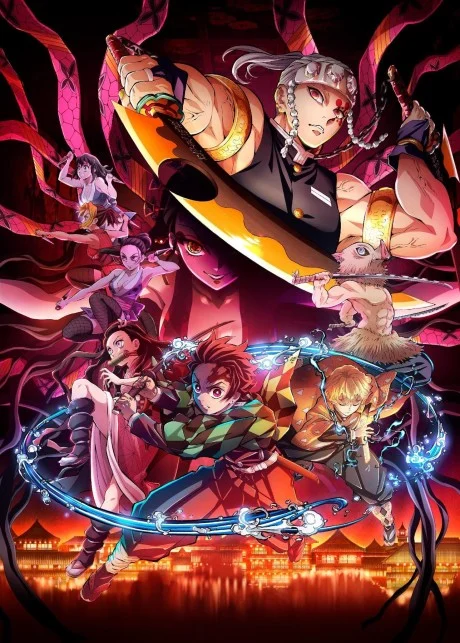
Overview
Demon Slayer: Kimetsu no Yaiba Entertainment District Arc is a self-contained eleven-episode television chapter in which Tanjiro Kamado and his companions accept a mission alongside the Sound Hashira, Tengen Uzui, in a district of pleasure houses where a demon has been preying on the people who live and work there. For viewers following the larger saga, its value lies in the change of scenery: the forests, mountains, and training grounds of earlier material give way to lantern-lit streets and the layered social world of the oiran, giving this stretch of the story a look and rhythm of its own rather than repeating earlier missions.
The arc's appeal is its concentration. Eleven episodes let a single confrontation unfold in stages, so the pacing favors escalating set pieces over episodic variety, and the production answers with vivid color, fluid sword choreography, and unsettling demon designs. The stakes stay personal for the central cast even as the scale of the fighting grows, and the shorter run makes this an easy entry to sample for anyone curious about the series without committing to a full season order.
Approachability depends on tolerance for intense material. The tone is action-forward with supernatural horror elements, bloodshed, and some disturbing imagery, so younger or more sensitive viewers may find it heavy despite the franchise's mainstream popularity. Earlier seasons supply useful context about the ensemble and their ongoing conflict, and a widely available English dub lowers the barrier for those who prefer it, but the mission premise itself is straightforward enough for newcomers to follow.
Synopsis
Following the events at the Rengoku residence, Tanjiro Kamado and his companions accept a new assignment in the Entertainment District, a sprawling pleasure quarter where music, drink, and desire are openly sold and where demons are known to hide among the crowds. The mission is led by Tengen Uzui, the Sound Hashira, a flamboyant swordsman who treats the hunt as a spectacle and who has a personal stake in the district's troubles. Something has been preying on the people there, and the Demon Slayer Corps wants it found and destroyed.
Tanjiro is joined by his fellow slayers Zenitsu Agatsuma and Inosuke Hashibira, while his younger sister Nezuko, now a demon herself, travels with the group as always. Because the district is a place of secrets and guarded entrances, the team cannot simply march in with swords drawn; they must spread out and work undercover among the district's many houses and residents, relying on aliases, quick thinking, and the help of Uzui's wives, who were sent ahead to gather information before contact with them was lost.
The central conflict turns on finding an enemy that does not want to be found. The demon responsible for the disappearances is hidden somewhere within the district's routines and disguises, and the slayers must identify it without exposing themselves or endangering the people around them. Their search draws them into a confrontation that tests each of them differently, and it pushes Tanjiro and Nezuko into a fight where protecting one another becomes as important as landing a decisive blow.
Trailer
Should You Watch It?
This automatic starting point balances the series length, pacing, time commitment, and available Volluble research data. Editors can override it when firsthand knowledge suggests a better entry point.
Characters and Voice Actors25 characters
Tanjirou Kamado
Main character- Japanese: Natsuki Hanae
- English: Zach Aguilar
Nezuko Kamado
Main character- Japanese: Akari Kitou
- English: Abby Trott
Inosuke Hashibira
Main character- Japanese: Yoshitsugu Matsuoka
- English: Bryce Papenbrook
Zenitsu Agatsuma
Main character- Japanese: Hiro Shimono
- English: Aleks Le
Tengen Uzui
Main character- Japanese: Katsuyuki Konishi
- English: Ray Chase
Muzan Kibutsuji
Supporting character- Japanese: Toshihiko Seki
- English: Greg Chun
Kyoujurou Rengoku
Supporting character- Japanese: Satoshi Hino
- English: Mark Whitten
Giyuu Tomioka
Supporting character- Japanese: Takahiro Sakurai
- English: Johnny Yong Bosch
Muichirou Tokitou
Supporting character- Japanese: Kengo Kawanishi
Shinobu Kochou
Supporting character- Japanese: Saori Hayami
Mitsuri Kanroji
Supporting character- Japanese: Kana Hanazawa
Sanemi Shinazugawa
Supporting character- Japanese: Tomokazu Seki
Obanai Iguro
Supporting character- Japanese: Kenichi Suzumura
- English: Erik Scott Kimerer
Gyoumei Himejima
Supporting character- Japanese: Tomokazu Sugita
Matsuemon Tennouji
Supporting character- Japanese: Takumi Yamazaki
- English: Doug Erholtz
Hotaru Haganezuka
Supporting character- Japanese: Daisuke Namikawa
- English: Robbie Daymond
Kanao Tsuyuri
Supporting character- Japanese: Reina Ueda
- English: Brianna Knickerbocker
Daki
Supporting character- Japanese: Miyuki Sawashiro
- English: Erica Lindbeck
Gyuutarou
Supporting character- Japanese: Ryouta Oosaka
- English: Brandon McInnis
Makio
Supporting character- Japanese: Shizuka Ishigami
- English: Erica Mendez
Suma
Supporting character- Japanese: Nao Touyama
- English: Emi Lo
Hinatsuru
Supporting character- Japanese: Atsumi Tanezaki
- English: Anairis Quiñones
Akaza
Supporting character- Japanese: Akira Ishida
- English: Lucien Dodge
Douma
Supporting character- Japanese: Mamoru Miyano
- English: Stephen Fu
Naho Takada
Supporting character- Japanese: Yuuki Kuwahara
- English: Kimberly Woods
Production and Staff26 credits
View all 14 additional credits
Franchise Context
Demon Slayer: Kimetsu no Yaiba began as Koyoharu Gotouge's manga and was adapted into an anime television series by the studio ufotable, with the first season airing in 2019. The Entertainment District Arc serves as the principal arc of the show's second season, continuing the same narrative thread rather than restarting it. It follows the Kamado siblings and their allies after the events of the Mugen Train story, which reached audiences first as a theatrical film before the series moved on.
This places the arc as a continuation within an ongoing serial, not a spin-off, reboot, or alternate retelling. It draws directly from the corresponding portion of the manga and retains the protagonist, supporting cast, and creative team that define the parent series. Viewers coming from the first season or the Mugen Train film can move into these eleven episodes in sequence, and the storyline then carries forward into later arcs of the television adaptation.
Since the franchise spans manga volumes, films, and multiple television arcs, this entry is best understood as one segment of a much larger whole. It presents a largely self-contained mission with its own antagonist and setting, yet it assumes familiarity with the characters and events that came before it.
Franchise Path
After You Finish
Community Verdict
Quick reader and viewer signals from the Volluble community.
Would you recommend this?
Did the ending satisfy you?
Would you watch it again?
Report an issue
Spot something wrong on this page? Tell us what needs attention.
0 Comments
Be the first to comment.