
Overview
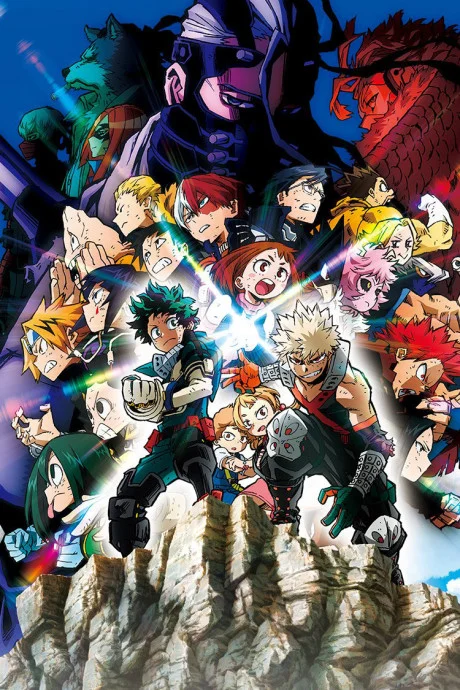
My Hero Academia: Heroes Rising occupies a distinct spot among the series' theatrical outings: a 2019 side-story movie that gives Class 1-A a mission away from school grounds and the usual teacher oversight. Its 104-minute runtime keeps the focus on a single escalating crisis, making it feel like a compact action feature rather than an extended episode. The film matters because it captures the franchise's core appeal, young heroes learning to coordinate under pressure, while testing them against a threat that feels immediate and personal.
What the movie offers is a brisk superhero spectacle with clear stakes, team-based combat, and a rural island setting that separates it from the urban patrols familiar from the main story. The villain Nine brings a menacing Quirk and forces the students to rely on one another in ways that highlight both their growth and their limits. For viewers who enjoy shonen action, ensemble casts, and stories where cooperation matters as much as individual power, this is an easy recommendation.
It is also a welcoming entry point for casual fans who want a self-contained My Hero Academia adventure. The English dub and availability on Netflix and Crunchyroll make it easy to access, and the movie explains enough of its world to follow without deep prior knowledge, though returning viewers will catch more of the character dynamics and callbacks. As an individual work, Heroes Rising stands on its own as a focused, high-energy piece of the larger saga.
Synopsis
My Hero Academia: Heroes Rising is the second feature film in the My Hero Academia franchise, and it follows the students of UA High School's Class 1-A as they take on a winter break assignment on Nabu Island, a quiet community far off the coast of Japan. Instead of training under their instructors, the classmates are expected to establish and run their own professional hero agency, handling the everyday requests and small emergencies that come with looking after a place where little usually happens.
The story centers on Izuku Midoriya, whose earnest determination to grow into a hero shapes how he approaches the work, along with his rival Katsuki Bakugo and classmates such as Ochaco Uraraka. For a time the island gives the group a taste of independent hero life, and the residents gradually come to depend on them.
That calm is broken by the arrival of Nine, a formidable villain, and his followers, whose abilities and intentions place the islanders in immediate danger. With no teachers nearby and no easy way to call for reinforcements, the students must decide how far they are willing to go to protect the people who have placed their trust in them. The film builds its central conflict around that isolation and the group's shared response to a threat well beyond the scope of their usual school exercises.
Trailer
Should You Watch It?
Watch it if you enjoy
- Watch if you enjoy My Hero Academia's Class 1-A operating as an ensemble, with Deku, Bakugo, Uraraka, and classmates sharing the spotlight.
- Watch if you want a self-contained shonen action movie where students run their own hero agency on a rural island and face an escalating villain crisis.
- Watch if you prefer franchise side-story films with an original plot, returning staff and cast, English dub, and streaming availability.
It may not suit you if
- May not suit viewers who need full franchise context, since the film assumes familiarity with Class 1-A and hero society without retelling it.
- May not suit those who prefer mainline canon arcs or direct manga adaptation over an original theatrical side story.
- May not suit viewers sensitive to villain attacks, terrorism-adjacent threats, or peril facing a small island community.
The primary starting work is a movie, so the full film is the natural Volluble Test Drive. This gives you the complete story instead of applying an episodic trial to a feature-length work.
Why It Connects With Audiences
Why people love it
- It gives Class 1-A a rare mission without teachers nearby, letting teamwork and independent hero work drive the action.
- The Nabu Island setting and 104-minute runtime keep the story focused on a single escalating crisis rather than episodic detours.
- Bones' production, Kenji Nagasaki's direction, and the returning cast connect it to the franchise's established theatrical style.
- Its story reportedly incorporates elements Kōhei Horikoshi once considered for the series finale, adding curiosity for franchise followers.
Common criticisms
- As an original side story, it can feel non-essential to the main My Hero Academia manga and television timeline.
- Its plot leans on familiar shonen movie structure: an isolated location, a powerful villain, and students forced to coordinate under pressure.
- Newcomers may find it less accessible because it assumes prior setup and does not reintroduce the cast or hero society.
Volluble DNA
A quick profile of the title’s dominant storytelling ingredients.
Characters and Voice Actors25 characters
Izuku Midoriya
Main character- Japanese: Daiki Yamashita
- English: Justin Briner
Katsuki Bakugou
Main character- Japanese: Nobuhiko Okamoto
- English: Clifford Chapin
Nine
Main character- Japanese: Yoshio Inoue
- English: Johnny Yong Bosch
Shouto Todoroki
Supporting character- Japanese: Yuuki Kaji
- English: David Matranga
Ochako Uraraka
Supporting character- Japanese: Ayane Sakura
- English: Luci Christian
Tenya Iida
Supporting character- Japanese: Kaito Ishikawa
- English: J. Michael Tatum
Tsuyu Asui
Supporting character- Japanese: Aoi Yuuki
- English: Monica Rial
Toshinori Yagi
Supporting character- Japanese: Kenta Miyake
- English: Christopher Sabat
Shouta Aizawa
Supporting character- English: Christopher Wehkamp
- Japanese: Junichi Suwabe
Tomura Shigaraki
Supporting character- Japanese: Kouki Uchiyama
- English: Eric Vale
Momo Yaoyorozu
Supporting character- Japanese: Marina Inoue
- English: Colleen Clinkenbeard
Eijirou Kirishima
Supporting character- Japanese: Toshiki Masuda
- English: Justin Cook
Minoru Mineta
Supporting character- Japanese: Ryou Hirohashi
- English: Brina Palencia
Mina Ashido
Supporting character- Japanese: Eri Kitamura
- English: Caitlin Glass
Denki Kaminari
Supporting character- Japanese: Tasuku Hatanaka
- English: Kyle Phillips
Jin Bubaigawara
Supporting character- English: Newton Pittman
- Japanese: Daichi Endou
Hanta Sero
Supporting character- Japanese: Kiyotaka Furushima
- English: Christopher Bevins
Mashirao Ojiro
Supporting character- Japanese: Kousuke Miyoshi
- English: Mike McFarland
Kyouka Jirou
Supporting character- Japanese: Kei Shindou
- English: Trina Nishimura
Fumikage Tokoyami
Supporting character- Japanese: Yoshimasa Hosoya
- English: Jessie James Grelle
Mezou Shouji
Supporting character- Japanese: Masakazu Nishida
- English: Ian Sinclair
Tooru Hagakure
Supporting character- Japanese: Kaori Nazuka
- English: Felecia Angelle
Kouji Kouda
Supporting character- Japanese: Takuma Nagatsuka
- English: Greg Ayres
Rikidou Satou
Supporting character- Japanese: Tooru Nara
- English: Cris George
Himiko Toga
Supporting character- English: Leah Clark
- Japanese: Misato Fukuen
Production and Staff26 credits
View all 14 additional credits
Production Background
My Hero Academia: Heroes Rising is a 2019 Japanese animated superhero film built around an original story that features characters from the My Hero Academia manga by Kōhei Horikoshi. It was produced by Bones and distributed by Toho, with Kenji Nagasaki directing from a screenplay by Yōsuke Kuroda. Daiki Yamashita and Nobuhiko Okamoto lead an ensemble cast, and the film runs 104 minutes.
A second film for the franchise was announced in March 2019, and the production brought back the staff and cast from the first movie. According to the record, the story incorporates elements that Horikoshi had once considered using as a finale for the series, which gives this film a distinct place in the property's production history. Its source material is the manga.
The movie was released in 2019 and later arrived on home video, with a Blu-ray and DVD release dated July 15, 2020 that included an Epilogue Plus edition featuring a new picture drama. An English dub was produced, and the film is available through streaming services including Netflix and Crunchyroll.
Franchise Context
My Hero Academia: Heroes Rising is an individual anime film within the larger My Hero Academia franchise. It is the second theatrical feature in that franchise, following the earlier movie, and it functions as a side story rather than the opening chapter of the series. The core narrative begins in the manga and television anime, so this movie is best understood as a continuation and expansion of that established world.
The film adapts neither a single manga arc nor an isolated spinoff premise. It uses an original story built around the manga's characters and setting, produced by Bones with the returning creative team and cast from the previous movie. Because it is a theatrical installment, it stands apart from the episodic television timeline while remaining part of the same continuity.
For viewers exploring the franchise, Heroes Rising comes after the initial series setup and after the first My Hero Academia film. It is not an alternate version or a reboot, and it does not replace the main manga or anime. Its place is as a connected side-story movie that adds a self-contained mission to the larger My Hero Academia saga.
Where This Fits in My Hero Academia
A spoiler-light guide to where this exact work fits within the broader My Hero Academia franchise.
-
Step 1
Begin with the main My Hero Academia anime or manga, which introduces UA Class 1-A and the core hero society setup.
-
Step 2
Treat My Hero Academia: Heroes Rising as a side-story movie rather than a required mainline installment.
-
Step 3
Watch it after you are familiar with the main cast and early main-story arcs, since it assumes that context without retelling it.
-
Step 4
If you are following the films, place it after the earlier My Hero Academia movie and before any later franchise film.
-
Step 5
Afterward, return to the main My Hero Academia storyline or continue with later franchise installments.
Franchise Path
- Begin with the My Hero Academia manga or TV anime to meet UA Class 1-A and the hero-society setup.
- Then watch the first My Hero Academia film before this second theatrical side story.
- Heroes Rising follows as a connected side-story movie set after early main-story context, not a reboot.
- After it, return to the main My Hero Academia storyline or move to later franchise films.
After You Finish
Continue with
- After finishing, continue with the My Hero Academia main anime or manga to follow the larger hero-society arc.
- If staying with films, watch later My Hero Academia theatrical installments after this second movie.
- This movie's Nabu Island mission is self-contained, but its growth beats pay off more if you continue the main story.
Community Verdict
Quick reader and viewer signals from the Volluble community.
Would you recommend this?
Did the ending satisfy you?
Would you watch it again?
Try Something Similar
Report an issue
Spot something wrong on this page? Tell us what needs attention.
0 Comments
Be the first to comment.