
Overview
Hunter x Hunter (2011) matters because it treats the shounen adventure format as a flexible foundation rather than a fixed formula. Its world invites curiosity through travel, unusual abilities, dangerous professions, and treasure-hunting, then repeatedly tests the easy assumptions that come with heroic stories. Fights are often contests of judgment and creativity as much as strength, while the series gives its ensemble room to pursue different motives, loyalties, and definitions of justice. That balance makes this 148-episode television anime feel broader and more thoughtful than its premise may initially suggest.
The experience shifts comfortably between playful discovery, intense competition, criminal danger, tragedy, and philosophical tension. Friendship is important, but it is not treated as a simple answer to every problem, and the cast's flaws can be as compelling as their talents. Viewers who enjoy coming-of-age stories with morally complicated rivals, strategic action, and a steadily expanding sense of danger should find plenty to engage with. The approachable entry point is its clear emotional core and accessible adventure setup, while its willingness to challenge genre expectations rewards viewers who stay attentive to changing stakes and character choices. As a complete anime series based on its manga source, it offers a substantial standalone viewing journey for newcomers who want both energetic entertainment and a more demanding ensemble fantasy.
Synopsis
Hunter x Hunter (2011) follows Gon Freecss, a determined 12-year-old from Whale Island who learns that his absent father, Ging, is alive and was a celebrated Hunter. Hunters are licensed adventurers who undertake dangerous work, from pursuing criminals to exploring unknown territories and seeking rare treasures. Hoping to understand his father and eventually meet him, Gon leaves home to take the demanding Hunter Examination, a perilous test with a notoriously low success rate.
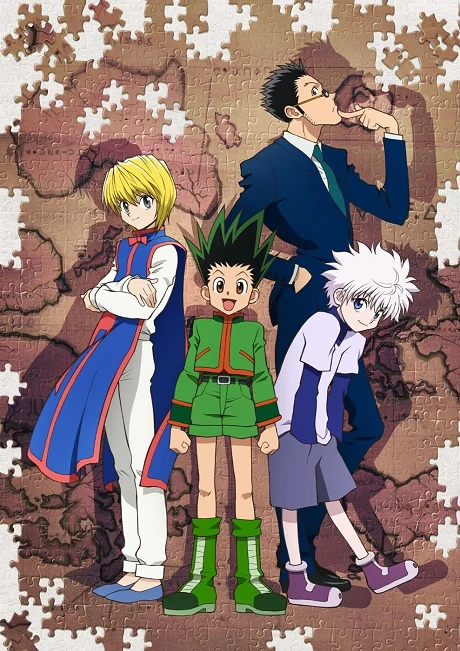
During the examination, Gon forms an enduring friendship with three other candidates: Kurapika, who seeks justice for a personal tragedy; Leorio, who wants to become a doctor; and Killua Zoldyck, a rebellious boy raised within a family of assassins. Their different goals and histories shape the group as they face physical trials, rival candidates, criminal threats, and opponents with extraordinary abilities. After the examination, the path of a Hunter leads them into wider journeys involving combat, travel, treasure hunting, organized crime, and difficult moral choices. Gon’s search for Ging remains a central thread, while the friends’ relationships are tested by the dangers surrounding their chosen profession and by the ambitions each carries into the world.
Trailer
Should You Watch It?
Watch it if you enjoy
- Choose it if you want a long-form adventure built around travel, dangerous professions, treasure hunting, and a clear coming-of-age journey.
- It suits viewers who enjoy strategic fights, unusual abilities, ensemble friendships, and moral choices that challenge simple heroic assumptions.
It may not suit you if
- Its 148-episode television run requires a substantial time commitment and moves across playful, competitive, criminal, tragic, and philosophical modes.
- Viewers seeking consistently light adventure or straightforward power-based battles may find its shifting tone and morally complicated conflicts challenging.
This automatic starting point balances the series length, pacing, time commitment, and available Volluble research data. Editors can override it when firsthand knowledge suggests a better entry point.
Why It Connects With Audiences
Why people love it
- The series gives Gon, Kurapika, Leorio, and Killua distinct goals and histories, letting friendship coexist with personal motives and difficult choices.
- Its battles often emphasize judgment, creativity, and special abilities rather than strength alone, while the expanding world supports varied kinds of adventure.
Common criticisms
- The broad format and changing story modes may feel uneven to viewers who prefer a tightly focused premise or a consistent tone.
- Its dangerous Hunter profession, criminal threats, tragedy, and gore-related classification themes may be heavier than the approachable adventure setup initially suggests.
Volluble DNA
A quick profile of the title’s dominant storytelling ingredients.
Characters and Voice Actors25 characters
Gon Freecss
Main character- Japanese: Megumi Han
- English: Erica Mendez
Killua Zoldyck
Main character- Japanese: Mariya Ise
- English: Cristina Vee
Kurapika
Main character- Japanese: Miyuki Sawashiro
- English: Erika Harlacher
Leorio Paradinight
Main character- Japanese: Keiji Fujiwara
- English: Matthew Mercer
Hisoka Morow
Main character- Japanese: Daisuke Namikawa
- English: Keith Silverstein
Ging Freecss
Supporting character- Japanese: Rikiya Koyama
- English: Marc Diraison
Illumi Zoldyck
Supporting character- Japanese: Masaya Matsukaze
- English: Chris Hackney
Chrollo Lucilfer
Supporting character- Japanese: Mamoru Miyano
- English: Robbie Daymond
Zeno Zoldyck
Supporting character- Japanese: Hiroshi Ootake
- English: Joseph Ochman
Silva Zoldyck
Supporting character- Japanese: Kouichi Yamadera
- English: Chris Tergliafera
Feitan Portor
Supporting character- Japanese: Kappei Yamaguchi
- English: Scratch Fox
Bonolenov Ndongo
Supporting character- Japanese: Choo
Franklin Bordeaux
Supporting character- Japanese: Hidenobu Kiuchi
- English: Edward Bosco
Kortopi
Supporting character- Japanese: Shinya Hamazoe
- English: Tony Oliver
Machi Komacine
Supporting character- Japanese: Rena Maeda
- English: Abby Trott
Nobunaga Hazama
Supporting character- Japanese: Naoya Uchida
- English: Joe Thomas
Shalnark Ryuseih
Supporting character- Japanese: Noriko Hidaka
- English: Griffin Burns
Shizuku Murasaki
Supporting character- Japanese: Miho Arakawa
- English: Janice Kawaye
Phinks Magcub
Supporting character- Japanese: KENN
- English: David Vincent
Pakunoda
Supporting character- Japanese: Romi Park
- English: Erica Lindbeck
Uvogin
Supporting character- Japanese: Akio Ootsuka
- English: Patrick Seitz
Baka Ki El Dogra
Supporting character- Japanese: Takuma Suzuki
- English: David Collins
Menchi
Supporting character- Japanese: Aya Hirano
- English: Amanda Celine Miller
Kalluto Zoldyck
Supporting character- Japanese: Mamiko Noto
- English: Lauren Landa
Leroute
Supporting character- Japanese: Mika Kanai
- English: Marieve Herington
Production and Staff26 credits
View all 14 additional credits
Production Background
Hunter x Hunter (2011) is a Japanese television anime adapted from Yoshihiro Togashi’s manga series. Madhouse produced the series, with Hiroshi Kōjina serving as director. The production was made as a TV adaptation rather than a film or a short-form release, and its source material is identified as manga. This places the individual series within a long-running adaptation of Togashi’s work while keeping its production identity tied to the 2011 television version.
The series began broadcasting on Nippon Television on October 2, 2011, and continued through September 2014, concluding after 148 episodes. Its completed run gives this adaptation a substantial television format, allowing the story to follow Gon Freecss as he pursues the Hunter path and encounters Kurapika, Leorio, and Killua. The recorded production credits remain specific to this work: Togashi is credited as the manga creator, Madhouse as the animation studio, and Kōjina as director. The 2011 start date, September 2014 conclusion, and 148-episode total distinguish this finished TV series as its own anime entry, separate from the manga source on which it is based.
Franchise Context
Hunter x Hunter (2011) is the main television anime adaptation of Yoshihiro Togashi’s Hunter × Hunter manga. It serves as an entry point to the franchise rather than a continuation or spin-off, introducing the setting, Hunter profession, and central cast from the beginning of Gon Freecss’s journey. Its source-material classification is manga, so this page covers the anime version and not the printed series itself.
The series aired from October 2011 through September 2014 and concluded with 148 episodes. Its broad television format allows it to follow the franchise’s early establishment and subsequent adventures as a continuous adaptation, while remaining a distinct anime production from the manga. The credited production was handled by Madhouse and directed by Hiroshi Kōjina. Within the franchise, this entry is therefore best understood as the 2011 TV adaptation and primary anime experience, rather than an alternate-format side story or a movie-length retelling.
Where This Fits in Hunter x Hunter
A spoiler-light guide to where this exact work fits within the broader Hunter x Hunter franchise.
Exact position: This is Main anime entry 2 and main anime entry 2 of 2. It follows Hunter x Hunter.
-
Step 1
Start here: Hunter x Hunter (2011) is the listed main anime entry, and no earlier connected franchise work is supplied as required viewing.
-
Step 2
Watch all 148 episodes in release order. No separate sequel, prequel, or alternate follow-up is identified in the supplied record, so the series is the natural stopping point for this anime path.
Franchise Path
- Hunter x Hunter
- Hunter x Hunter (2011) (current)
After You Finish
Continue with
This is currently the latest main anime entry in Volluble's saved franchise path.
Community Verdict
Quick reader and viewer signals from the Volluble community.
Would you recommend this?
Did the ending satisfy you?
Would you watch it again?
Report an issue
Spot something wrong on this page? Tell us what needs attention.
0 Comments
Be the first to comment.