
Overview
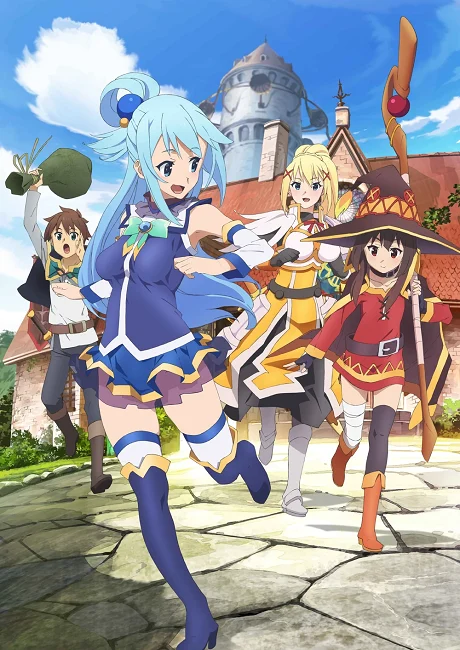
KONOSUBA -God's blessing on this wonderful world! matters because it arrived in 2016 as a deliberate rebuttal to the self-serious isekai power fantasy. Where contemporaries handed their protagonists cheat skills, this series hands Kazuma Satou a goddess who is louder than she is useful, a world that expects him to work day jobs before it permits adventuring, and a party assembled almost entirely from spectacular misfits. The joke is structural rather than incidental, and that structure is a large part of why the show still anchors conversations about genre parody.
The experience is fast, loud, and built on comic momentum. Ten episodes keep the pacing tight, moving between slapstick set pieces, deadpan commentary, and the slow accumulation of small disasters. Aqua's theatrical sulking, Megumin's single-minded devotion to one explosion spell, and Darkness's enthusiasm for punishment each supply a distinct comic rhythm, while Kazuma's exasperated narration ties them into a working ensemble. The fantasy trappings are familiar on purpose, which lets the satire aim at the habits of adventurers rather than at the setting itself.
Approachability is high. The season is short, widely streamed, and available with an English dub, making it an easy entry point for viewers who are new to isekai or who simply want a comedy. Some jokes lean on crude humor and nudity, so audiences preferring gentler material may want to sample an episode first. Those who enjoy meta humor, slapstick, and a cast that fails upward will likely find it rewarding.
Trailer
Should You Watch It?
Watch it if you enjoy
- Watch if you enjoy isekai parody that turns mundane day jobs and useless party members into the central joke.
- Watch if you like fast, loud ensemble comedy with distinct running gags and deadpan narration.
- Watch if you want a short, widely streamed introduction to a light-novel-based fantasy franchise.
- Watch if you appreciate satire of power-fantasy conventions rather than a straight power trip.
It may not suit you if
- May not suit viewers who prefer sincere isekai where the hero receives useful cheat skills.
- May not suit viewers avoiding bawdy humor, fanservice, or nudity references; the entry is tagged Nudity and Primarily Adult Cast.
- May not suit viewers who dislike loud, petty, or dysfunctional characters driving the comedy.
- May not suit viewers seeking a self-contained story; this is the first season and later franchise entries continue the cast.
This automatic starting point balances the series length, pacing, time commitment, and available Volluble research data. Editors can override it when firsthand knowledge suggests a better entry point.
Why It Connects With Audiences
Why people love it
- The ensemble's comic rhythms: Aqua's theatrics, Megumin's single-spell obsession, Darkness's punishment enthusiasm, and Kazuma's exasperated narration.
- The structural parody makes mundane work, average skills, and a useless bonus part of the joke rather than an afterthought.
- The tight ten-episode season moves quickly between slapstick set pieces, deadpan commentary, and accumulating small disasters.
- Availability on Crunchyroll, Netflix, and YouTube plus an English dub makes it an accessible entry point.
Common criticisms
- A recurring critique is that the humor can lean heavily on repeated running gags and loud reactions.
- Some viewers may find the satire broad, with familiar fantasy trappings doing more work than sharp genre commentary.
- The bawdy jokes, fanservice, and nudity references may undercut the comedy for some audiences.
- The characters can be intentionally unlikable or one-note, which some viewers may find tiresome over the season.
Volluble DNA
A quick profile of the title’s dominant storytelling ingredients.
Characters and Voice Actors25 characters
Kazuma Satou
Main character- Japanese: Jun Fukushima
- English: Arnie Pantoja
Aqua
Main character- Japanese: Sora Amamiya
- English: Faye Mata
Megumin
Main character- Japanese: Rie Takahashi
- English: Erica Mendez
Darkness
Main character- Japanese: Ai Kayano
- English: Cristina Vee
Wiz
Supporting character- English: Brianna Knickerbocker
- Japanese: Yui Horie
Luna
Supporting character- English: Erika Harlacher
- Japanese: Sayuri Hara
Eris
Supporting character- English: Kira Buckland
- Japanese: Ayaka Suwa
Sena
Supporting character- English: Allegra Clark
- Japanese: Hitomi Nabatame
Arakuremono
Supporting character- Japanese: Tetsu Inada
- English: Imari Williams
Beldia
Supporting character- English: Patrick Seitz
- Japanese: Hiroki Yasumoto
Keith
Supporting character- English: Keith Silverstein
- Japanese: Wataru Hatano
Kyouya Mitsurugi
Supporting character- English: Billy Kametz
- Japanese: Takuya Eguchi
Dust
Supporting character- Japanese: Junji Majima
- English: Lucien Dodge
Hakase
Supporting character- Japanese: Choo
- English: Keith Silverstein
Rin
Supporting character- Japanese: Yumiri Hanamori
- English: Jackie Lastra
Lolisa
Supporting character- English: Kira Buckland
- Japanese: Nanami Yamashita
Fio
Supporting character- Japanese: Yoshino Aoyama
- English: Jackie Lastra
Cremea
Supporting character- Japanese: Yumeha Kouda
- English: Ryan Bartley
Cedre
Supporting character- English: Frank Todaro
- Japanese: Yuu Wakabayashi
Garilhe
Supporting character- English: Keith Silverstein
- Japanese: Kouzou Douzaka
Heinz
Supporting character- English: Jordan Reynolds
- Japanese: Haruka Jinya
Uketsuke Succubus
Supporting character- Japanese: Kotono Mitsuishi
- English: Julie Ann Taylor
Tenshi
Background character- English: Christine Cabanos
- Japanese: Ai Kakuma
Yunyun
Background characterTaylor
Background character- Japanese: Reiou Tsuchida
Production and Staff26 credits
View all 14 additional credits
Franchise Context
This 2016 television anime is the opening entry in the KONOSUBA anime franchise and is cataloged as the main anime installment. It adapts the light novel series, introducing the core premise and cast to viewers rather than continuing from an earlier animated season. Within the broader franchise, it functions as the beginning of the anime branch, not a spin-off, recap, or stand-alone story. The official site records that a second season was announced in March 2016, during the first season's broadcast, which confirms this series was designed as the start of an ongoing animated adaptation rather than a self-contained one-off.
Because the record lists this as an individual work with ten episodes, it should be treated as the first TV season, distinct from later franchise entries and from the original light novels. Its status as a main anime adaptation means later seasons, films, or related media build on the characters and setting established here. The entry therefore serves as the franchise's animated introduction and the reference point for following KONOSUBA anime projects.
Franchise Path
- Start here: the 2016 TV anime is the main anime introduction to the KONOSUBA franchise and adapts the light novels' opening premise.
- After this season, move to the announced second TV season, then later KONOSUBA anime seasons or films that continue the same cast and setting.
After You Finish
Continue with
- Continue with KONOSUBA Season 2; it follows the same party and world established in these ten episodes.
Community Verdict
Quick reader and viewer signals from the Volluble community.
Would you recommend this?
Did the ending satisfy you?
Would you watch it again?
Report an issue
Spot something wrong on this page? Tell us what needs attention.
0 Comments
Be the first to comment.