
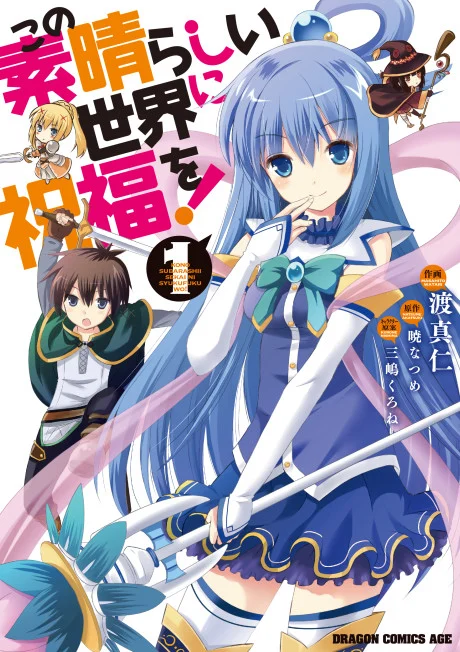
Overview
This manga adaptation of KonoSuba offers a distinct entry point into a comedy franchise that became a touchstone of the isekai parody wave. Where the prose light novels carry more internal narration and the anime leans on performance timing, the manga version translates the material into visual slapstick: exaggerated expressions, punchy panel beats, and a steady rhythm of comic escalation. It is the version readers may gravitate toward when they want the jokes delivered through drawing rather than description.
The appeal rests on its willingness to treat a fantasy adventure as a chaotic group project. Quests go wrong, rewards are squandered, and the party's talents are matched only by their capacity to antagonize one another. Fans of dungeon crawling, medieval-flavored settings, and satire of self-serious hero narratives will find familiar scaffolding used as a launchpad for farce. Romance elements appear mostly as a source of friction within the ensemble.
Approachability is high for readers comfortable with mainstream comedic fantasy and episodic pacing. The structure makes it easy to dip in and out, and the humor depends more on character dynamics than on deep genre knowledge, though genre familiarity sharpens the parody. Content sits within mainstream mature territory rather than explicit adult material. As one strand of a larger franchise, this manga stands as a companion to the novels and anime, not a replacement for them.
Synopsis
This manga adaptation of KonoSuba: God’s Blessing on This Wonderful World! follows Kazuma Sato, a reclusive game-loving teenager whose short life ends in a ridiculous accident. Awakening before a haughty goddess named Aqua, he is offered a chance to start over in a fantasy world. Instead of choosing a powerful weapon or ability, Kazuma makes an impulsive selection that binds Aqua to his new life, and the two arrive in a medieval-style realm where adventuring is a job and monsters are real.
There Kazuma joins the guild and gradually gathers a party of talented but deeply flawed companions: Megumin, an archmage obsessed with explosive magic; Darkness, a crusader whose noble ideals hide a reckless streak; and Aqua, whose divine status does not translate into useful judgment. Together they take on quests, dungeon crawls, and everyday problems, but their clashing personalities and poor decisions often turn simple tasks into expensive disasters.
The series balances fantasy adventure with slapstick comedy and satire of isekai conventions. Kazuma wants a comfortable life, yet his party’s antics, mounting debts, and embarrassing reputation keep pulling him into trouble. The central conflict lies in surviving this wonderful world while managing companions who are more hindrance than help, and in finding small victories amid constant chaos.
Should You Read It?
Read it if you enjoy
- You enjoy isekai comedy that satirizes genre tropes while still delivering guild quests, monsters, and dungeon crawls.
- You like ensemble slapstick where a party of talented but deeply flawed companions turns simple tasks into escalating disasters.
- You want a visual KonoSuba entry point, with exaggerated expressions and punchy panel timing instead of prose-heavy narration.
- You prefer episodic fantasy comedy that is easy to dip in and out of, with romance mostly as friction among the group.
It may not suit you if
- You prefer a straightforward heroic power fantasy where the protagonist is competent and the party is reliable.
- You dislike secondhand embarrassment, constant bickering, or humor built on poor decisions and squandered rewards.
- You expect a central romance arc; here romantic elements mostly surface as friction within the ensemble.
- You want the light novel's internal narration, since this manga adaptation translates events into visual comedy.
Why It Connects With Audiences
Why people love it
- Kazuma's impulsive choice to bring Aqua along immediately establishes the series' signature blend of divine trouble and deadpan consequences.
- Megumin, Darkness, and Aqua are talented but deeply flawed, so quests become chaotic group projects rather than clean victories.
- The medieval fantasy scaffolding of guilds, monsters, and dungeon crawls is used as a launchpad for farce and satire.
- Masahito Watari's artwork leans into visual slapstick, using exaggerated expressions and punchy panel beats for comic escalation.
Common criticisms
- Some readers may find the episodic structure and repeated party failures make the comedy feel cyclical rather than progressive.
- Romance elements are mostly friction within the ensemble, which can disappoint those expecting a central romantic payoff.
- As a direct adaptation, it retells light novel material rather than offering a separate continuity, so franchise veterans may find fewer surprises.
- The humor's reliance on bickering and embarrassing decisions may wear thin for readers who prefer warmer character dynamics.
Volluble DNA
A quick profile of the title’s dominant storytelling ingredients.
Characters33 characters
Kazuma Satou
Main characterAqua
Main characterMegumin
Main characterDarkness
Main characterYunyun
Supporting characterChomusuke
Supporting characterWiz
Supporting characterLuna
Supporting characterSena
Supporting characterEris
Supporting characterArakuremono
Supporting characterIris Belzerg
Supporting characterKomekko
Supporting characterKeith
Supporting characterVanir
Supporting characterBeldia
Supporting characterKyouya Mitsurugi
Supporting characterHakase
Supporting characterDust
Supporting characterRin
Supporting characterSylvia
Supporting characterWolbach
Supporting characterFio
Supporting characterHans
Supporting characterCremea
Supporting characterSoketto
Supporting characterCedre
Supporting characterLolisa
Supporting characterGarilhe
Supporting characterHeinz
Supporting characterUketsuke Succubus
Supporting characterTenshi
Background characterTaylor
Background characterManga Staff10 credits
View all 7 additional credits
Franchise Context
This entry is the manga version of Konosuba: God's Blessing on This Wonderful World!, an adaptation of Natsume Akatsuki's light novel series. The light novels are the foundation of the franchise, while this manga retells the same core premise in a visual format with artwork by Masahito Watari. It began serialization in 2014 and remains ongoing, making it one of the earlier alternate-media expansions of the property rather than the original starting point.
Within the larger franchise, the manga sits alongside the light novels and other adaptations, but it is not a spin-off or a standalone story. It is a direct adaptation that follows Kazuma Satou and his party through the fantasy world established in the source novels. Readers looking for the franchise's beginning should turn to the light novels, while this manga offers a parallel entry point and a different presentation of the same material. Its place in the franchise is therefore as a continuing adaptation, not as the main narrative source or a separate continuity.
Franchise Path
- Begin with Natsume Akatsuki's light novels for the franchise origin and the fuller divergent plot.
- Read this 2014 manga adaptation by Masahito Watari for a visual, slapstick retelling of the same party.
- Then try the anime adaptation for performance-timed comedy if you prefer motion and voice acting.
After You Finish
Continue with
- This manga remains ongoing; keep up with new chapters, then continue with the light novels for source arcs and later story progression.
Community Verdict
Quick reader and viewer signals from the Volluble community.
Would you recommend this?
Did the ending satisfy you?
Would you read it again?
Report an issue
Spot something wrong on this page? Tell us what needs attention.
0 Comments
Be the first to comment.