
Overview
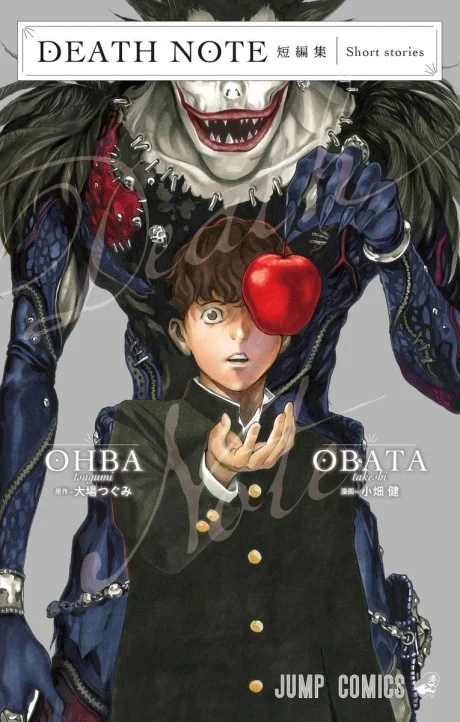
Death Note Short Stories is a single-volume manga collection rather than a continuation series, bringing together six shorter pieces by writer Tsugumi Ohba and artist Takeshi Obata. Its value on the shelf comes from showing how flexible the original premise always was: the notebook can be handed to different people in different eras, and each new holder produces a different moral result. For readers who know the main run, this is the uncommon companion volume that adds perspective instead of simply extending a plot.
What the collection offers is variety rather than escalation. The stories shift register noticeably, moving from a restrained look at L's daily habits and his time at Wammy's House to a four-panel gag strip, and from the ominous a-Kira chapter to the earliest pilot version of the concept. The tone swings between melancholy and dark comedy, and the strongest entries care most about the psychology of ordinary people handed an impossible instrument. Because each piece stands alone, the book reads as a set of variations on a theme rather than a missing chapter of a larger narrative.
Approachability depends on how much context a reader brings. Longtime fans will catch the references to Kira's lingering influence and to familiar characters without effort. Newcomers are best served by starting with the pilot chapter, which lays out the rules and the central temptation from scratch and needs no prior reading. The material is grim and suspenseful rather than graphically violent, though it carries a strong content level for crime, manipulation, and death. Readers who enjoy moral puzzles, detective fiction, and short-form storytelling will find this a compact, self-contained way to sample the franchise's core idea.
Synopsis
Death Note Short Stories is a single-volume manga anthology written by Tsugumi Ohba and illustrated by Takeshi Obata, published in 2021. Rather than continuing one narrative, it collects six short pieces that share the world of the main series, ranging from the original pilot chapter to later tales set well after the events readers of Death Note already know. Two of those stories center on figures identified as C-Kira and a-Kira.
Recurring characters tie the collection together. The death god Ryuk returns as the amused observer who hands the notebook to humans, while L appears in quieter vignettes about his daily routines and his time at Wammy's House. The pilot chapter follows a young student named Taro Kagami, and another story brings Near back into the picture as the notebook resurfaces in a new generation.
Across the volume the central conflict stays constant: what it costs to use the Death Note, and what it costs to refuse it. Each chapter places familiar or entirely new people in front of that choice, then watches how quickly the promise of absolute judgment reshapes their lives. Detectives, successors, and gods alike circle the same question of whether such power can ever truly be set down once someone has picked it up.
Should You Read It?
Read it if you enjoy
- You are a fan of the original Death Note and want to see how its premise plays out with new notebook holders across different eras.
- You enjoy anthology collections where each story stands alone and explores a distinct moral or psychological angle.
- You are curious about the creative origins, such as the 2003 pilot chapter and vignettes about L's daily life.
- You appreciate a mix of tones, from melancholy character studies to dark comedy, within a supernatural crime framework.
It may not suit you if
- You expect a direct continuation or escalation of the main Death Note plot rather than standalone variations.
- You prefer a single sustained narrative over a volume that shifts between serious stories and four-panel gag strips.
- You have not read the original series, as the collection assumes familiarity with its concepts and characters.
- You are seeking major new developments for the core cast instead of character-focused side material.
This automatic starting point balances the series length, pacing, time commitment, and available Volluble research data. Editors can override it when firsthand knowledge suggests a better entry point.
Why It Connects With Audiences
Why people love it
- Readers may value how the core premise adapts to different holders and eras, yielding fresh moral dilemmas.
- The collection offers rare glimpses into L's daily habits and past, adding texture to a beloved character.
- The pilot chapter provides historical insight into the series' origins and early concept.
- The variety of tones, from melancholy to dark comedy, can appeal to those who enjoy range within a franchise.
Common criticisms
- Some readers might find the tonal shifts uneven, particularly between serious stories and the four-panel gag strips.
- Because each piece stands alone, the volume may feel less cohesive than a single narrative.
- Those seeking a substantial continuation of the main plot may be disappointed by the side-story nature and brevity.
- The collection assumes prior knowledge, so newcomers may find it less accessible without reading the main series first.
Volluble DNA
A quick profile of the title’s dominant storytelling ingredients.
Manga Staff7 credits
View all 5 additional credits
Production Background
Death Note Short Stories is a single-volume manga collection written by Tsugumi Ohba and illustrated by Takeshi Obata, the same creative team behind the original Death Note series. Shueisha published the volume under its Jump Comics imprint in print and digital formats on February 4, 2021. The print edition runs 226 pages and carries the ISBN 978-4-08-882573-1.
The book gathers six pieces that had previously appeared separately, spanning roughly two decades of work by the creators. The earliest is the Taro Kagami chapter, which dates to 2003 and stands as the original Death Note story. Later material includes the C-Kira chapter from 2008 and the a-Kira chapter from 2019, two vignettes centered on L, L - One Day and L - The Wammy's House, both from 2008, and a set of four-panel gag comics from 2005. Assembling these scattered one-shots into a single volume is the central fact of this release, since the contents are original stories by Ohba and Obata rather than an adaptation of another work.
Outside Japan, Kana published a French edition as part of its Dark Kana collection, with translation by Thibaud Desbief, and the collection is available to English-language readers through VIZ.
Franchise Context
Death Note Short Stories is a manga anthology within the Death Note franchise created by writer Tsugumi Ohba and artist Takeshi Obata. Released in 2021 as a single volume collecting six chapters, it is an individual companion work rather than the main serial. It is not an adaptation, reboot, or alternate retelling of the core series.
The collection serves as a continuation and expansion of the Death Note world. Its stories were originally published across different years, ranging from early 2000s pilot material to later installments such as C-Kira and a-Kira, plus L-focused vignettes. This makes it a curated side-story volume, functioning as both a follow-up for returning readers and a standalone sampler.
Within the broader franchise, Death Note Short Stories is a spin-off anthology. It assumes familiarity with the original manga's concepts and characters, but each chapter can be read on its own. It complements the main narrative without replacing or rewriting it, and it is often positioned after the original series in reading order.
Where This Fits in Death Note
A spoiler-light guide to where this exact work fits within the broader Death Note franchise.
-
Step 1
Begin with the main Death Note manga, the core series that establishes the notebook's rules, its cast, and the central Kira conflict. This collection builds on that groundwork rather than introducing it.
-
Step 2
Read this volume after finishing that main series. The C-Kira and a-Kira stories unfold in the aftermath of the original ending and land hardest once you know how that story resolved.
-
Step 3
Treat the L vignettes and the four-panel gag strips as optional side material, since they add character texture instead of advancing the plot. The Kagami Tarou pilot chapter stands apart from the main narrative, so it can be sampled before or after without disrupting anything.
-
Step 4
Nothing here is required before the anime adaptation or other franchise entries, and no later work continues from it, so this functions as an epilogue-style companion rather than an alternate starting point.
Franchise Path
- Start with the main Death Note manga; this collection assumes you already know the notebook's rules and the Kira conflict.
- Place Short Stories after the main series, since the C-Kira and a-Kira chapters sit in the aftermath of its ending.
- Treat the L vignettes and four-panel gag strips as optional side reads; the Kagami Tarou pilot stands apart and can be sampled anytime.
After You Finish
Continue with
- No later Death Note work continues from this volume; it works as a complete, epilogue-style companion to the main manga.
Community Verdict
Quick reader and viewer signals from the Volluble community.
Would you recommend this?
Did the ending satisfy you?
Would you read it again?
Report an issue
Spot something wrong on this page? Tell us what needs attention.
0 Comments
Be the first to comment.