
Overview
Dragon Ball GT stands out in the Dragon Ball anime lineage as an anime-original television sequel rather than an adaptation of Akira Toriyama's manga. Arriving in 1996 and running 64 episodes, it treats the aftermath of Dragon Ball Z as a springboard for a separate continuity, which makes it a notable curiosity for viewers interested in how the franchise expanded beyond its source material.
Its appeal lies in a looser, travel-driven mood: Goku is restored to a child's body, and the early episodes lean into cosmic adventure alongside Pan and Trunks. That setup gives the series a different rhythm from the tournament-heavy and power-scaling focus of its predecessor, while later arcs return to the high-stakes combat the franchise is known for. The result is an uneven but distinctive entry that can be enjoyed as a side journey rather than a direct continuation of the manga's storyline.
Viewers who have finished Dragon Ball Z and want more time with its characters may find this approachable, especially with an English dub and streaming availability on Hulu, Crunchyroll, and Hoopla. It may suit fans open to alternate-continuity storytelling and a more episodic space adventure, while those seeking a faithful manga adaptation or a tightly canon follow-up should adjust expectations.
Synopsis
Dragon Ball GT begins when Emperor Pilaf finally gathers the Black Star Dragon Balls, a set said to be far more powerful than the familiar Dragon Balls of Earth. Before Pilaf can make his wish for world domination, Son Goku arrives and interrupts him. The wish goes wrong, and Goku is transformed back into a child. The Black Star Dragon Balls then scatter across the galaxy, setting the story in motion.
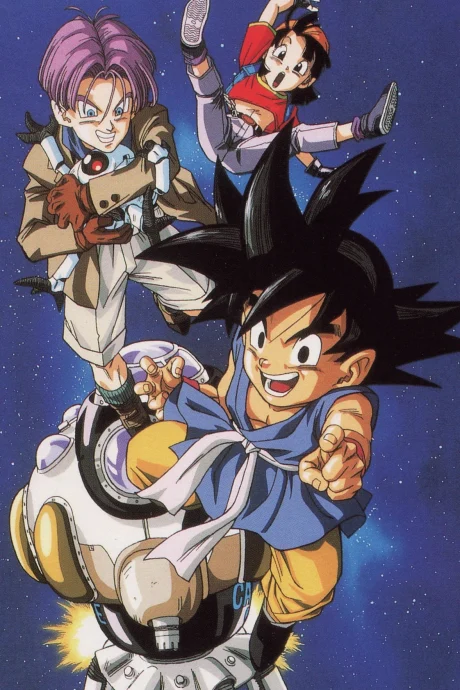
Goku soon learns that these Dragon Balls carry a terrible consequence. If they are not all collected and returned within one year, the Earth will explode. To prevent disaster, Goku joins his granddaughter Pan and the young adult Trunks on a journey through space. Their mission is to track down the scattered Black Star Dragon Balls before the deadline passes.
As the trio travels from planet to planet, they encounter strange cultures, powerful enemies, and unexpected allies. Goku must adapt to fighting in a child's body while leading the search, and the group's resolve is tested by the many dangers of their galactic quest. The series follows their race against time to save their home.
Trailer
Should You Watch It?
Watch it if you enjoy
- You finished Dragon Ball Z and want more time with Goku, Pan, and Trunks in an anime-original side branch.
- You enjoy a looser, travel-driven space adventure over tournament-heavy arcs, especially in the early episodes.
- You are curious how the franchise continued without adapting Akira Toriyama's manga.
- You prefer an English dub with streaming options such as Hulu, Crunchyroll, and Hoopla.
It may not suit you if
- You want a direct, manga-faithful continuation; the catalog files this entry as an alternate continuity.
- You dislike Goku being turned back into a child, which reshapes the series' fights and tone.
- You want the tight power-scaling and tournament rhythm of Dragon Ball Z sustained throughout.
- You prefer franchise entries that the later animated continuations depend on; this is an optional side branch.
This automatic starting point balances the series length, pacing, time commitment, and available AniList community signals. Editors can override it when firsthand knowledge suggests a better entry point.
Why It Connects With Audiences
Why people love it
- The opening premise sends Goku, Pan, and Trunks planet-hopping to recover scattered Dragon Balls, giving the franchise an unusual cosmic-adventure rhythm.
- Pan and a grown Trunks round out the leads, offering a different trio dynamic from earlier Dragon Ball teams.
- Later arcs return to the high-stakes combat the franchise is known for, so action-focused viewers still find payoff.
- As an anime-exclusive sequel produced by Toei Animation, it shows how the franchise expanded beyond its source manga.
Common criticisms
- Because it is anime-original rather than a manga adaptation, it can feel like a branch apart from the core storyline.
- Its tone shifts between light episodic space travel and serious combat, which some viewers find uneven.
- Restoring Goku to a child's body can undercut the growth the character reached by the end of Dragon Ball Z.
- Some viewers find the 64-episode run's pacing looser than the arc structure of its predecessor.
Volluble DNA
A quick profile of the title’s dominant storytelling ingredients.
Characters and Voice Actors25 characters
Gokuu Son
Main character- Japanese: Masako Nozawa
- English: Sean Schemmel
- English: Stephanie Nadolny
- English: Zoe Slusar
- English: Jeremiah Yurk
Trunks
Main character- Japanese: Takeshi Kusao
- English: Eric Vale
- English: Matthew Erickson
Pan
Main character- Japanese: Yuuko Minaguchi
- English: Elise Baughman
- English: Kate Bristol
- English: Caitlynne Medrek
Giru
Main character- English: Sonny Strait
- English: Matthew Erickson
- Japanese: Shinobu Satouchi
Pu’ar
Supporting character- Japanese: Naoko Watanabe
- English: Monika Antonelli
Bulma
Supporting character- Japanese: Hiromi Tsuru
- English: Tiffany Vollmer
- English: Kristin Nowosad
Vegeta
Supporting character- English: Christopher Sabat
- Japanese: Ryou Horikawa
- English: Roger Rhodes
Piccolo
Supporting character- English: Christopher Sabat
- Japanese: Toshio Furukawa
- English: Ethan Cole
Majin Boo
Supporting character- Japanese: Kouzou Shioya
- English: Josh Martin
- English: Corby Proctor
Gohan Son
Supporting character- English: Kyle Hebert
- Japanese: Masako Nozawa
- English: Scott Roberts
Gyuumaou
Supporting character- English: Kyle Hebert
- Japanese: Daisuke Gouri
Yajirobe
Supporting character- Japanese: Mayumi Tanaka
Bee
Supporting character- English: Christopher Bevins
Chi-Chi
Supporting character- Japanese: Naoko Watanabe
- English: Cynthia Cranz
- English: Debbie Munro
Marron
Supporting character- English: Meredith McCoy
- Japanese: Tomiko Suzuki
- English: Lori Barnes-Smith
Bulma no Mama
Supporting characterOolong
Supporting character- English: Bradford Jackson
- Japanese: Naoki Tatsuta
Tenkaichi Budokai Announcer
Supporting character- English: Eric Vale
- Japanese: Yukimasa Kishino
- English: Tommy James
Videl
Supporting character- Japanese: Yuuko Minaguchi
- English: Susan Huber
- English: Jennifer Holder
Umigame
Supporting character- English: Christopher Sabat
- Japanese: Daisuke Gouri
- English: Dave Pettitt
Paresu
Supporting character- English: Carol-Anne Day
- Japanese: Natsumi Yanase
- English: Amber Cotton
Shu
Supporting character- Japanese: Tesshou Genda
- English: Chris Cason
- English: Jonathan Love
General Blue
Supporting characterStaff Officer Black
Supporting characterPilaf
Supporting character- English: Chuck Huber
- Japanese: Shigeru Chiba
- English: Dean Galloway
Production and Staff25 credits
View all 13 additional credits
Production Background
Dragon Ball GT is a Japanese anime television series produced by Toei Animation. The 64-episode series premiered in Japan on Fuji Television and its FNS affiliates, beginning its broadcast in February 1996 and running through November 1997. Individual episodes run roughly 24 minutes.
Unlike the earlier Dragon Ball and Dragon Ball Z television adaptations, Dragon Ball GT does not adapt Akira Toriyama's manga. It was made as an anime-exclusive sequel to Dragon Ball Z, telling an original story that reuses the same characters and universe rather than following published manga material. The catalog treats it as an alternate continuity entry in the franchise.
The work is credited as based on Akira Toriyama's Dragon Ball manga franchise. An English dub was produced, and the series has been carried by streaming services including Hulu, Crunchyroll, and Hoopla.
Franchise Context
Dragon Ball GT sits within the wider Dragon Ball franchise alongside the earlier television adaptations Dragon Ball and Dragon Ball Z. Produced by Toei Animation and broadcast in Japan from 1996 to 1997 for a total of 64 episodes, it is not an adaptation of Akira Toriyama's manga. Instead it is an anime-exclusive continuation that reuses the established cast and universe while telling an original story, which places it as a continuation of the animated line rather than a straight retelling of existing manga material.
Within the franchise's continuity, the catalog classifies this entry's relationship as an alternate continuity. Its premise sets it apart from the arcs that came before: a wish on the Black Star Dragon Balls turns Son Goku back into a child and scatters the orbs across the galaxy, forcing a race to recover them within a year to keep Earth from being destroyed. Goku travels with his granddaughter Pan and a grown Trunks, so the series opens a fresh adventure thread rather than picking up directly where the previous animated storyline left off.
For readers exploring the franchise, therefore, Dragon Ball GT works as a branching, self-contained chapter of the Dragon Ball anime lineage. It builds on characters and conventions that earlier entries established, and it stands as one distinct version of how that world could continue, separate from the manga's own path and connected to the broader franchise hub that gathers the related works together.
Where This Fits in Dragon Ball
A spoiler-light guide to where this exact work fits within the broader Dragon Ball franchise.
-
Step 1
Start with the original Dragon Ball television series, then watch Dragon Ball Z, since Dragon Ball GT assumes you already know Goku, his family, and the events that closed out the Z storyline.
-
Step 2
Come to Dragon Ball GT only after finishing Dragon Ball Z. It is an anime-exclusive sequel rather than an adaptation of the Dragon Ball manga, so nothing in the manga run leads directly into it.
-
Step 3
Treat it as an alternate continuity branch. The 64-episode series spins off into its own timeline from the end of Z and is optional for viewers following the core manga-derived path.
-
Step 4
Other Dragon Ball continuations do not depend on this series, so treat GT as a side branch you can visit after Z or skip entirely without losing the main thread.
Franchise Path
- Begin with the original Dragon Ball TV series, then watch Dragon Ball Z to understand Goku, his family, and the post-Z status quo.
- After Dragon Ball Z, treat Dragon Ball GT as an optional alternate-continuity branch rather than a manga-required step.
- GT itself is a 64-episode anime-exclusive sequel; it assumes familiarity with the animated Dragon Ball and Dragon Ball Z line.
After You Finish
Continue with
- No direct sequel continues GT's specific alternate timeline; the 64-episode series stands as a self-contained side branch.
- Other Dragon Ball anime continuations do not depend on finishing GT, so viewers can move to them without losing the core path.
Community Verdict
Quick reader and viewer signals from the Volluble community.
Would you recommend this?
Did the ending satisfy you?
Would you watch it again?
Sources2 sources
0 Comments
Be the first to comment.