
Overview
Dragon Ball Z stands as a pivotal anime television series that brought Japanese animation into mainstream global consciousness, particularly in North America and Europe. Its 1989 debut and six-year broadcast run cemented a template for serialized shounen action, blending intense martial arts battles with elaborate power progression and a sprawling cast. For many viewers, it was the gateway into anime fandom, and its influence on later action series remains unmistakable.
The series offers a sustained experience of escalating stakes, where Earth's defenders confront alien warriors, androids, and magical entities. At its core, it follows Goku's adult life while giving significant attention to his son Gohan's growth and the redemption of former rivals like Piccolo and Vegeta. The mix of comedy, tragedy, and operatic combat creates a rhythm that rewards long-term investment across its 291 episodes.
This individual series may appeal to fans of adventure and martial arts storytelling who appreciate a long-form narrative with memorable transformations and emotional payoff. While it continues from the earlier Dragon Ball series, many viewers begin here without prior knowledge, aided by the availability of an English dub and streaming on services like Crunchyroll and Bilibili TV. It remains an accessible entry point for those curious about classic shounen anime.
Synopsis
Dragon Ball Z is the 1989 television sequel to the earlier Dragon Ball series, picking up with Son Goku as an adult who has settled into family life with his wife Chi-Chi and their young son, Gohan. The relative calm is short lived. Goku learns that he belongs to an extraterrestrial warrior race known as the Saiyans, a revelation that pulls him, his family, and his friends into conflicts far larger than anything they faced before, with the fate of the planet repeatedly hanging in the balance.
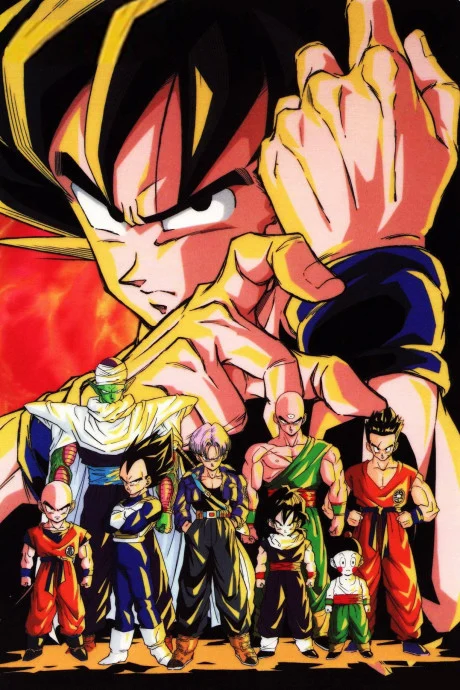
The cast expands well beyond its original core. Goku remains the central figure, driven by an almost cheerful appetite for testing his own limits, but his son Gohan grows from a timid child into a significant presence in the story. Piccolo, once a bitter enemy, develops into a mentor and ally, while Vegeta, a proud Saiyan prince introduced as an adversary, gradually becomes one of the series' most important rival figures. Krillin, Bulma, and a widening circle of friends and fighters round out the ensemble.
The primary conflict is one of escalating defense. Earth is threatened in turn by organized Saiyan warriors, by an interplanetary tyrant and his forces, and by other powerful enemies that emerge from the fallout of each battle. Against these opponents, Goku and his companions train, transform, and forge uneasy alliances, balancing the demands of martial arts combat with the quieter responsibilities of family and loyalty. The series blends action and adventure with broad comedy and a coming of age thread that runs through Gohan in particular.
Trailer
Should You Watch It?
Watch it if you enjoy
- Viewers drawn to long-form martial-arts adventure with escalating stakes, power progression, and memorable transformations may find the 291-episode run rewarding.
- Fans of ensemble shounen storytelling that follows Goku's adult life alongside Gohan's growth and the gradual redemption of rivals like Piccolo and Vegeta.
- Newcomers curious about a landmark gateway anime that helped bring Japanese animation into mainstream awareness in North America and Europe.
- Those who prefer dubbed viewing can access the full run with English audio on Crunchyroll and Bilibili TV.
It may not suit you if
- Viewers wanting a short, quickly resolved story may find the long episode count and repeated planet-in-peril conflicts demanding over a sustained run.
- The catalog lists Gore and Tragedy among its themes, so combat-driven violence and emotional loss may not suit every viewer.
- Those who prefer to begin at a franchise's start should note this is a direct sequel to the 1986 Dragon Ball series, not a standalone entry.
- Depending on taste, the operatic tone and lengthy power-up pacing may feel slower than the fast-moving action premise suggests.
This automatic starting point balances the series length, pacing, time commitment, and available AniList community signals. Editors can override it when firsthand knowledge suggests a better entry point.
Why It Connects With Audiences
Why people love it
- Often regarded as a gateway into anime fandom, its 1989 debut and six-year broadcast run helped popularize serialized shounen action worldwide.
- The mix of comedy, tragedy, and martial-arts spectacle, paired with a widening cast, offers emotional payoff for those invested across the full run.
- Its direct sequel status to Dragon Ball means the show builds on established characters and world history rather than starting from scratch.
- A confirmed English dub plus streaming on Crunchyroll and Bilibili TV keeps the complete series accessible to international audiences.
Common criticisms
- Some viewers find the 291-episode length and seven-year continuous broadcast sprawling, with stretches that may feel prolonged.
- The structure of successively stronger threats, from Saiyan warriors to interplanetary tyrants, can strike some as formulaic over time.
- Because it adapts the remaining manga chapters and continues the 1986 series, newcomers may find the continuity and cast history heavy to enter mid-franchise.
- Long-form pacing and dense battle arcs may make it harder for casual viewers to follow across such an extended run.
Volluble DNA
A quick profile of the title’s dominant storytelling ingredients.
Characters and Voice Actors25 characters
Gokuu Son
Main character- English: Kirby Morrow
- Japanese: Masako Nozawa
- English: Sean Schemmel
- English: Jillian Michaels
- English: Ian James Corlett
- English: Peter Kelamis
- English: Stephanie Nadolny
Vegeta
Main character- English: Christopher Sabat
- English: Brian Drummond
- Japanese: Ryou Horikawa
Piccolo
Main character- English: Christopher Sabat
- English: Scott McNeil
- Japanese: Toshio Furukawa
Gohan Son
Main characterKuririn
Main character- Japanese: Mayumi Tanaka
- English: Sonny Strait
- English: Terry Klassen
Pu’ar
Supporting character- English: Cathy Weseluck
- Japanese: Naoko Watanabe
- English: Monika Antonelli
Bulma
Supporting character- Japanese: Hiromi Tsuru
- English: Tiffany Vollmer
- English: Maggie Blue O’Hara
- English: France Perras
- English: Lalainia Lindbjerg
Majin Boo
Supporting character- English: Justin Cook
- English: Scott McNeil
- Japanese: Kouzou Shioya
- English: Brian Dobson
- English: Josh Martin
Gyuumaou
Supporting character- English: Kyle Hebert
- Japanese: Daisuke Gouri
- English: Mark Britten
- English: Dave Ward
Suno
Supporting character- Japanese: Naoko Watanabe
- English: Susan Huber
- English: France Perras
Upa
Supporting character- English: Dameon Clarke
- Japanese: Mitsuko Horie
- English: Alistair Abell
Yajirobe
Supporting character- Japanese: Mayumi Tanaka
- English: Mike McFarland
- English: Brian Drummond
Jinzouningen 16-gou
Supporting character- Japanese: Hikaru Midorikawa
- English: Scott McNeil
- English: Jeremy Inman
Bee
Supporting character- English: Christopher Bevins
- Japanese: Tomiko Suzuki
Bora
Supporting character- Japanese: Banjou Ginga
- English: Dameon Clarke
- English: Terry Klassen
Chi-Chi
Supporting character- English: Laura Bailey
- Japanese: Naoko Watanabe
- English: Cynthia Cranz
- English: Lisa Ann Beley
- Japanese: Mayumi Shou
Briefs Hakase
Supporting character- English: Mark Stoddard
- English: Scott McNeil
- Japanese: Jouji Yanami
- English: Paul Dobson
- English: Chris Forbis
Gohan Son
Supporting character- English: Kyle Hebert
- English: Brad Swaile
- English: Dameon Clarke
- Japanese: Masako Nozawa
- English: Saffron Henderson
- English: Jillian Michaels
- English: Stephanie Nadolny
- Japanese: Osamu Saka
- English: Christopher Sabat
- English: Terry Klassen
Lunch
Supporting character- English: Meredith McCoy
- Japanese: Mami Koyama
- English: Leah Clark
Marron
Supporting character- English: Meredith McCoy
- English: Cathy Weseluck
- Japanese: Tomiko Suzuki
Bulma no Mama
Supporting character- English: Cynthia Cranz
- English: Willow Johnson
- English: Jane Perry
- Japanese: Hiroko Emori
- Japanese: Youko Kawanami
- Japanese: Mariko Mukai
Oolong
Supporting character- English: Richard Newman
- English: Bradford Jackson
- Japanese: Naoki Tatsuta
- English: Mark Britten
- English: Alec Willows
Tenkaichi Budokai Announcer
Supporting character- English: Eric Vale
- English: Michael Dobson
- Japanese: Hirotaka Suzuoki
Baba Uranai
Supporting character- Japanese: Mayumi Tanaka
- English: Linda Young
- Japanese: Junpei Takiguchi
- English: Brian Drummond
- English: Ellen Kennedy
- English: Elan Ross Gibson
Videl
Supporting character- Japanese: Yuuko Minaguchi
- English: Moneca Stori
- English: Kara Edwards
Production and Staff26 credits
View all 14 additional credits
Production Background
Dragon Ball Z is a Japanese anime television series produced by Toei Animation. It premiered in Japan on Fuji Television and its FNS affiliates on April 26, 1989, and concluded on January 31, 1996, running for 291 episodes with a standard runtime of about 24 minutes each. Within the record it is cataloged as a television series and as a direct sequel to the 1986 Dragon Ball television series.
The show adapts the remaining 325 chapters of Akira Toriyama's Dragon Ball manga, with manga credited as its source material. Production spanned roughly seven years of continuous broadcast, and the series is listed as finished, with English dub availability confirmed alongside streaming on Crunchyroll and Bilibili TV.
The series was later dubbed for broadcast in at least 81 countries worldwide, extending its reach far beyond its original Japanese run. This page covers the Dragon Ball Z television series itself, its production by Toei Animation, and its broadcast history rather than the wider franchise.
Franchise Context
Dragon Ball Z is the 1989 television anime that continues the story of the Dragon Ball franchise rather than starting it. It follows the earlier Dragon Ball anime as a direct sequel and adapts the later portion of Akira Toriyama's original Dragon Ball manga, shifting focus to Goku's adult life, his son Gohan, and a new generation of allies and enemies.
Within the franchise, this entry is a mainline anime installment and an adaptation of source manga material, not a spin-off, alternate version, or stand-alone work. Its 291-episode run makes it one of the central pillars of the animated Dragon Ball timeline, bridging the original series and later franchise continuations while remaining distinct from the manga chapters it adapts.
The series aired in Japan from 1989 to 1996 and was later dubbed internationally, helping expand the Dragon Ball franchise beyond its original manga and earlier anime. On this individual-work page, Dragon Ball Z is presented as a specific sequel series within the larger franchise, not as a summary or replacement for the entire Dragon Ball property.
Where This Fits in Dragon Ball
A spoiler-light guide to where this exact work fits within the broader Dragon Ball franchise.
-
Step 1
Start with the 1986 Dragon Ball television series, because Dragon Ball Z is its direct sequel and picks up with Goku as an adult, so the earlier show supplies the cast, world, and character history this one builds on.
-
Step 2
Continue into Dragon Ball Z itself, the 1989 to 1996 follow-up that adapts the remaining chapters of Akira Toriyama's manga across 291 episodes and moves through successive threats such as Vegeta, Frieza, Cell, and Majin Buu.
-
Step 3
Treat this as a main-line continuation rather than an optional or alternate entry: it follows the first series in sequence, and its story runs alongside Goku's son Gohan and the growth of rivals like Piccolo and Vegeta.
-
Step 4
Pick your format for that same stretch of story. The full television run is available with an English dub on Crunchyroll and Bilibili TV, while the later manga chapters offer a reading route covering the equivalent material.
Franchise Path
- Begin with the 1986 Dragon Ball TV series; Dragon Ball Z is its direct sequel and assumes earlier cast, world, and character history.
- Then watch Dragon Ball Z (1989–1996), the mainline anime sequel adapting the later chapters of Akira Toriyama's Dragon Ball manga.
- After that, later Dragon Ball franchise anime can carry the timeline forward; this page treats Dragon Ball Z as an individual mainline entry.
After You Finish
Continue with
- After finishing Dragon Ball Z, continue with later Dragon Ball TV entries in the same franchise if you want the timeline extended.
- Dragon Ball Z's own 291-episode run is complete, so no additional episode or season is needed to finish this entry.
- If you prefer to stop here, Dragon Ball Z delivers a complete mainline arc through its final episodes.
Community Verdict
Quick reader and viewer signals from the Volluble community.
Would you recommend this?
Did the ending satisfy you?
Would you watch it again?
0 Comments
Be the first to comment.