
Overview
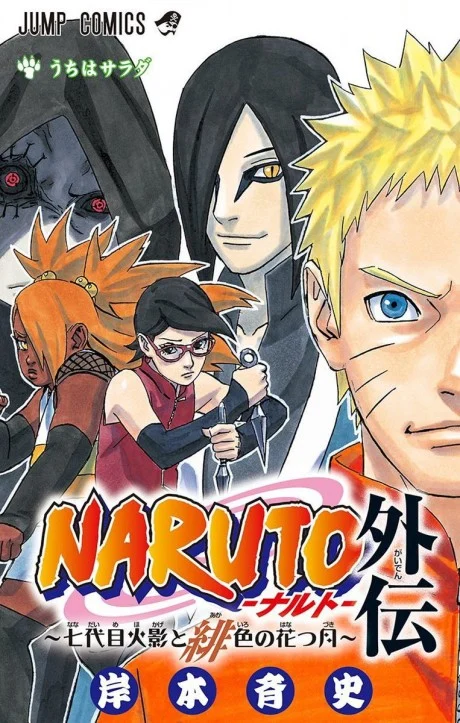
Naruto: The Seventh Hokage and the Scarlet Spring is a ten-chapter side story by series creator Masashi Kishimoto, released in 2015 and collected in a single volume. Rather than extending the scale of the main Naruto saga, it narrows the lens onto Sarada Uchiha, a young ninja whose questions about her family pull the focus away from battlefield spectacle and toward something smaller and more personal. For a franchise built on escalating conflicts, that shift in scope is what makes this work notable: it treats the quiet aftermath of a long war as worthy of its own story.
The experience here is a compact mystery wrapped around a family drama. Sarada's search for the truth about her origins gives the manga a clear forward pull, and the action beats that do arrive carry weight because they are tied to her relationships rather than to a world-ending threat. Kishimoto's artwork remains expressive, and the short chapter count keeps the pacing tight. Readers who appreciate character-driven interludes in a larger action series will find this one especially satisfying.
This is an approachable entry for anyone curious about the generation that follows Naruto, and its single-volume length makes it an easy commitment. Prior familiarity with the parent series helps, since the emotional payoff depends on knowing these characters and the history behind them. The manga is available in English through VIZ Media and Shonen Jump, and it stands as a self-contained piece within the wider franchise rather than a replacement for it.
Synopsis
Naruto: The Seventh Hokage and the Scarlet Spring is a 2015 spin-off manga written and illustrated by Masashi Kishimoto. Set after the great ninja war, it takes place in an era of peace as a new generation of ninja begins to grow up. The story centers on Sarada Uchiha, a young ninja in training who is troubled by questions about her family, especially the long absence of her father, Sasuke, and whether Sakura is truly her birth mother.
At the same time, Naruto now serves as the Seventh Hokage, balancing his duties with fatherhood as his son Boruto demands his attention. Sarada sets out to learn the truth about her origins, and her search brings her into contact with a dangerous group connected to the Uchiha clan. This group has its sights set on Sasuke, turning Sarada's personal quest into a confrontation that tests her growing abilities and her understanding of her parents.
Across its ten chapters, collected in a single volume, the manga keeps its focus on Sarada's search for answers. Characters from the previous generation appear, but the story remains grounded in Sarada's perspective as she grapples with what family, inheritance, and belonging mean to her.
Should You Read It?
Read it if you enjoy
- Best for Naruto readers who finished the original series and want a short postwar side story centered on Sarada Uchiha.
- Recommended for fans of character-driven family drama who prefer a personal mystery over large-scale ninja battles.
- Useful for readers curious about the generation after Naruto and the bridge toward Boruto-era stories.
- A good fit if you want a complete single-volume manga with ninja and shounen themes and tight pacing.
It may not suit you if
- May not suit newcomers to Naruto, since it assumes familiarity with Naruto, Sasuke, Sakura, and the Uchiha backstory.
- Readers seeking world-ending conflicts or nonstop action may find this side story's narrower family mystery less eventful.
- If you want a full mainline continuation rather than an optional ten-chapter branch, this may feel supplementary.
This automatic starting point balances the series length, pacing, time commitment, and available Volluble research data. Editors can override it when firsthand knowledge suggests a better entry point.
Why It Connects With Audiences
Why people love it
- Sarada's search for answers gives the manga a clear emotional and mystery-driven pull.
- It uses a rare postwar peace setting to explore family, inheritance, and belonging through a new generation.
- Kishimoto's expressive artwork and compact chapter count can keep the reading experience tight.
- It works as an accessible bridge between the original Naruto era and later next-generation stories.
Common criticisms
- Some may feel the story assumes prior Naruto knowledge, limiting its appeal as a standalone read.
- As a ten-chapter side story, it can seem inessential beside the main series' larger conflicts.
- Kishimoto has said he had difficulty writing Sarada due to inexperience portraying female characters, which some may see reflected in her portrayal.
- Its action beats are tied to personal relationships rather than a world-ending threat, so action-first readers may find the stakes smaller.
Volluble DNA
A quick profile of the title’s dominant storytelling ingredients.
Characters34 characters
Sasuke Uchiha
Main characterNaruto Uzumaki
Main characterSarada Uchiha
Main characterKakashi Hatake
Supporting characterKawaki
Main characterSakura Haruno
Supporting characterSai
Supporting characterSuigetsu Houzuki
Supporting characterYamato
Supporting characterShikamaru Nara
Supporting characterRock Lee
Supporting characterChouji Akimichi
Supporting characterGuy Might
Supporting characterKabuto Yakushi
Supporting characterAnko Mitarashi
Supporting characterOrochimaru
Supporting characterHinata Hyuuga
Supporting characterKarin
Supporting characterGaara
Supporting characterJuugo
Supporting characterShino Aburame
Supporting characterShizune
Supporting characterKurama
Supporting characterBoruto Uzumaki
Supporting characterInojin Yamanaka
Supporting characterIruka Umino
Supporting characterShikadai Nara
Supporting characterTemari
Supporting characterChouchou Akimichi
Supporting characterMitsuki
Supporting characterShin Uchiha
Supporting characterTsunade Senju
Supporting characterShin Uchiha
Supporting characterIno Yamanaka
Background characterManga Staff4 credits
View all 3 additional credits
Production Background
Naruto: The Seventh Hokage and the Scarlet Spring is a spin-off manga written and illustrated by Masashi Kishimoto. It was released in 2015, running from April 27 to July 6 of that year, and comprises 10 chapters collected in a single volume. The work is an original manga side story rather than an adaptation, set shortly after the epilogue of the main Naruto series.
Kishimoto developed the manga to further explore Sarada Uchiha's relationship with her parents as well as the long-distance marriage between Sasuke Uchiha and Sakura Uchiha. The narrative follows Sarada's search for the truth about her origins and her absent father. In production context, Kishimoto has said he had difficulty writing Sarada because he was inexperienced in portraying female characters.
For English-language readers, the manga has been made available through VIZ Media, Shonen Jump, and Mangas.io. It is classified as an action work with ninja and shounen themes.
Franchise Context
Naruto: The Seventh Hokage and the Scarlet Spring is a spin-off manga within the larger Naruto franchise. Written and illustrated by Masashi Kishimoto, it is a short individual work of ten chapters collected in one volume, serialized in 2015. It sits apart from the main Naruto narrative as a side story rather than a reboot or alternate continuity. It follows the original series and belongs to the postwar era opened by Naruto's epilogue.
Within franchise chronology, this manga serves as a continuation and bridge. It is not the starting point, since readers are expected to know the original Naruto. By focusing on Sarada Uchiha and her family, it expands the generation that comes after Naruto, Sasuke, and Sakura. It also connects to the Boruto era, helping establish the next phase of the franchise while remaining a self-contained side story.
As a spin-off, it complements rather than replaces the main series. It is an original manga, not an adaptation of an earlier anime or novel. Its placement after the original run makes it a transitional entry, useful for readers who want to see how the world and its central families changed before Boruto's own adventures. It can be read as a standalone episode, but its full impact depends on familiarity with the parent saga.
Where This Fits in NARUTO
A spoiler-light guide to where this exact work fits within the broader NARUTO franchise.
-
Step 1
Start with the original Naruto manga and read through its ending first. This side story is set shortly after that epilogue and assumes familiarity with Naruto, Sasuke, Sakura, and the Uchiha backstory.
-
Step 2
Then read Naruto: The Seventh Hokage and the Scarlet Spring as a short 10-chapter, single-volume side story. It follows Sarada Uchiha as she investigates her family, so it works best once the main Naruto plot has concluded.
-
Step 3
Treat this as an optional but rewarding branch rather than a replacement for the main series. Readers who want only Sarada's arc can read it after Naruto, while completionists can slot it before later next-generation material involving Boruto and the new era.
-
Step 4
If you continue into next-generation Naruto stories, use this side story as a bridge between the original series and that newer era. It is not the whole franchise, just one focused entry in the larger Naruto world.
Franchise Path
- Begin with the original Naruto manga and finish its main story; this side story assumes knowledge of Naruto, Sasuke, Sakura, and the Uchiha backstory.
- Read Naruto: The Seventh Hokage and the Scarlet Spring as a 10-chapter, single-volume postwar side story focused on Sarada Uchiha.
- Then move into next-generation Naruto material, including the Boruto era, if you want to follow the franchise beyond this bridge.
After You Finish
Continue with
- This side story is complete in one volume; for continuation, continue with Boruto: Naruto Next Generations, which carries the next-generation era forward.
Community Verdict
Quick reader and viewer signals from the Volluble community.
Would you recommend this?
Did the ending satisfy you?
Would you read it again?
Report an issue
Spot something wrong on this page? Tell us what needs attention.
0 Comments
Be the first to comment.