
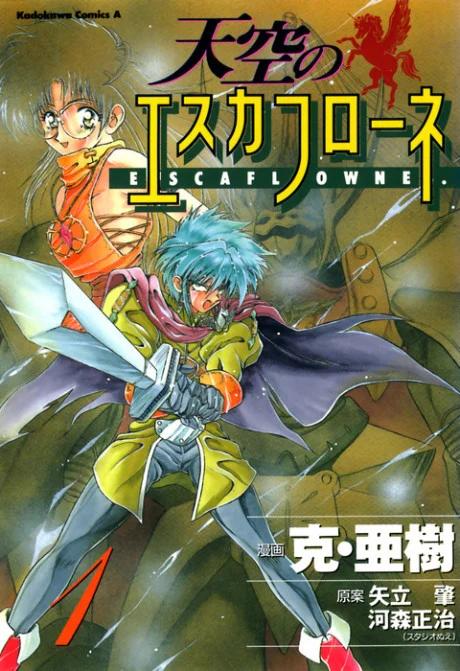
Overview
The Vision of Escaflowne manga matters as a complete, self-contained route into a premise that blends isekai displacement with mecha combat, political war, romance, and fortune-telling. Across eight volumes and thirty-four chapters, it gives Hitomi, Van, and the world of Gaea room to breathe while keeping the focus on momentum and emotional stakes. For readers who know the name but not this version, it is a chance to encounter the story in a compact shounen register rather than as a sprawling commitment.
Its appeal lies in the contrast between intimate character drama and large-scale conflict. Tarot motifs and Hitomi's growing abilities sit alongside dragon fights, royal responsibility, and the pressures of the Zaibach campaign. The manga's limited length gives it a brisk, pressure-cooker rhythm, with romance and battlefield tension arriving in close succession. It is less about exhaustive lore than about how young people make choices when prophecy, duty, and affection pull them in different directions.
This work is approachable for newcomers who enjoy classic fantasy adventure, mecha, and slow-burn romance, and for shounen readers who want a finished series they can read in a focused stretch. Prior knowledge of the broader Escaflowne name is not required. Because no current official edition is verified, interested readers may need to look for older printings or library copies.
Synopsis
In this manga, ordinary high school student Hitomi Hoshino experiments with tarot cards and is abruptly carried to Gaea, a distant world divided by war. There she encounters Van Fanel, the young prince of Fanelia, whose homeland has been devastated by the expanding Zaibach Empire. Their meeting draws Hitomi into a conflict far larger than she can initially understand.
On Gaea, Hitomi's tarot readings grow sharper and more reliable, making her insights valuable to Van and his allies. Van pilots the mysterious mechanical armor Escaflowne, and his efforts to defend his people bring him into contact with the knight Allen Schezar and other figures caught between rival kingdoms and Zaibach's ambitions. Hitomi must navigate unfamiliar customs, dangerous battlefields, and her own unsettling visions while trying to find a place in a world that treats her abilities as both a gift and a strategic asset.
The central struggle follows Van and his companions as they resist Zaibach's push for control and seek to understand the power tied to Escaflowne. Hitomi's presence becomes increasingly important to that fight, but the manga also keeps attention on the bonds forming among the young people involved and on the choices they face when loyalty, duty, and survival pull in different directions.
Should You Read It?
Read it if you enjoy
- Readers who want a complete, self-contained manga route into isekai displacement, mecha combat, political war, and romance.
- Newcomers curious about Escaflowne but preferring a compact 34-chapter shounen manga over the 1996 anime's longer commitment.
- Fans of classic fantasy adventure who like tarot motifs and fortune-telling woven into battlefield stakes.
It may not suit you if
- Readers seeking the 1996 anime as the franchise's central version; this is a parallel manga take, not a summary of the TV series.
- Those who want exhaustive Gaea lore over a brisk, character-driven pressure-cooker rhythm.
- Readers who prefer low-conflict fantasy; the premise centers on war, a devastated homeland, and strategic danger.
This automatic starting point balances the series length, pacing, time commitment, and available Volluble research data. Editors can override it when firsthand knowledge suggests a better entry point.
Why It Connects With Audiences
Why people love it
- Its appeal lies in contrasting intimate character drama with large-scale conflict, including dragon fights, royal responsibility, and Zaibach's campaign.
- Hitomi's growing tarot abilities and unsettling visions add a fortune-telling thread to Van's mecha and battlefield choices.
- The limited length can give romance and battlefield tension a brisk, close-succession rhythm rather than a sprawling pace.
Common criticisms
- A possible criticism is that 34 chapters leave less room for exhaustive worldbuilding than a longer treatment might.
- Its parallel relationship to the 1996 anime can confuse newcomers expecting the broadcast version's central storyline.
- The quick shifts between romance and battlefield tension may feel pressurized to readers wanting more breathing room.
Volluble DNA
A quick profile of the title’s dominant storytelling ingredients.
Characters21 characters
Hitomi Kanzaki
Main characterVan Fanel
Main characterAllen Schezar
Main characterDilandau Albatou
Supporting characterFolken Fanel
Supporting characterMerle
Supporting characterDryden Fassa
Supporting characterMillerna Sara Aston
Supporting characterDornkirk
Supporting characterBalgus Ganesha
Supporting characterChid Ouji
Supporting characterMogura Otoko
Supporting characterShikikan
Supporting characterNaria
Supporting characterEriya
Supporting characterChesta
Supporting characterJajuka
Supporting characterGaddes
Supporting characterZongi
Supporting characterVarie Fanel
Supporting characterPlaktu
Supporting characterManga Staff5 credits
View all 2 additional credits
Franchise Context
This entry is the main manga work in the Escaflowne franchise, not the 1996 television anime and not a side-story spin-off. The saved record identifies it as an individual manga titled Vision of Escaflowne, with 34 chapters collected in eight volumes, and marks its relationship to the franchise as main_manga. It therefore belongs to the manga branch of the franchise, while the anime is a separate work.
The record dates the manga's run from 1994 to 1998. Source excerpts place the television anime's premiere in 1996, so this manga should not be treated simply as a comic adaptation of that broadcast series. It is a distinct franchise entry with its own serialized form and volume count. Readers moving between the anime and manga should regard this page as the manga-side version of the shared Escaflowne property, not as a summary of the entire franchise or of the TV series.
Where This Fits in The Vision of Escaflowne
A spoiler-light guide to where this exact work fits within the broader The Vision of Escaflowne franchise.
-
Step 1
Begin with the 1996 anime television series if you want the franchise's central version and the most common entry point.
-
Step 2
Approach this 1994 manga as a parallel manga take on the same Gaea premise, not as a required prequel to the anime.
-
Step 3
Treat it as optional or alternate for newcomers, and read it after the anime if you want another version of Hitomi and Van's story.
-
Step 4
After finishing these 34 chapters, continue with other Escaflowne adaptations or follow-up material rather than expecting a direct sequel inside this manga.
Franchise Path
- Franchise path: begin with the 1996 Escaflowne TV anime as the central version; this 1994 manga is a parallel manga take, not a required prequel.
- Read this manga as an alternate manga-side route through Hitomi and Van's Gaea story.
After You Finish
Continue with
- No direct manga sequel follows these 34 chapters; continue within the franchise via the 1996 TV anime or other Escaflowne adaptations.
Community Verdict
Quick reader and viewer signals from the Volluble community.
Would you recommend this?
Did the ending satisfy you?
Would you read it again?
Report an issue
Spot something wrong on this page? Tell us what needs attention.
0 Comments
Be the first to comment.