
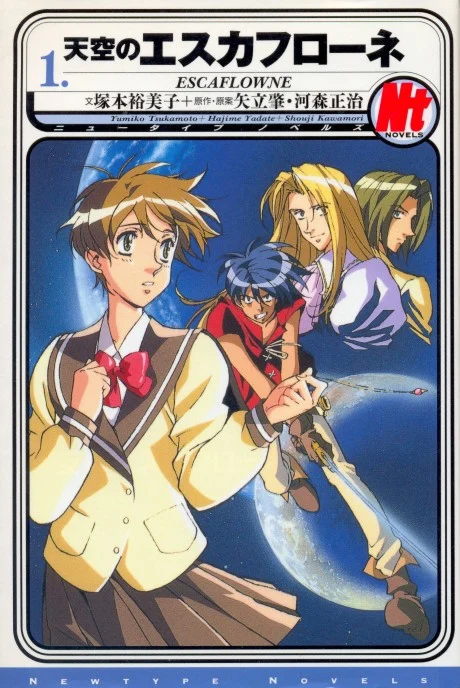
Overview
This six-volume novel adaptation gives the Escaflowne story a different texture from its animated counterpart. Instead of relying on movement, color, and soundtrack, it asks readers to build Gaea in their minds from description and interior perspective. That makes it valuable for anyone curious about how the same material plays when the emphasis shifts toward prose. Its appeal lies less in novelty of plot than in the experience of spending time with Hitomi, Van, and the conflict around Zaibach through a more text-driven lens.
The work mixes isekai displacement with fantasy worldbuilding, mecha stakes, and romance. Hitomi's fortune-telling ability and her outsider position give the story a human anchor amid political and military conflict. Readers who like a female protagonist navigating an unfamiliar world, and who are comfortable with a story that balances adventure with relationship drama, will find clear hooks here. The mecha element is present through Escaflowne itself, but the novel format may suit those who prefer imaginative scale over animation spectacle.
Because this is a specific six-volume adaptation rather than the franchise as a whole, it is best approached as one version of the Escaflowne story. It may be especially approachable for readers who already enjoy prose fantasy and want a completed text route into the material. Those seeking the original anime should look to that work separately. This page concerns the novel adaptation and what it offers on its own terms.
Synopsis
This six-volume novel adaptation centers on Hitomi Kanzaki, an ordinary high school student whose life is upended when a young man named Van Fanel appears on her school's running track while fighting a dragon. In the clash she is drawn away from Earth and deposited on the planet Gaea, a world of kingdoms, strange technology, and uneasy alliances that is entirely unlike her own.
There she meets Van, a prince of the small kingdom of Fanelia, and is soon caught up in his effort to unite Gaea's nations against the expansionist Zaibach Empire. Van commands the Escaflowne, a giant机械 suit of mystical armor tied to his royal line, and he is joined by allies including Allen, a knight from the kingdom of Asturia. Hitomi, who has long had an interest in fortune telling, finds that her latent abilities grow unusually strong on Gaea, making her presence valuable to those around her and difficult to explain.
The central conflict follows the struggle to hold off Zaibach while Hitomi tries to work out why she was brought to this world, what Van's past conceals, and how the Escaflowne itself is connected to her. Her feelings for Van and the pressures of a war she never chose give the story its emotional weight as she searches for a way to understand her role in events far larger than herself.
Should You Read It?
Read it if you enjoy
- You want Hitomi's isekai story told through prose, with Gaea built from description and interior perspective rather than animation.
- You like a female protagonist whose fortune-telling ability becomes central to a war she never chose.
- You are curious how the 1996 anime's premise reads as a finished six-volume novel adaptation.
It may not suit you if
- You want the anime's movement, color and soundtrack; this version trades spectacle for text.
- You expect an original story rather than a prose reworking of the 1996 television series.
- You want mecha action foregrounded; Escaflowne is present, but the format favors imaginative scale over battle spectacle.
This automatic starting point balances the series length, pacing, time commitment, and available Volluble research data. Editors can override it when firsthand knowledge suggests a better entry point.
Why It Connects With Audiences
Why people love it
- Hitomi's outsider position and growing foresight give the large-scale conflict a human anchor.
- The prose route offers more room to sit with Hitomi, Van and the pressure of the Zaibach struggle.
- It works as a companion to the anime, giving readers a second angle on the same world.
Common criticisms
- As an adaptation rather than an original work, it may feel redundant to readers already steeped in the anime.
- Its catalog placement under manga despite a novel format can make the book tricky to find or identify.
- Readers seeking the definitive version are often steered toward the television series first.
Volluble DNA
A quick profile of the title’s dominant storytelling ingredients.
Characters21 characters
Hitomi Kanzaki
Main characterVan Fanel
Main characterAllen Schezar
Main characterDilandau Albatou
Supporting characterFolken Fanel
Supporting characterMerle
Supporting characterDryden Fassa
Supporting characterMillerna Sara Aston
Supporting characterDornkirk
Supporting characterBalgus Ganesha
Supporting characterChid Ouji
Supporting characterMogura Otoko
Supporting characterShikikan
Supporting characterNaria
Supporting characterEriya
Supporting characterChesta
Supporting characterJajuka
Supporting characterGaddes
Supporting characterZongi
Supporting characterVarie Fanel
Supporting characterPlaktu
Supporting characterManga Staff7 credits
Production Background
Tenkuu no Escaflowne is a six-volume novel-format adaptation listed in the catalog as an individual manga entry. Its publication window ran from 19 June 1996 to 25 August 1997, spanning the period around the original Escaflowne television anime. The record identifies the work as an adaptation of that anime rather than an original prose story, so its production history is closely tied to the screen project that preceded and overlapped with it.
The source anime was created by Shōji Kawamori and produced by Sunrise, premiering on TV Tokyo from April to September 1996. Those details provide the key production context for this novel version, which arrived while the anime was still fresh in the Japanese market and continued after the broadcast concluded. The catalog gives Japanese origin and a finished status but does not name a separate novel author or publisher for this edition, so the adaptation credit remains the clearest production link in the saved record.
Across its six volumes, this version represents a prose reworking of the Escaflowne material, distinct from the television series and from other franchise entries. The record notes no episode count or chapter count and treats the six volumes as the main installment measure. Its 1996 start date places it among the franchise's early tie-in publications, and its 1997 end date marks the completion of this particular novel run.
Franchise Context
This six-volume Tenkuu no Escaflowne novel is an adaptation within the broader Escaflowne franchise, not the franchise's starting point. The source it adapts is the 1996 television anime The Vision of Escaflowne, created by Shoji Kawamori and produced by Sunrise. This prose version was published from 1996 to 1997, so it sits alongside the anime as a media-specific retelling rather than as an original or continuing storyline.
As an alternate prose version, it is distinct from the television series while sharing its premise and main characters, including Hitomi, Van, and the giant machine Escaflowne. The saved record lists it as a finished six-volume work and catalogs it under manga despite its novel format, a classification detail that should not be confused with the anime itself. For franchise context, treat this entry as a supplementary adaptation that offers another route into the same world, not as a replacement for the television series or as the hub for the entire franchise.
Where This Fits in The Vision of Escaflowne
A spoiler-light guide to where this exact work fits within the broader The Vision of Escaflowne franchise.
-
Step 1
Start with the 1996 television anime, The Vision of Escaflowne, since the supplied record describes this six-volume novel as an adaptation of that anime.
-
Step 2
Read Tenkuu no Escaflowne after the anime, or treat it as an alternate prose version if you want a different route through Hitomi and Van's story.
-
Step 3
No direct sequel to this novel is established in the supplied record; after finishing the core anime, continue with other Escaflowne franchise entries for broader context. This page covers only the novel adaptation, not the whole franchise.
Franchise Path
- Start with the 1996 TV anime The Vision of Escaflowne, the source this novel adapts.
- Then read this six-volume novel as an alternate prose route through Hitomi and Van's story.
After You Finish
Continue with
- No direct sequel to this novel is established in the saved record.
- After finishing, continue with other Escaflowne franchise entries if you want broader context.
Community Verdict
Quick reader and viewer signals from the Volluble community.
Would you recommend this?
Did the ending satisfy you?
Would you read it again?
Report an issue
Spot something wrong on this page? Tell us what needs attention.
0 Comments
Be the first to comment.