
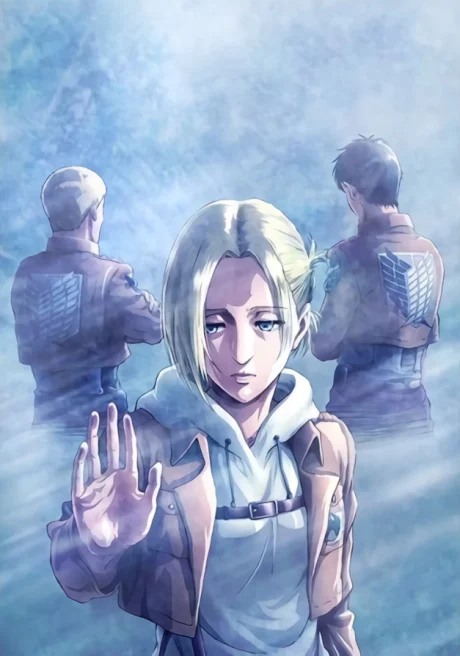
Synopsis
Attack on Titan: Lost Girls is a three-part original animation production spun off from the Attack on Titan saga, adapting the spinoff light novel of the same name. Instead of following the Survey Corps on the front lines, it narrows its focus to two young women from the main cast: Mikasa Ackerman and Annie Leonhart. Each installment offers a self-contained, more intimate look at life inside the walls, running alongside events of the parent series rather than retelling them.
One thread centers on Mikasa and her bond with Eren, unfolding within a vision of an alternate world in which her parents were never killed. The other follows Annie during her time with the Military Police Brigade in the Stohess District, where she agrees to take on a missing person case involving Carly Stratmann, a university graduate and the daughter of a wealthy businessman. With only a short window to work and the district's underworld full of dangerous figures, Annie leans on her comrade Hitch Dreyse for cover, and Hitch's help comes with conditions attached.
Across both stories the central conflict is as much internal as external: the pull between the lives these characters might have lived and the duties, secrets, and reputations that define them. Investigation and mystery drive the action, while the emotional weight settles on loyalty, identity, and what each woman is willing to sacrifice to keep her own position intact.
Trailer
Should You Watch It?
This automatic starting point balances the series length, pacing, time commitment, and available Volluble research data. Editors can override it when firsthand knowledge suggests a better entry point.
Characters and Voice Actors25 characters
Annie Leonhart
Main character- Japanese: Yuu Shimamura
- English: Lauren Landa
Mikasa Ackerman
Main character- Japanese: Yui Ishikawa
- English: Trina Nishimura
Eren Yeager
Supporting character- Japanese: Yuuki Kaji
- English: Bryce Papenbrook
Reiner Braun
Supporting character- Japanese: Yoshimasa Hosoya
Armin Arlert
Supporting character- Japanese: Marina Inoue
- English: Jessie James Grelle
Grisha Yeager
Supporting character- Japanese: Hiroshi Tsuchida
- English: Chris Hury
Marco Bott
Supporting character- Japanese: Ryouta Oosaka
- English: Austin Tindle
Marlo Freudenberg
Supporting character- Japanese: Tomokazu Sugita
- English: Todd Haberkorn
Keith Shadis
Supporting character- Japanese: Tsuguo Mogami
- English: Patrick Seitz
Moses no Haha
Supporting character- Japanese: Kyouko Terase
- English: Linda Young
Mikasa no Chichi
Supporting character- Japanese: Daichi Endou
- English: Jarrod Greene
Mikasa no Haha
Supporting character- Japanese: Yuuka Hirose
- English: Colleen Clinkenbeard
Hitch Dreyse
Supporting character- Japanese: Akeno Watanabe
- English: Brittney Karbowski
Boris Feulner
Supporting character- Japanese: Yuuichi Karasuma
- English: Micah Solusod
Dennis Aiblinger
Supporting character- Japanese: Seirou Ogino
Annie no Chichi
Supporting character- Japanese: Unshou Ishizuka
- English: Bill Jenkins
Carly Stratmann
Supporting character- Japanese: Junko Kitanishi
- English: Marisa Duran
Lou Meade
Supporting character- Japanese: Kaito Ishikawa
- English: Y. Chang
Wald Richter
Supporting character- Japanese: Jouji Nakata
- English: Frank Todaro
Elliot G. Stratmann
Supporting character- Japanese: Kiyomitsu Mizuuchi
- English: D.C. Douglas
Kagami Otoko
Supporting character- Japanese: Takayuki Masuda
- English: Alex Organ
Kemper Boltz
Background characterZoku 3
Background characterZoku 2
Background characterZoku 1
Background characterProduction and Staff25 credits
View all 13 additional credits
Production Background
Attack on Titan: Lost Girls originated as a Japanese novel written by Hiroshi Seko, a spin-off of Hajime Isayama's Attack on Titan. The franchise record lists its source material as a light novel, and the book's stories turn on two female characters from the parent series, Mikasa Ackerman and Annie Leonhart, each receiving a self-contained narrative rather than a retelling of the main storyline.
A manga adaptation followed, beginning serialization in August 2015 and running through May 2016. That version carried the Lost Girls material into the comics format before the property was revisited for animation.
The animated adaptation was produced as a three-part original animation DVD rather than a broadcast television series. Its installments were released on December 8, 2017, April 9, 2018, and August 9, 2018, each bundled with the 24th, 25th, and 26th limited edition volumes of the original manga respectively. The three episodes run about 25 minutes each. The OVA is finished, has an English dub, and is available for streaming through Crunchyroll.
Franchise Context
Attack on Titan: Lost Girls belongs to the wider Attack on Titan franchise, yet it stands apart from the main narrative line. It began as a light novel by Hiroshi Seko, a spin-off rather than a continuation or a retelling of Hajime Isayama's central story. The franchise's core follows Eren Yeager and the Survey Corps in their war against the Titans, while Lost Girls narrows its focus to two female characters, Mikasa Ackerman and Annie Leonhart.
Within the franchise's publication history, this manga adaptation arrived after the original series was well established, running from 2015 to 2016. It is not an alternate version of the main story and does not replace events in the primary canon. Instead it works as a side story that fills in character perspective, with one tale set in an imagined world where Mikasa's parents survive and another following Annie during her time in the Military Police Brigade.
A three-part OVA adaptation released in 2017 and 2018 alongside limited editions of the original manga carried that same side-story material into animation. Readers and viewers can treat Lost Girls as optional, self-contained companion material rather than a required chapter of the main storyline.
Community Verdict
Quick reader and viewer signals from the Volluble community.
Would you recommend this?
Did the ending satisfy you?
Would you watch it again?
Report an issue
Spot something wrong on this page? Tell us what needs attention.
0 Comments
Be the first to comment.