
Overview
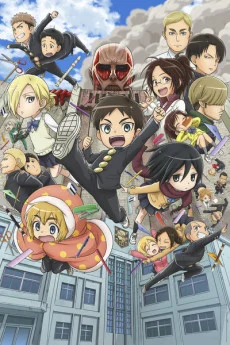
Attack on Titan: Junior High is a 2015 anime television series that reframes the intense world of Attack on Titan as a junior high school comedy. Across twelve short episodes, it swaps grim survival for classroom rivalries, exaggerated gags, and chibi versions of familiar characters. Its role is not to replace or summarize the main saga but to offer a playful side story that fans can enjoy as a change of pace.
The show's main appeal is its affectionate parody. It leans on school life routines, ensemble interactions, and slapstick humor while keeping the recognizable Titan threat as a running joke. The short runtime and mild content make it easy to sample, and the English dub plus streaming availability on Tubi, Hulu, and Crunchyroll help it reach viewers who prefer a lighter commitment.
People who already know Attack on Titan will catch the most references, but this work can also function as a lightweight school comedy for those who enjoy parody and chibi art. It is a compact, self contained entry within the broader franchise, best approached as a comedic companion rather than a dramatic starting point.
Synopsis
Attack on Titan: Junior High is a 2015 anime television series that reimagines the world of Attack on Titan as a school comedy. The story is set in a junior high school where familiar characters, including Eren and Mikasa, appear as younger chibi-style students. Instead of the grim struggle of the original series, everyday school life is filled with gags that parody its story and notable scenes.
The central character is Eren, whose hotheaded determination often lands him in trouble as he contends with Titans in a comedic school environment. Mikasa remains close by, and the cast navigates classes, clubs, and other school activities. The primary conflict comes from the comedic friction between Eren and the Titans, as well as the ordinary pressures of junior high life.
The series balances episodic humor with an ensemble of characters whose personalities are exaggerated for comedy. It is a parody spin-off, so its events and tone differ from the main Attack on Titan storyline.
Preview
Should You Watch It?
Watch it if you enjoy
- Watch if you want a light, self-contained Attack on Titan parody with chibi versions of the cast.
- Sample it if you enjoy school-life comedy, ensemble gags, and short 18-minute episodes.
- English-dub viewers can try it on Tubi TV, Hulu, or Crunchyroll.
It may not suit you if
- May not suit viewers wanting the original's grim survival drama or canon story progression.
- Some jokes lean on familiarity with Attack on Titan, so newcomers may miss references.
- Skip if chibi art, slapstick, or episodic school comedy is not your preference.
This automatic starting point balances the series length, pacing, time commitment, and available Volluble research data. Editors can override it when firsthand knowledge suggests a better entry point.
Why It Connects With Audiences
Why people love it
- The parody affectionately remixes recognizable Attack on Titan moments into classroom humor.
- Its ensemble cast and exaggerated personalities support lively school-life interactions.
- Short episodes and mild content make it an easy, low-commitment change of pace.
Common criticisms
- Humor can depend on prior knowledge of the main series, making some gags feel like inside references.
- The comedic spin-off may not satisfy viewers hoping for serious Titan action or plot development.
- Its episodic gag structure may feel slight to those seeking a more substantial narrative.
Volluble DNA
A quick profile of the title’s dominant storytelling ingredients.
Characters and Voice Actors25 characters
Mikasa Ackerman
Main character- English: Trina Nishimura
- Japanese: Yui Ishikawa
Eren Yeager
Main character- Japanese: Yuuki Kaji
- English: Bryce Papenbrook
Armin Arlert
Main character- Japanese: Marina Inoue
- English: Jessie James Grelle
Narrator
Supporting character- Japanese: Marina Inoue
- English: Jessie James Grelle
Levi
Supporting character- Japanese: Hiroshi Kamiya
- English: Matthew Mercer
Sasha Blouse
Supporting character- Japanese: Yuu Kobayashi
- English: Ashly Burch
Reiner Braun
Supporting character- English: Robert McCollum
- Japanese: Yoshimasa Hosoya
Connie Springer
Supporting character- Japanese: Hiro Shimono
- English: Clifford Chapin
Bertolt Hoover
Supporting character- English: David Matranga
- Japanese: Tomohisa Hashizume
Annie Leonhart
Supporting character- Japanese: Yuu Shimamura
- English: Lauren Landa
Hannes
Supporting character- Japanese: Keiji Fujiwara
- English: David Wald
Erwin Smith
Supporting character- Japanese: Daisuke Ono
- English: J. Michael Tatum
Jean Kirstein
Supporting character- Japanese: Kishou Taniyama
- English: Mike McFarland
Carla Yeager
Supporting character- Japanese: Yoshino Takamori
- English: Jessica Cavanagh
Grisha Yeager
Supporting character- Japanese: Hiroshi Tsuchida
- English: Chris Hury
Marco Bott
Supporting character- Japanese: Ryouta Oosaka
- English: Austin Tindle
Krista Lenz
Supporting character- Japanese: Shiori Mikami
- English: Bryn Apprill
Ilse Langnar
Supporting character- Japanese: Sachi Kokuryuu
- English: Marissa Lenti
Petra Ral
Supporting character- English: Caitlin Glass
- Japanese: Natsuki Aikawa
Mike Zacharias
Supporting character- English: Jason Douglas
- Japanese: Kenta Miyake
Hange Zoe
Supporting character- Japanese: Romi Park
- English: Jessica Calvello
Nile Dok
Supporting character- Japanese: Anri Katsu
- English: Ian Sinclair
Darius Zackly
Supporting character- English: John Swasey
- Japanese: Hideaki Tezuka
Marlo Freudenberg
Supporting character- Japanese: Tomokazu Sugita
- English: Todd Haberkorn
Dieter Ness
Supporting character- Japanese: Kouichi Sakaguchi
- English: Jonathan Brooks
Production and Staff26 credits
View all 14 additional credits
Production Background
Attack on Titan: Junior High is the 2015 anime television adaptation of Saki Nakagawa's parody manga of the same name. Nakagawa created the manga, which was serialized in Kodansha's Bessatsu Shonen Magazine from April 2012 to July 2016. The series reimagines characters from Hajime Isayama's Attack on Titan as junior high students, using chibi designs and school comedy scenarios. The official copyright line credits Saki Nakagawa, Hajime Isayama, Kodansha, and the Attack on Titan: Junior High Production Committee.
The anime aired as a 12-episode television series from October 4 to December 20, 2015, with each episode running about 18 minutes. It was broadcast during the fall 2015 season, and a rebroadcast followed in January 2016. The adaptation was sourced from the manga and keeps the parody's school setting while drawing on the main series' story and memorable moments for comedic effect.
An English dub was produced, and the series has been available through streaming services including Tubi TV, Hulu, and Crunchyroll. Its production context is tied to the broader Attack on Titan phenomenon, but this work remains a distinct comedy spin-off rather than a direct adaptation of the main story. A later sequel manga, Attack on Titan: High School, ran from June to August 2018 and continued the school parody concept in a different setting.
Franchise Context
Attack on Titan: Junior High functions as a comedic spin-off within the larger Attack on Titan franchise, not as a mainline installment or direct continuation. It originated as a parody manga by Saki Nakagawa, serialized in Bessatsu Shonen Magazine from 2012 to 2016, which reimagined Hajime Isayama's characters in a junior high school setting. The 2015 anime television series adapts that manga, so its relationship to the franchise is both adaptation and alternate version. It shares character names and nods to notable moments while placing them in lighthearted school comedy contexts.
The anime sits apart from the main Attack on Titan continuity, so viewers do not need to follow the original story in order to understand its premise. It is a self-contained entry made up of 12 short episodes. Within the franchise, it represents a parallel, parody-focused branch. A later manga sequel, Attack on Titan: High School, continued the concept in 2018 with six chapters, showing that this comedic offshoot developed its own small lineage. Within the broader franchise, Junior High should be treated as a companion work rather than a replacement or summary of the main series.
Where This Fits in Attack on Titan
A spoiler-light guide to where this exact work fits within the broader Attack on Titan franchise.
-
Step 1
Read or watch the original Attack on Titan first if you want the parody references to land. Attack on Titan: Junior High is a comedy spin-off of that core series, so prior familiarity helps but is not strictly required.
-
Step 2
Watch Attack on Titan: Junior High as an alternate school parody. This 12 episode TV anime is optional for the main franchise and does not replace or continue the canonical Attack on Titan storyline.
-
Step 3
Skip it without worry if you only want the main saga. It is a self-contained gag series, not a required chapter in the core narrative.
-
Step 4
If you enjoy this parody line, continue with the short manga sequel Attack on Titan: High School. Otherwise, return to the main Attack on Titan series or manga.
Franchise Path
- Attack on Titan main series -> Attack on Titan: Junior High (optional parody branch) -> Attack on Titan: High School (manga sequel).
After You Finish
Continue with
- Continue with the short manga sequel Attack on Titan: High School (six chapters), which extends this parody branch.
Community Verdict
Quick reader and viewer signals from the Volluble community.
Would you recommend this?
Did the ending satisfy you?
Would you watch it again?
Report an issue
Spot something wrong on this page? Tell us what needs attention.
0 Comments
Be the first to comment.