
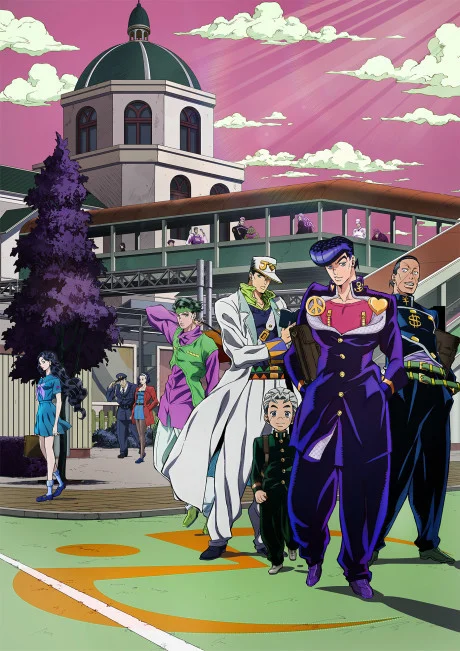
Overview
Diamond is Unbreakable marks a deliberate change of scale for the JoJo's Bizarre Adventure anime. Rather than another continent-crossing journey, this 2016 television season, adapted by David Production from Hirohiko Araki's manga, settles into one town and builds its drama from the people who live there. That shift matters because it proves the series can generate tension and wonder without constant travel, and it gives the adaptation room to develop a broad cast of Stand users whose personalities drive the story as much as their powers do.
What the work offers is a hybrid experience: part small-town mystery, part ensemble comedy, part supernatural thriller. Episodes often function as self-contained encounters that gradually feed into a larger threat, so the viewing rhythm alternates between light character humor and genuinely unsettling confrontations. The result is an inviting episodic structure with a cumulative payoff, set in a place that feels lived in rather than merely visited.
Because it introduces a new protagonist and a largely new supporting cast in a fresh location, this season can serve as an accessible entry point for viewers curious about JoJo but unsure where to begin, while long-time followers will recognize returning figures and inherited continuity. It suits audiences drawn to urban fantasy, mystery, and ensemble storytelling, and to works that mix warmth with sudden violence. The material includes gore and dark turns, so it is best approached by viewers comfortable with mainstream mature action and horror elements.
Synopsis
Set in 1999, roughly a decade after the fierce events that took place in Egypt, the story opens when Jotaro Kujo travels to the Japanese town of Morioh in search of Josuke Higashikata, the teenage son his grandfather Joseph Joestar never knew he had. Jotaro quickly discovers that Josuke carries the same supernatural gift known as a Stand, and that the young man has built an ordinary life around school, friends, and the neighborhood where he grew up.
Josuke stands at the center of the tale, a warm-hearted but quick-tempered high schooler whose Stand lets him restore and reshape damaged objects. Around him gathers a widening circle of Morioh residents, including classmates and locals who each possess their own Stand abilities, some friendly and others dangerous. Jotaro stays close as a link to earlier generations, while the town itself serves as the stage for a string of bizarre occurrences.
Driving the main conflict is a mysterious bow and arrow said to awaken Stand powers in anyone it strikes. As new Stand users surface and disturbing incidents pile up, Josuke and his companions begin searching for the arrow and the person behind it, determined to defend the quiet community they call home.
Trailer
Should You Watch It?
Watch it if you enjoy
- You enjoy small-town mysteries where supernatural encounters gradually build toward a larger threat.
- You like ensemble casts where each character's personality and Stand power drive the story.
- You want an accessible entry point to JoJo that introduces a new protagonist and setting.
- You appreciate a mix of light character humor and genuinely unsettling confrontations.
It may not suit you if
- You prefer the globe-trotting adventures of earlier JoJo parts; this season stays in one town.
- You dislike episodic structures that alternate between lighter character episodes and darker encounters.
- You want a complete franchise conclusion; this is a middle chapter that leads into later parts.
- You avoid supernatural body horror or gore; the series includes such themes.
This automatic starting point balances the series length, pacing, time commitment, and available Volluble research data. Editors can override it when firsthand knowledge suggests a better entry point.
Why It Connects With Audiences
Why people love it
- The shift to a single town lets the story feel lived-in and character-focused.
- The ensemble cast of Stand users drives both comedy and tension across the season.
- The adaptation balances self-contained encounters with a cumulative payoff.
- It offers an accessible entry point while still connecting to the larger Joestar lineage.
Common criticisms
- The slower, town-bound structure may feel less urgent to viewers expecting a globe-trotting adventure.
- The mixture of light comedy and unsettling horror may clash for some viewers.
- Its largely self-contained story may disappoint viewers seeking direct continuation of prior JoJo arcs.
- The episodic rhythm, while varied, may feel inconsistent to those preferring a single driving plot.
Volluble DNA
A quick profile of the title’s dominant storytelling ingredients.
Characters and Voice Actors25 characters
Jousuke Higashikata
Main character- Japanese: Yuuki Ono
- English: Billy Kametz
Yoshikage Kira
Main character- Japanese: Toshiyuki Morikawa
- English: D.C. Douglas
Joutarou Kuujou
Main character- Japanese: Daisuke Ono
- English: Matthew Mercer
Kouichi Hirose
Main character- Japanese: Yuuki Kaji
- English: Zach Aguilar
Okuyasu Nijimura
Main character- Japanese: Wataru Takagi
- English: Jalen Cassell
- Japanese: Konami Saitou
Rohan Kishibe
Main character- Japanese: Takahiro Sakurai
- English: Vic Mignogna
Joseph Joestar
Supporting character- Japanese: Unshou Ishizuka
- English: Richard Epcar
Yukako Yamagishi
Supporting character- Japanese: Mamiko Noto
- English: Faye Mata
Mikitaka Hasekura
Supporting character- Japanese: Yasuyuki Kase
- English: Mark Whitten
Keichou Nijimura
Supporting character- Japanese: Tomoyuki Shimura
- English: Jason Marnocha
- Japanese: Mariko Higashiuchi
Reimi Sugimoto
Supporting character- Japanese: Sayuri Hara
- English: Kira Buckland
Shigekiyo Yanguu
Supporting character- Japanese: Kappei Yamaguchi
- English: Brian Beacock
Akira Otoishi
Supporting character- Japanese: Shoutarou Morikubo
- English: Andrew Russell
Tomoko Higashikata
Supporting character- Japanese: Megumi Toyoguchi
- English: Allegra Clark
- Japanese: Shizuka Itou
Terunosuke Miyamoto
Supporting character- English: Alan Lee
- Japanese: Kengo Kawanishi
Yoshihiro Kira
Supporting character- English: Steve Kramer
- Japanese: Shigeru Chiba
Aya Tsuji
Supporting character- English: Katelyn Gault
- Japanese: Sayaka Oohara
Anjuurou Katagiri
Supporting character- English: Lex Lang
- Japanese: Kenji Hamada
Yuuya Fungami
Supporting character- English: Phillip Reich
- Japanese: Kishou Taniyama
Hayato Kawajiri
Supporting character- Japanese: Rina Satou
- English: Laura Stahl
Masazou Kinoto
Supporting character- Japanese: Makoto Ishii
- English: Stefan Martello
Tamami Kobayashi
Supporting character- English: Frank Todaro
- Japanese: Satoshi Tsuruoka
Toshikazu Hazamada
Supporting character- Japanese: Hiroki Shimowada
- English: Lucien Dodge
Toyohiro Kanedaichi
Supporting character- Japanese: Kouichi Toochika
- English: Sean Chiplock
Tonio Trussardi
Supporting character- English: Christopher Bevins
- Japanese: Tokuyoshi Kawashima
Production and Staff26 credits
View all 14 additional credits
Franchise Context
Diamond is Unbreakable is the third season of the JoJo's Bizarre Adventure anime produced by David Production, adapting Part 4 of Hirohiko Araki's long-running manga. It follows the Stardust Crusaders season and arrives before Golden Wind, placing it in the middle of the animated run rather than at its start or finish. The season continues the larger story while shifting to a new protagonist and a new setting, which lets it function as a largely self-contained chapter for viewers who have not followed every prior arc.
Links to earlier parts still matter. Jotaro Kujo, the lead of Stardust Crusaders, returns in a supporting role, and the Joestar family line carries forward through Josuke Higashikata. The town of Morioh and its residents give the season an episodic rhythm distinct from the travel-driven structure of the parts surrounding it.
The franchise reaches well past the main television seasons to include the Thus Spoke Kishibe Rohan OVAs and later manga parts. Within that wider catalog, this entry marks the point where the series settles into one town and an ensemble focus.
Where This Fits in JoJo’s Bizarre Adventure
A spoiler-light guide to where this exact work fits within the broader JoJo’s Bizarre Adventure franchise.
-
Step 1
Start with the first anime season covering Phantom Blood and Battle Tendency to learn the Joestar lineage, Hamon, and the franchise's generational structure.
-
Step 2
Continue with Stardust Crusaders, the second anime season, since Diamond is Unbreakable is set after its events and begins with Jotaro's visit to Morioh.
-
Step 3
Watch Diamond is Unbreakable as the third anime season and a core Part 4 adaptation. It is mainline, not optional or an alternate continuity.
-
Step 4
Move on to Golden Wind, the fourth anime season and next mainline Part, after finishing this season.
-
Step 5
If you want side material after Part 4, the Kishibe Rohan OVA offers a lighter spinoff focused on a supporting character.
Franchise Path
- Start with JoJo Season 1 (Phantom Blood/Battle Tendency) for the Joestar lineage, Hamon, and generational structure.
- Then watch Stardust Crusaders (Season 2), since Diamond is Unbreakable is set after its events and begins with Jotaro's visit to Morioh.
- Diamond is Unbreakable is the mainline third anime season adapting Part 4; it is not optional or an alternate continuity.
- After this, continue to Golden Wind (Season 4/Part 5), the next mainline anime season in the JoJo franchise.
After You Finish
Continue with
- After finishing Diamond is Unbreakable, continue with Golden Wind, the next mainline JoJo anime season and Part 5.
- For optional side material in the same franchise, try Thus Spoke Kishibe Rohan, an OVA spinoff focused on a supporting character.
- The Part 4 story is complete, but the larger JoJo franchise continues with later Parts.
Community Verdict
Quick reader and viewer signals from the Volluble community.
Would you recommend this?
Did the ending satisfy you?
Would you watch it again?
Report an issue
Spot something wrong on this page? Tell us what needs attention.
0 Comments
Be the first to comment.