
Overview
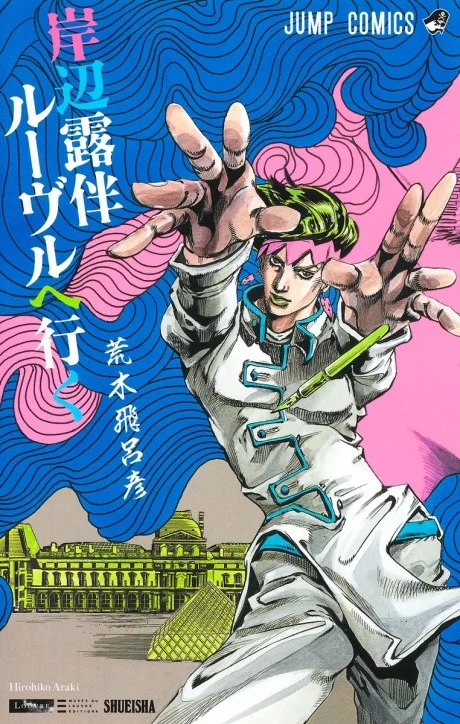
Rohan at the Louvre stands out as a compact collision of manga storytelling and one of the world's most famous museums. It takes the idea of an artist confronting a haunted object and turns it into a tense, self-contained mystery about obsession, history, and the dangerous pull of forbidden art. The full-color presentation and one-shot length make it feel like a gallery piece with teeth, offering a focused dose of supernatural dread rather than a sprawling narrative.
The experience is built around atmosphere and escalating unease. Readers who enjoy psychological horror, ghost stories, and art-world mysteries will find plenty to latch onto, especially if they like stories where curiosity and creative ambition carry real consequences. Body horror elements and a moderate content level mean it is best suited to audiences comfortable with darker supernatural imagery, though the compact format keeps the intensity contained.
Because it is a single-volume work, Rohan at the Louvre is an approachable entry point for readers curious about the character or about manga set in the Louvre. It rewards attention to mood, visual detail, and the uneasy relationship between artist and subject, and it can be appreciated on its own terms without prior knowledge of a larger series.
Synopsis
Rohan at the Louvre centers on Rohan, a young Japanese manga artist whose curiosity is stirred when he meets a striking and enigmatic woman. She tells him of a painting said to be two hundred years old and burdened by a curse, created with the darkest ink ever produced. That ink was drawn from a tree a thousand years old, felled by the painter without the Emperor's permission, an act that cost the artist his life. The painting itself survived, preserved from destruction by a curator at the Louvre.
Ten years after that conversation, Rohan travels to Paris and approaches the museum in person, asking that the work be brought up from deep within its archives. He is compelled by the legend and by a personal need to see the painting for himself, and he is wholly unprepared for what his request sets in motion.
The story plays out as a horror and mystery tale with psychological and supernatural currents, following a manga artist whose craft sits at the heart of the danger. What begins as an investigation into an old story becomes a confrontation with a curse that has waited a long time for someone to disturb it.
Should You Read It?
Read it if you enjoy
- You enjoy psychological and supernatural horror delivered in a compact one-shot manga format.
- You are curious about a Rohan Kishibe side story set in the Louvre, readable without full JoJo knowledge.
- You like art-world mysteries where an artist's obsession with a cursed painting drives the plot.
- You appreciate full-color presentation and atmospheric, self-contained supernatural dread.
It may not suit you if
- You prefer long serialized narratives rather than a single-volume side story.
- You are uncomfortable with body horror, gore, ghosts, and darker supernatural imagery.
- You want a standalone mystery with no connections to a larger franchise, even if prior reading isn't required.
- You dislike stories where curiosity and forbidden art lead to unsettling consequences.
The primary starting work is a one-shot, so reading the complete story is the natural Volluble Test Drive rather than stopping after an arbitrary chapter count.
Why It Connects With Audiences
Why people love it
- The one-shot format makes the cursed-painting mystery tight and focused.
- Rohan's perspective as a manga artist adds a creative, personal stake to the supernatural threat.
- The Louvre setting and archival descent give the horror a distinctive art-world atmosphere.
- Full-color presentation and JoJo-adjacent side-story appeal can attract fans of the character.
Common criticisms
- Some readers may find the single-chapter length too brief for deep character or plot development.
- The story leans on atmosphere and curse lore more than elaborate mystery mechanics.
- Familiarity with Rohan or JoJo may enhance enjoyment, even if not required.
- Body horror and moderate content may limit its appeal for sensitive readers.
Volluble DNA
A quick profile of the title’s dominant storytelling ingredients.
Characters6 characters
Rohan Kishibe
Main character
Thus Spoke Rohan Kishibe
characterNanase Fujikura
Main characterKouichi Hirose
Supporting characterOkuyasu Nijimura
Supporting characterJousuke Higashikata
Background characterManga Staff8 credits
View all 7 additional credits
Franchise Context
Rohan at the Louvre is a one-shot manga spin-off within the wider JoJo's Bizarre Adventure franchise, centered on Rohan Kishibe, the manga artist who appears in several JoJo-related stories. It is not the beginning of the main JoJo saga, nor a continuation of a numbered arc. Instead, it is a stand-alone side story that sends Rohan to Paris for a supernatural mystery tied to the Louvre. The 2011 release consists of a single chapter collected in one volume, so it can be read independently from longer serialized installments.
Within the franchise, this work belongs to the Rohan-focused branch of side material rather than the central JoJo lineage. Its original story is not an adaptation or a remake of another entry. Readers who know Rohan from JoJo will recognize his curiosity, creative drive, and encounters with the paranormal, but the one-shot does not require full knowledge of the parent series. This page covers only Rohan at the Louvre, not the broader franchise.
Franchise Path
- Franchise path: Rohan at the Louvre is a stand-alone one-shot side story within JoJo's Bizarre Adventure.
- It focuses on Rohan Kishibe, the manga artist from JoJo side material.
- Read independently; no numbered JoJo arc or prior Rohan story is required.
After You Finish
Continue with
- No sequel or continuation: this one-shot is complete and stands alone.
Community Verdict
Quick reader and viewer signals from the Volluble community.
Would you recommend this?
Did the ending satisfy you?
Would you read it again?
Sources1 sources
Report an issue
Spot something wrong on this page? Tell us what needs attention.
0 Comments
Be the first to comment.