
Overview
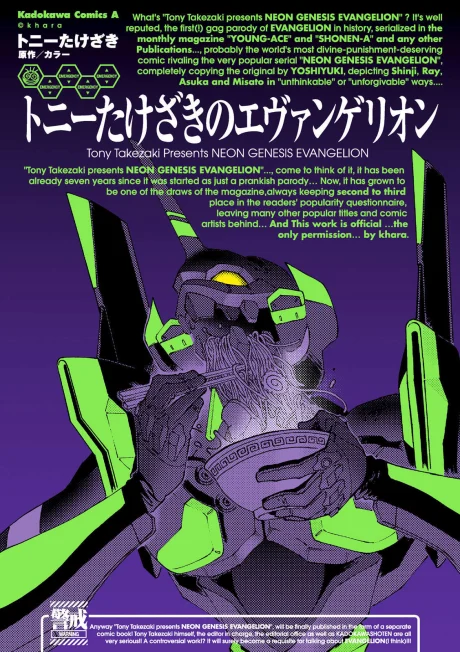
Tony Takezaki’s Neon Genesis Evangelion matters as a compact comic counterpoint to the weightier image associated with its source material. Rather than treating mecha conflict, Angels, military structure, and post-apocalyptic stakes with solemnity, this finished manga approaches them through parody. Its value is not in expanding the surrounding franchise, but in showing how recognizable ideas can become the foundation for a brisk, self-contained comedy.
The experience is concentrated and easy to fit into a short reading session: 36 chapters collected in one volume, with the manga format keeping the jokes moving at its own pace. The mecha setting gives the humor a familiar framework, while the character-focused themes and comedic tone make this a lighter alternative to more serious science-fiction drama. It is best approached as an affectionate comic reinterpretation rather than as a replacement for the original work.
Readers already familiar with Evangelion are likely to find the parody’s premise most immediately approachable, since recognition gives its reversals and contrasts more context. Still, newcomers who enjoy concise gag manga, genre satire, or comedy built around military and robot-fiction conventions may find it accessible without committing to a longer series. As a single-volume manga, it offers a low-barrier way to sample a playful side of a well-known mecha setting.
Synopsis
Tony Takezaki’s Neon Genesis Evangelion is a comedy manga that reworks the familiar Evangelion setup as a series of irreverent gag stories. The setting centers on NERV, a heavily armed organization responsible for defending humanity from the Angels, hostile beings that threaten a world already shaped by apocalyptic danger. To meet that threat, selected teenagers operate giant humanoid Evangelions, placing young pilots inside a military system that treats extraordinary battles as part of its daily routine.
The manga follows the pilots, NERV personnel, and other recognizable figures of this setting as they contend with the practical absurdities of their assignments, their personalities, and the organization around them. Military procedure, looming catastrophe, and the enormous scale of the Evangelions are repeatedly set against character-based humor, turning the tension between serious duty and unruly behavior into the work’s main source of conflict. The cast’s contrasting temperaments drive many of the situations, while the Angels and the demands of combat provide a recurring backdrop. Published as a finished, single-volume manga comprising 36 chapters, this is a parody-focused interpretation of its science-fiction and mecha premise rather than a straightforward dramatic retelling.
Should You Read It?
Read it if you enjoy
- Read it if you know Evangelion and want a compact, self-contained gag reinterpretation of its NERV, Angels, and Evangelion setup.
- Its 36 chapters in one finished volume suit readers seeking brisk mecha parody rather than a long narrative.
It may not suit you if
- It may not suit readers seeking the original franchise’s serious science-fiction drama or a continuation of its central storyline.
- The humor relies on recognizable Evangelion characters and situations, so newcomers may have less context for its reversals.
This automatic starting point balances the series length, pacing, time commitment, and available Volluble research data. Editors can override it when firsthand knowledge suggests a better entry point.
Why It Connects With Audiences
Why people love it
- The manga turns military procedure, apocalyptic stakes, and giant-robot combat into recurring character-based comedy.
- Its single-volume format offers a concentrated alternate take without requiring a lengthy reading commitment.
Common criticisms
- Readers wanting expanded continuity or major franchise development may find its parody-focused, self-contained scope limited.
- The irreverent gag approach may feel mismatched for readers who prefer Evangelion’s conflicts treated with sustained seriousness.
Volluble DNA
A quick profile of the title’s dominant storytelling ingredients.
Manga Staff1 credits
Production Background
Named for Tony Takezaki, this Japanese manga is cataloged as a gag work that parodies the Evangelion series. Its source material is manga, making this entry the print work itself rather than an anime adaptation, remake, or film. The available record identifies no separate animation studio or publisher for this title, and the production information does not provide additional creator credits beyond the name attached to the work. Its comedy and mecha classification reflects its focus as a parody within the Evangelion setting, while its finished status distinguishes it from an ongoing serialization.
The work began publication on October 4, 2010, and concluded on September 11, 2011. It contains 36 chapters collected into a single volume, with 2010 listed as its release year in the catalog. This gives Tony Takezaki’s Neon Genesis Evangelion a compact publication history, spanning less than a year from its recorded start to completion rather than continuing as a long-running multi-volume series. The available record does not verify a current official edition. Beyond its identification as a finished Japanese manga and its parody relationship to the Evangelion series, no further publication or production details are supplied.
Franchise Context
Tony Takezaki’s Neon Genesis Evangelion is a completed manga entry within the broader Neon Genesis Evangelion franchise. It is a gag manga that parodies the Evangelion series, so it functions as an alternate comedic version of the franchise rather than the beginning of its core narrative. This page covers the manga itself, not the original television anime, a film, or another adaptation.
Published as a one-volume work with 36 chapters, this entry stands apart from the franchise’s primary dramatic storyline in tone and purpose. Its relationship to Evangelion is defined by parody and reinterpretation, making it best approached as a self-contained side work for readers familiar with the larger property. It does not establish a new main continuity or serve as a direct continuation of the central manga or anime narrative.
Where This Fits in Neon Genesis Evangelion
A spoiler-light guide to where this exact work fits within the broader Neon Genesis Evangelion franchise.
-
Step 1
Begin with the main Neon Genesis Evangelion story to establish the setting, characters, and core conflict.
-
Step 2
Read Tony Takezaki's Neon Genesis Evangelion afterward as an optional, alternate comedy manga. It is a finished one-volume parody rather than a continuation of the main narrative.
-
Step 3
When finished, return to other Evangelion franchise works or reimaginings according to interest. This manga has no required follow-up within its own story.
Franchise Path
- Read the main Neon Genesis Evangelion story first for its setting and characters; then read this finished, one-volume parody as an alternate comedic side work.
After You Finish
Continue with
- No same-franchise continuation is required: this manga is complete and self-contained rather than a continuation of the central narrative.
Community Verdict
Quick reader and viewer signals from the Volluble community.
Would you recommend this?
Did the ending satisfy you?
Would you read it again?
Report an issue
Spot something wrong on this page? Tell us what needs attention.
0 Comments
Be the first to comment.