
Overview
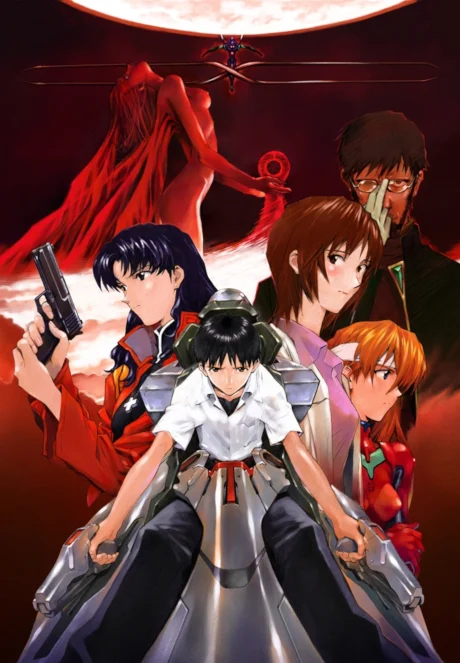
Neon Genesis Evangelion: Death & Rebirth matters as a revealing snapshot of Evangelion in transition. Released as a feature rather than a conventional standalone story, it gathers material from the television series into a compressed, restructured experience and adds new animation. Its two-part design reflects a production moment shaped by audience demand, with the film serving as both a recap and a bridge toward the larger theatrical conclusion. That makes it historically distinctive, even when its form is less self-contained than a typical anime movie.
The experience is dense, psychologically charged, and deliberately uneven in a way that suits Evangelion’s fractured atmosphere. Military spectacle, giant robots, apocalyptic science fiction, adolescent vulnerability, and philosophical unease share the same limited runtime, creating an impressionistic return to the series rather than a fresh beginning. Viewers already familiar with the television anime may appreciate its reorganization and added material most, while newcomers should approach it as an unusual introduction rather than a complete entry point. It can still appeal to audiences who enjoy challenging mecha drama, tragic coming-of-age stories, and ambitious films that prioritize mood and thematic pressure over straightforward accessibility. Its English dub and Netflix availability also make this demanding work relatively easy to sample.
Synopsis
Neon Genesis Evangelion: Death & Rebirth is a two-part animated film centered on Shinji Ikari, a fourteen-year-old boy who arrives in the fortified city of Toyko-3 to meet his estranged father. His arrival coincides with an assault by monstrous beings known as Angels, turning a difficult family reunion into a crisis with consequences for the city and its inhabitants. Shinji is drawn into the Evangelion program and unexpectedly synchronizes with Evangelion Unit 01, a giant machine that he is ordered to pilot permanently.
The film’s first section, Evangelion: Death, retells and reshapes material from the earlier Neon Genesis Evangelion television series, following Shinji and the other young pilots as they confront the Angel threat and the emotional strain of military service. Their battles are inseparable from questions of identity, isolation, parental approval, and the purpose of the Evangelions themselves. Behind the defensive operation, powerful institutions pursue their own plans, creating a wider conflict involving secrecy, conspiracy, and the fate of a world still marked by the catastrophic Second Impact. Rebirth forms the second part of this movie project, carrying the story toward material beyond the recap while preserving its focus on the pilots’ precarious struggle against both external enemies and forces within their own organization.
Trailer
Should You Watch It?
Watch it if you enjoy
- Watch after the original television series for a compressed recap with restructured material and additional animation.
- Choose it if you enjoy psychologically charged mecha drama, apocalyptic science fiction, and transitional theatrical entries.
It may not suit you if
- It may not suit viewers seeking a fully self-contained movie, since much of Death revisits the television series.
- Its dense, fragmented presentation may be challenging without familiarity with the characters, conspiracies, and prior events.
The primary starting work is a movie, so the full film is the natural Volluble Test Drive. This gives you the complete story instead of applying an episodic trial to a feature-length work.
Why It Connects With Audiences
Why people love it
- Viewers may value its reorganization of Evangelion’s early story and its glimpse of the feature-film project’s transition.
- The combination of military spectacle, adolescent vulnerability, tragedy, and philosophical unease gives the recap a distinctive atmosphere.
Common criticisms
- The compilation structure can feel uneven or compressed compared with watching the television episodes in full.
- Rebirth functions as an interim bridge rather than a complete conclusion, which may limit its satisfaction as a standalone film.
Volluble DNA
A quick profile of the title’s dominant storytelling ingredients.
Characters and Voice Actors20 characters
Rei Ayanami
Main character- Japanese: Megumi Hayashibara
- English: Amanda Winn Lee
- English: Ryan Bartley
Shinji Ikari
Main character- English: Spike Spencer
- Japanese: Megumi Ogata
- English: Casey Mongillo
Asuka Langley Souryuu
Main character- English: Tiffany Grant
- Japanese: Yuuko Miyamura
- English: Stephanie McKeon
Misato Katsuragi
Main character- Japanese: Kotono Mitsuishi
- English: Allison Keith-Shipp
- English: Carolyn Keranen
Kensuke Aida
Supporting character- Japanese: Tetsuya Iwanaga
- English: Benjamin Isaac Diskin
- English: Kurt Stoll
Ritsuko Akagi
Supporting character- Japanese: Yuriko Yamaguchi
- English: Sue Ulu
- English: Erica Lindbeck
Shigeru Aoba
Supporting character- Japanese: Takehito Koyasu
- English: Jason C. Lee
- English: Billy Kametz
Kohzou Fuyutsuki
Supporting character- Japanese: Motomu Kiyokawa
- English: Guil Lunde
- English: JP Karliak
Hikari Horaki
Supporting character- Japanese: Junko Iwao
- English: Kimberly Yates
- English: Abby Trott
Makoto Hyuuga
Supporting character- Japanese: Hiro Yuuki
- English: Keith Burgess
- English: Daniel MK Cohen
Maya Ibuki
Supporting character- Japanese: Miki Nagasawa
- English: Christine Cabanos
- English: Amy Seeley
Gendou Ikari
Supporting character- Japanese: Fumihiko Tachiki
- English: Tristan Macavery
- English: Ray Chase
Yui Ikari
Supporting character- Japanese: Megumi Hayashibara
- English: Amanda Winn Lee
Ryouji Kaji
Supporting character- Japanese: Kouichi Yamadera
- English: Aaron Krohn
- English: Greg Chun
Kaworu Nagisa
Supporting character- Japanese: Akira Ishida
- English: Aaron Krohn
- English: Clifford Chapin
Touji Suzuhara
Supporting character- Japanese: Tomokazu Seki
- English: Johnny Yong Bosch
- English: Brett Weaver
Pen Pen
Supporting character- English: Amanda Winn Lee
- English: Cherami Leigh
Keel Lorentz
Supporting character- Japanese: Mugihito
- English: D.C. Douglas
- English: Tom Booker
Naoko Akagi
Supporting character- Japanese: Mika Doi
- English: Laura Chapman
Kyouko Zeppelin Souryuu
Supporting character- Japanese: Maria Kawamura
Production and Staff27 credits
View all 15 additional credits
Production Background
Neon Genesis Evangelion: Death & Rebirth is a 1997 Japanese animated feature and the first installment of the Neon Genesis Evangelion feature-film project. It was produced as an original anime work rather than an adaptation of manga material, and its structure is divided into two sections, Evangelion: Death and Evangelion: Rebirth. With a listed runtime of 104 minutes, the film expands the television property into a theatrical release while remaining closely tied to the events and presentation of the series.
The Death section is primarily a recap assembled from scenes in the first 24 episodes of Neon Genesis Evangelion, reorganized into a compilation format and supplemented with additional animation created after the original broadcast. The film emerged following the television series' success and strong audience demand for an alternate ending. Its release was also shaped by the troubled production of End of Evangelion: when that film's progress caused a delay shortly before its planned release, Death & Rebirth was announced as an interim feature intended to keep fans engaged. The project was later re-edited and re-released in several forms, making this 1997 movie a distinct early theatrical presentation rather than a replacement for the television series or a separate manga adaptation.
Franchise Context
Neon Genesis Evangelion: Death & Rebirth is a 1997 anime movie set within the Neon Genesis Evangelion franchise. It is not the beginning of a separate continuity or a remake of the television series. Instead, it is the first installment of the franchise’s feature film project, created in response to the series’ success and strong audience interest in an alternate ending.
The movie is structured in two parts. “Death” revisits and rearranges material from the first 24 episodes of Neon Genesis Evangelion, adding some animation produced after the original broadcast. This makes the entry primarily a recap and re-presentation of the television story rather than a wholly new continuation. “Rebirth” forms the second part of the project and was connected to the delayed production of End of Evangelion, serving as an interim theatrical release while that film was not yet ready. The movie therefore occupies a transitional position in the franchise: it summarizes the preceding series while introducing the feature-film project that would address its requested alternate conclusion.
Where This Fits in Neon Genesis Evangelion
A spoiler-light guide to where this exact work fits within the broader Neon Genesis Evangelion franchise.
-
Step 1
Begin with the original Neon Genesis Evangelion television series, which this film revisits through its first 24 episodes.
-
Step 2
Watch Neon Genesis Evangelion: Death & Rebirth afterward as an optional recap and feature-film transition, with some additional animation.
-
Step 3
Continue to End of Evangelion to follow the broader feature-film project and its alternate-ending context.
Franchise Path
- Watch Neon Genesis Evangelion first; this movie recaps and restructures its early story.
- Continue with End of Evangelion for the broader feature-film project and alternate-ending context.
After You Finish
Continue with
- Continue with End of Evangelion, which follows this film project’s transition toward its alternate conclusion.
Community Verdict
Quick reader and viewer signals from the Volluble community.
Would you recommend this?
Did the ending satisfy you?
Would you watch it again?
Report an issue
Spot something wrong on this page? Tell us what needs attention.
0 Comments
Be the first to comment.