
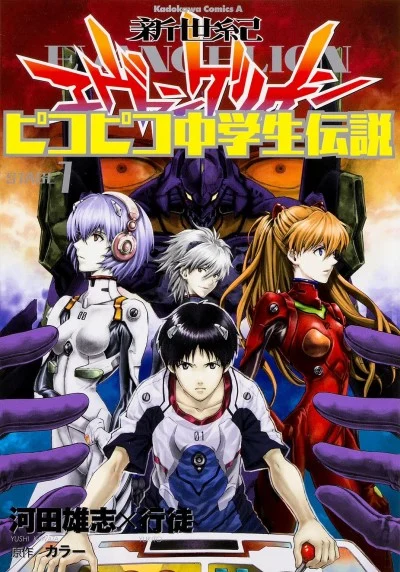
Overview
Neon Genesis Evangelion: Legend of the Piko Piko Middle School Students matters because it turns a famously serious science-fiction framework into a playground for comedy. Rather than treating Evangelion’s familiar character lineup as untouchable, this finished manga uses Shinji, Rei, Asuka, and Kaworu in a deliberately lighter setting, where video games and school-life energy take priority over solemn drama. Its appeal lies in that contrast: recognizable science-fiction stakes are present, but the tone invites mischief instead of contemplation.
The manga offers a breezy parody experience built around gaming references, comic character dynamics, and the pleasure of seeing established ideas rearranged into something knowingly silly. Its five-volume, 70-chapter format gives the premise room to function as an ongoing joke rather than a single extended gag, while its comedy and slice-of-life classification make it less demanding than a darker Evangelion entry. Readers who already enjoy Evangelion may appreciate the playful reshuffling of its cast and conventions. It can also suit manga readers who are curious about the franchise but prefer approachable comedy, school settings, and science-fiction parody to a more intense or dramatically heavy starting point. Familiarity with the broader property will sharpen the references, but the straightforward comic premise makes this individual manga easy to understand on its own terms.
Synopsis
Mysterious invaders are threatening Earth, and an emergency plan is put into motion: recruit a group of elite middle school students and have them play video games designed to train them for the real battle ahead. The chosen students are Shinji Ikari, Rei Ayanami, Asuka Langley Soryu, and Kaworu Nagisa, a familiar group placed in an unusually casual and game-focused setting. Rather than immediately becoming the dependable defenders that the situation demands, the students are far more interested in playing than in getting into the robot.
Neon Genesis Evangelion: Legend of the Piko Piko Middle School Students reworks the familiar science-fiction setup as a comedy manga built around video game parodies and everyday student behavior. Its central conflict comes from the gap between the seriousness of the invasion and the team’s reluctance, distraction, or apparent inability to treat their training as a matter of life and death. The result is a lighthearted spin on an invasion-and-defense premise, with Shinji, Rei, Asuka, and Kaworu at the center of escalating efforts to prepare them for the fight. Across its finished five-volume story, the manga emphasizes comic misunderstandings, game-related situations, and the contrast between elite expectations and the students’ priorities without turning the looming threat into a conventional dramatic war narrative.
Should You Read It?
Read it if you enjoy
- Read it if you want a finished five-volume Evangelion parody centered on video-game humor and school-life antics.
- It may work best after encountering a core Evangelion premise, since the manga playfully rearranges familiar characters and situations.
It may not suit you if
- It may not suit readers seeking a mainline continuation, serious Evangelion drama, or a faithful retelling of the central storyline.
- The comedy depends on the contrast between an invasion threat and students more interested in playing games than preparing for battle.
This automatic starting point balances the series length, pacing, time commitment, and available Volluble research data. Editors can override it when firsthand knowledge suggests a better entry point.
Why It Connects With Audiences
Why people love it
- Readers may enjoy seeing Shinji, Rei, Asuka, and Kaworu redirected into a deliberately casual middle-school setting.
- Its 70 chapters give recurring game parodies, comic misunderstandings, and character dynamics room to develop across a complete story.
Common criticisms
- The lighter parody approach may feel too distant from Evangelion’s more solemn science-fiction presentation for some readers.
- Readers unfamiliar with the franchise’s cast and battle setup may have less context for the rearranged jokes and references.
Volluble DNA
A quick profile of the title’s dominant storytelling ingredients.
Characters22 characters
Rei Ayanami
Main characterShinji Ikari
Main characterAsuka Langley Souryuu
Main characterKensuke Aida
Supporting characterRitsuko Akagi
Supporting characterHikari Horaki
Supporting characterMaya Ibuki
Supporting characterShigeru Aoba
Supporting characterGendou Ikari
Supporting characterKohzou Fuyutsuki
Supporting characterMisato Katsuragi
Supporting characterKaworu Nagisa
Supporting characterMakoto Hyuuga
Supporting characterTouji Suzuhara
Supporting characterYui Ikari
Supporting characterRyouji Kaji
Supporting characterPen Pen
Supporting characterShiro Tokita
Supporting characterKeel Lorentz
Supporting characterNaoko Akagi
Supporting characterKyouko Zeppelin Souryuu
Supporting characterNarrator
Supporting characterManga Staff2 credits
Production Background
Neon Genesis Evangelion: Legend of the Piko Piko Middle School Students is a Japanese manga rather than an anime production, remake, or film. The supplied record does not identify the individual writer or artist, so no creator credit can be confirmed for this specific work. It is classified as a comedy, science-fiction, and slice-of-life manga, with parody central to its production concept. Its premise places familiar Evangelion characters in a middle-school setting where video games are tied to preparation for a larger conflict, establishing a deliberately playful approach to the source franchise rather than reproducing its main dramatic presentation.
The manga began publication on April 4, 2014, and concluded on August 4, 2018. It was completed at 70 chapters collected in five volumes. The record identifies its source material as “Other,” distinguishing it from a direct listing as an anime adaptation or a manga version of another recorded work. Dark Horse Comics lists an English-language trade paperback edition of Volume 1, providing an official publication page and presenting the title as a standalone manga volume. The publisher’s description also highlights the work’s video-game parody angle and its use of the established Evangelion cast. The title is available through Kadocomi in the supplied catalog, but no further serialization, editorial, or production-staff details are provided.
Franchise Context
Neon Genesis Evangelion: Legend of the Piko Piko Middle School Students is an alternate manga entry in the broader Neon Genesis Evangelion franchise. It is not a continuation of the main Evangelion storyline or a retelling presented as the franchise’s core manga. Instead, this finished series uses the setting and familiar characters in a separate comedic interpretation built around school life, science fiction, and parody.
Published from 2014 to 2018, the manga collects 70 chapters in five volumes. Shinji, Rei, Asuka, and Kaworu remain central figures, but their roles are redirected toward video games that are connected to an anticipated battle, allowing the series to play with the franchise’s recognizable battle premise rather than simply reproduce it. Its frequent video-game humor and deliberately familiar setup place it among Evangelion’s reimaginings and spin-off-style works, offering a lighter counterpart to the franchise’s better-known anime and manga narratives.
Where This Fits in Neon Genesis Evangelion
A spoiler-light guide to where this exact work fits within the broader Neon Genesis Evangelion franchise.
-
Step 1
If you are new to Evangelion, begin with a core version of its premise, centered on NERV, teenage pilots, Evangelions, and the Angels.
-
Step 2
Read this five-volume manga afterward as an optional parody spin-off. It reuses familiar characters and setup while shifting them into a video-game comedy, so it is not presented as a required continuation.
-
Step 3
Once finished, return to the franchise's mainline or reimagined works in their own reading or viewing order. No direct follow-up is identified for this manga.
Franchise Path
- Begin with Neon Genesis Evangelion, the core anime framework; read this finished manga afterward as an optional parody spin-off.
- This entry reworks Shinji, Rei, Asuka, and Kaworu into a video-game-focused middle-school comedy.
After You Finish
Continue with
- No direct follow-up is identified; this five-volume manga is complete and stands alone as a parody spin-off.
Community Verdict
Quick reader and viewer signals from the Volluble community.
Would you recommend this?
Did the ending satisfy you?
Would you read it again?
Report an issue
Spot something wrong on this page? Tell us what needs attention.
0 Comments
Be the first to comment.