
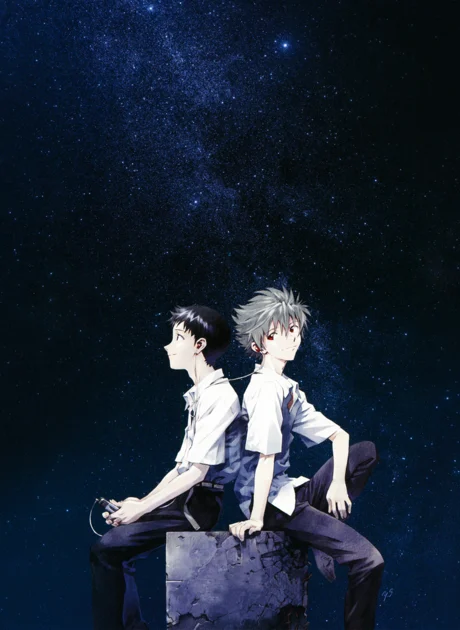
Overview
Evangelion: 3.0 You Can (Not) Redo matters as a deliberately destabilizing science-fiction film. Rather than treating its giant-robot spectacle as a straightforward escalation, it places psychological uncertainty, fractured loyalties, and the consequences of catastrophe at the center of the experience. As the third movie in the Rebuild of Evangelion sequence, it functions as a sharp turning point, reshaping expectations about what a familiar world and its conflicts are supposed to mean.
At 96 minutes, this is a concentrated, visually forceful watch built from post-apocalyptic imagery, military tension, philosophical unease, and tragic character drama. Its battles have weight, but the movie is often more interested in disorientation and emotional isolation than in clean victories or easy explanations. The result can feel severe and deliberately opaque, especially for viewers seeking a conventional mecha adventure. It may be approachable for audiences who enjoy ambitious anime films, psychological science fiction, alternate-world storytelling, and narratives willing to leave room for interpretation. Viewers new to this particular series may find its impact stronger after experiencing the earlier Rebuild films, while those drawn to challenging, emotionally unsettled animation will find this individual movie distinctive on its own terms.
Synopsis
Fourteen years after the Third Impact, Shinji Ikari awakens aboard a world he no longer recognizes. He has not aged, yet Earth has been devastated, NERV has been dismantled, and many of the people he once tried to protect now regard him as an enemy. The familiar institutions and relationships surrounding him have been reshaped by catastrophe, leaving Shinji isolated and uncertain about what happened during the years he cannot remember.
Asuka Langley Shikinami and Mari Illustrious Makinami continue to fight as Evangelion pilots, retrieving a crucial container from orbit while the struggle over humanity's future intensifies. Shinji is drawn into the conflict again and forms an important friendship with the enigmatic Nagisa Kaworu. Together, they face the continuing threat of the Angels, but the danger is no longer limited to battles against inhuman enemies. Former allies stand on opposing sides, and Shinji must navigate competing demands, buried consequences, and the possibility that his actions could push a damaged world closer to its end.
Blending mecha action with psychological drama and science fiction, the film follows Shinji's attempt to understand this altered reality and find a place within it. Its post-apocalyptic setting frames a conflict shaped as much by mistrust, grief, and fractured loyalties as by the Evangelions' battles.
Trailer
Should You Watch It?
Watch it if you enjoy
- Watch after the first two Rebuild of Evangelion films, as this is a continuation rather than a standalone starting point.
- Choose it if you enjoy visually forceful mecha films centered on psychological uncertainty, philosophical unease, and alternate-world storytelling.
It may not suit you if
- It may not suit viewers seeking a straightforward mecha adventure with clear explanations and clean victories.
- The post-apocalyptic setting, tragic drama, gore, and fractured loyalties can feel severe or emotionally isolating.
The primary starting work is a movie, so the full film is the natural Volluble Test Drive. This gives you the complete story instead of applying an episodic trial to a feature-length work.
Why It Connects With Audiences
Why people love it
- The film gives its 96-minute runtime concentrated momentum through military tension, giant-robot action, and striking post-apocalyptic imagery.
- Its altered world and focus on Shinji’s uncertainty create room for interpretation while reshaping expectations about familiar conflicts.
Common criticisms
- Its deliberate opacity and time-skip setting may make the story difficult to follow, especially without the earlier Rebuild films.
- Viewers may find the emphasis on disorientation, buried consequences, and emotional isolation less satisfying than a conventional continuation.
Volluble DNA
A quick profile of the title’s dominant storytelling ingredients.
Characters and Voice Actors21 characters
Shinji Ikari
Main character- Japanese: Megumi Ogata
- English: Spike Spencer
Kaworu Nagisa
Main character- Japanese: Akira Ishida
- English: Jerry Jewell
- English: Daman Mills
Rei Ayanami
Supporting character- English: Brina Palencia
- English: Amanda Winn Lee
- Japanese: Megumi Hayashibara
Sakura Nagashi
characterAsuka Langley Souryuu
Supporting character- Japanese: Yuuko Miyamura
- English: Tiffany Grant
Misato Katsuragi
Supporting character- Japanese: Kotono Mitsuishi
- English: Allison Keith-Shipp
Beautiful World
characterRitsuko Akagi
Supporting character- Japanese: Yuriko Yamaguchi
- English: Mary Faber
- English: Colleen Clinkenbeard
Gendou Ikari
Supporting character- Japanese: Fumihiko Tachiki
- English: John Swasey
Shigeru Aoba
Supporting character- English: Phil Parsons
- Japanese: Takehito Koyasu
- English: Jason C. Lee
Kohzou Fuyutsuki
Supporting character- English: Kent Williams
- Japanese: Motomu Kiyokawa
- English: Michael Ross
Makoto Hyuuga
Supporting character- English: Mike McFarland
- Japanese: Hiro Yuuki
- English: Joe Fria
Maya Ibuki
Supporting character- Japanese: Miki Nagasawa
- English: Caitlin Glass
- English: Amy Seeley
Mari Makinami Illustrious
Supporting character- English: Trina Nishimura
- English: Deneen Melody
- Japanese: Maaya Sakamoto
Keel Lorentz
Supporting character- Japanese: Mugihito
- English: Bill Jenkins
- English: Tom Booker
Sakura Suzuhara
Supporting character- Japanese: Miyuki Sawashiro
- English: Felecia Angelle
Sumire Nagara
Supporting character- Japanese: Sayaka Oohara
- English: Krishna Smitha
Hideki Tama
Supporting character- Japanese: Anri Katsu
- English: Aaron Roberts
Kouji Takao
Supporting character- Japanese: Akio Ootsuka
- English: Greg Dulcie
Midori Kitakami
Supporting character- Japanese: Mariya Ise
- English: Tia Ballard
- English: Bijou Vann
Yui Ikari
Background characterProduction and Staff26 credits
View all 14 additional credits
Production Background
Evangelion: 3.0 You Can (Not) Redo is a Japanese animated science fiction action film written and chief directed by Hideaki Anno. It was produced by Anno’s Studio Khara as a reworking of the original Neon Genesis Evangelion anime, and serves as the third film in the four-part Rebuild of Evangelion series. The production places this movie within the broader Evangelion setting while presenting it as a distinct theatrical feature rather than a television episode or manga installment.
The film first reached Japanese theaters on November 17, 2012, under the title Evangelion: 3.0 You Can (Not) Redo, or 3.0 in its version labeling. It later received a home-video edition titled 3.33 on April 24, 2013, with minor visual changes. A further version, 3.333, was released theatrically in IMAX on January 8, 2021. These revised editions preserve the same work while reflecting subsequent visual updates. The movie was followed by Evangelion: 3.0+1.0 Thrice Upon a Time in 2021, completing the Rebuild series after this film’s release.
Franchise Context
Evangelion: 3.0 You Can (Not) Redo is the third anime film in the Rebuild of Evangelion sequence, following the earlier entries in that film series rather than beginning a separate story. It is a 2012 animated feature with a single-film format, and its position makes it a continuation within the Rebuild narrative. The entry is not a manga adaptation or an independent side story, although its installment record uses a side-story relationship label.
Rebuild of Evangelion revisits material associated with the original Neon Genesis Evangelion anime in an alternate continuity, so this film is best understood as a reworked version of that broader premise rather than a direct continuation of the original television series. Its story advances the post-cataclysm setting and the ongoing conflicts surrounding the Evangelion pilots. The film was later followed by Evangelion: 3.0+1.0 Thrice Upon a Time, which completes the larger sequence. The title also exists in revised releases labeled 3.33 and 3.333, representing updated versions of this same movie rather than separate works.
Where This Fits in Neon Genesis Evangelion
A spoiler-light guide to where this exact work fits within the broader Neon Genesis Evangelion franchise.
-
Step 1
For the Rebuild continuity, begin with its first two films before reaching this third installment.
-
Step 2
Watch Evangelion: 3.0 You Can (Not) Redo after those earlier Rebuild films. It is a continuation of that movie sequence, not a standalone starting point.
-
Step 3
Choose one release version: 3.0 is the original theatrical cut, while 3.33 and 3.333 are later re-releases with visual changes rather than separate story entries.
-
Step 4
Continue with Evangelion: 3.0+1.0 Thrice Upon a Time, the fourth film that follows this one.
Franchise Path
- Rebuild of Evangelion film sequence: watch the first two films before this third installment, then continue to the fourth film.
After You Finish
Continue with
- Continue with Evangelion: 3.0+1.0 Thrice Upon a Time, the concluding fourth Rebuild film.
Community Verdict
Quick reader and viewer signals from the Volluble community.
Would you recommend this?
Did the ending satisfy you?
Would you watch it again?
Report an issue
Spot something wrong on this page? Tell us what needs attention.
0 Comments
Be the first to comment.