
Overview
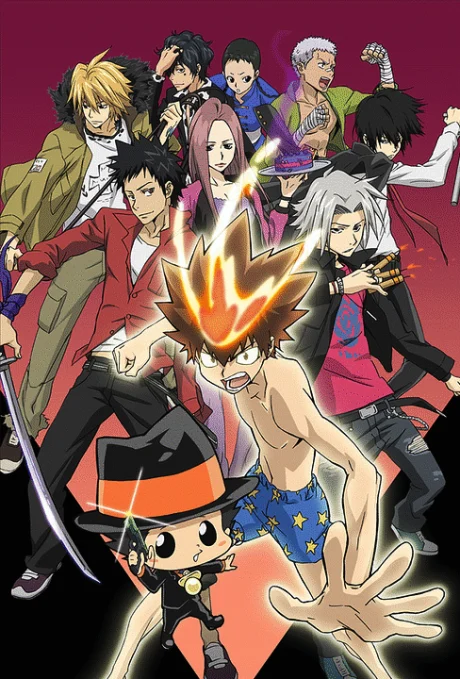
REBORN! matters because it takes a premise that sounds like a punchline, a gun-toting infant hitman sent to tutor a hapless middle schooler, and grows it into a long-running shonen action saga. What starts as a comedy of school life and small humiliations gradually widens into mafia politics, rival families, and ensemble battles, and the series earns that expansion by tying it to the slow maturing of its protagonist rather than to escalation alone. Across its lengthy run it becomes a useful study in how a comedic premise can be rebuilt into something weightier without discarding its sense of humor.
The experience is deliberately uneven in a rewarding way. Early episodes lean on slice of life comedy, classroom gags, and the absurd discipline of its tiny tutor, then the story shifts toward action, large casts of allies and rivals, and a coming of age arc that carries real stakes. Viewers who enjoy watching a timid lead slowly become someone worth following will find the length of the journey justified, while the comedic stretches keep the heavier mafia plotting from turning grim.
It is approachable for newcomers who like shonen ensemble stories and do not mind a slow build before the action arrives. The early comedy makes the premise gentle to enter, the finished run means no waiting for conclusion, and the series is available across several streaming services, so catching up is straightforward for anyone curious about a genre staple.
Synopsis
Tsunayoshi Sawada is a middle school student with little going for him: his grades are poor, his classmates overlook him, and the girl he admires barely knows he exists. His routine collapses when a small figure in a suit and fedora appears in his home and announces himself as Reborn, a professional hitman. Reborn has been dispatched by the Vongola, a powerful mafia family, to serve as Tsuna's tutor and prepare him for a role he never asked to inherit. The training begins immediately, and most of it involves surviving Reborn's unconventional lessons.
Tsuna quickly learns that his new status draws attention. He acquires a circle of allies, including hot-headed classmates and a variety of oddballs who attach themselves to him, while rival families and ambitious outsiders test whether he is worth following. Much of the early story balances school comedy with escalating violence as Tsuna's hesitant personality clashes with the expectations placed on a future boss.
Across its run the series moves between everyday school life and open confrontation, with Tsuna's slow growth as a leader and his loyalty to the people around him driving the arc. Reborn remains both mentor and menace, pushing his student toward a future that Tsuna spends much of the story trying to avoid.
Watch Episode 1
Should You Watch It?
Watch it if you enjoy
- Try REBORN! if you enjoy shonen action that grows out of a comedic school-life premise and a slow-burn coming-of-age lead.
- The 2006 anime is the main animated starting point, running 203 episodes across comedy, mafia politics, and ensemble battles.
- For a source-first route, Akira Amano's manga began in 2004 and is the originating version of the same core story.
It may not suit you if
- The early stretch leans on slice-of-life comedy and classroom gags before heavier mafia plotting and action take over, so it may require patience.
- Its 203-episode run adapts material from an ongoing manga and does not represent the complete franchise story.
- The premise mixes a gun-toting infant tutor, school life, and escalating violence, which may feel tonally uneven to some viewers.
This automatic starting point balances the series length, pacing, time commitment, and available Volluble research data. Editors can override it when firsthand knowledge suggests a better entry point.
Why It Connects With Audiences
Why people love it
- It turns an absurd premise—a hitman infant tutoring a hapless student—into a long-running shonen saga with genuine emotional stakes.
- Tsuna's gradual growth from timid middle schooler to reluctant leader gives the lengthy journey a clear coming-of-age throughline.
- The expanding ensemble of allies and rivals supports varied battles, mafia-family politics, and comedic interactions.
Common criticisms
- A frequent point of discussion is how long the series takes to shift from comedy into the action-heavy mafia conflicts many associate with it.
- Because the anime aired while the manga was still ongoing, it ends before adapting the full source material.
- Tonal shifts between classroom humor and violent confrontations can make the experience feel uneven for some viewers.
Volluble DNA
A quick profile of the title’s dominant storytelling ingredients.
Characters and Voice Actors25 characters
Tsunayoshi Sawada
Main character- Japanese: Yukari Kokubun
Reborn
Main character- Japanese: Ken Narita
- Japanese: Neeko
Hayato Gokudera
Main character- Japanese: Hidekazu Ichinose
- Japanese: Asako Yoshida
Takeshi Yamamoto
Main character- Japanese: Suguru Inoue
Mukuro Rokudo
Main character- Japanese: Toshinobu Iida
Kyouya Hibari
Main character- Japanese: Takashi Kondou
Lambo
Main character- Japanese: Junko Takeuchi
- Japanese: Kenjirou Tsuda
Ryouhei Sasagawa
Main character- Japanese: Hidenobu Kiuchi
Chrome Dokuro
Main character- Japanese: Satomi Akesaka
Fuuta de la Stella
Supporting character- Japanese: Yuuko Sanpei
Dino Cavallone
Supporting character- Japanese: Kenta Kamakari
- Japanese: KENN
Haru Miura
Supporting character- Japanese: Hitomi Yoshida
Dr. Shamal
Supporting character- Japanese: Katsuya
Kyouko Sasagawa
Supporting character- Japanese: Yuuna Inamura
Bianchi
Supporting character- Japanese: Rie Tanaka
I-Pin
Supporting character- Japanese: Li Mei Chan
Nana Sawada
Supporting character- Japanese: Rica Fukami
Ken Joshima
Supporting character- Japanese: Ryou Naitou
Chikusa Kakimoto
Supporting character- Japanese: Toshiyuki Toyonaga
Lancia
Supporting character- Japanese: Takeshi Maeda
Basil
Supporting character- Japanese: Yuka Terasaki
Belphegor
Supporting character- Japanese: Yuuki Fujiwara
Xanxus
Supporting character- Japanese: Masanori Ikeda
Levi A Than
Supporting character- Japanese: Yuuto Nakano
Colonnello
Supporting character- Japanese: Daisuke Nakamura
Production and Staff26 credits
View all 14 additional credits
Production Background
REBORN! originated as a manga written and illustrated by Akira Amano, serialized in Shueisha's Weekly Shonen Jump beginning in May 2004. The series remained in the magazine until November 2012, and its chapters were collected into 42 tankobon volumes. Amano built the story around Tsunayoshi Sawada, an ordinary middle school student who learns he is heir to the Vongola mafia family and is placed under the tutelage of the infant hitman Reborn. The premise blends action, comedy, school life, and supernatural elements, and the manga became a long running fixture of Weekly Shonen Jump across its eight year serialization.
An anime television adaptation was produced by Artland and broadcast on TV Tokyo, premiering in October 2006 and finishing in September 2010. It ran for 203 episodes with a runtime of roughly 24 minutes each, making it a substantial weekly series that carried a large portion of Amano's ongoing manga to the screen. The adaptation debuted about two years after the manga launched and aired for four years, covering story material that includes the series' time skip developments and its growing ensemble cast. The anime finished in 2010, while the source manga continued for another two years.
The property also generated video games, light novels, and other merchandise alongside the manga and anime, though those items sit outside the scope of this page. The anime remains available through several streaming outlets, including Crunchyroll, Hulu, Tubi TV, Bilibili TV, and YouTube, which helps keep the 2006 series accessible to viewers long after its original broadcast run concluded.
Franchise Context
This entry is the main anime television adaptation at the center of the Reborn! franchise. It adapts Akira Amano's manga, which began serialization in Shueisha's Weekly Shonen Jump in 2004, and it serves as the primary animated telling of that story rather than a spin-off, reboot, or alternate retelling. Viewers who come to the franchise through animation begin here.
Because the anime launched in 2006, while the source manga was still ongoing, it functions as a continuing adaptation rather than a self-contained side story. Its 203-episode run, broadcast from October 2006 to September 2010, follows the manga's central arc structure, and the printed series kept going for two more years afterward, so this entry does not represent the whole franchise. The manga remains the originating work.
The franchise also extends into video games, light novels, and other merchandise built around the same characters and premise. This page covers only the television anime, the franchise's best-known screen version and its main animated pillar, distinct from the manga that spawned it and from the various tie-in products.
Where This Fits in Katekyo Hitman Reborn!
A spoiler-light guide to where this exact work fits within the broader Katekyo Hitman Reborn! franchise.
Exact position: This is Season 1 and the first main anime entry in the current 1-part Volluble path.
-
Step 1
Begin with REBORN! through its 2006 anime TV adaptation, the main animated entry and a practical starting point for the story.
-
Step 2
If you prefer the source-first route, start the manga from volume 1; it is the original serialized version of the same core story.
-
Step 3
Choose either the anime or the manga as your main path rather than alternating, since they present the same material in different formats.
-
Step 4
After finishing one version, the other works best as an alternate-format revisit, not a required next chapter; no separate prequel or sequel is supplied here.
Franchise Path
- REBORN! (current)
After You Finish
Continue with
This is currently the latest main anime entry in Volluble's saved franchise path.
Community Verdict
Quick reader and viewer signals from the Volluble community.
Would you recommend this?
Did the ending satisfy you?
Would you watch it again?
Try Something Similar
Sources2 sources
Report an issue
Spot something wrong on this page? Tell us what needs attention.
0 Comments
Be the first to comment.