
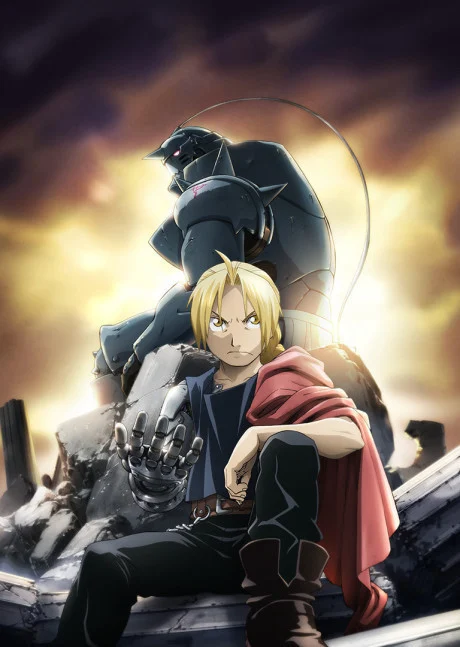
Overview
Fullmetal Alchemist: Brotherhood matters because it brings unusual discipline to a large-scale fantasy adventure. As a 64-episode television adaptation of Hiromu Arakawa’s manga, it gives its world room to develop while maintaining a clear sense of direction. Alchemy is more than a visual gimmick here: it supports questions about responsibility, sacrifice, power, faith, and the human cost of war. Military politics and conspiracy add weight to the action, while the series continues to make space for humor, travel, and the bonds among a broad ensemble.
The experience is energetic without being shallow. Battles, automail, guns, swords, and steampunk machinery provide immediate momentum, but the strongest appeal comes from how personal stakes connect to larger political and philosophical conflicts. Tragedy and gore can make its serious turns intense, yet the storytelling remains approachable through strong character contrasts, recurring comic relief, and a steadily advancing mystery. Viewers looking for a complete fantasy series with emotional range, substantial world-building, and a satisfying long-form structure may find it especially welcoming. Its English dub and familiar action-adventure framework also make it an accessible starting point for people who want a major anime experience without committing to an unfinished story. It should be treated as its own adaptation, distinct from the earlier 2003 Fullmetal Alchemist television series.
Synopsis
Edward and Alphonse Elric are brothers who turn to alchemy in an attempt to perform the forbidden act of human transmutation. Their experiment exacts a terrible cost: Edward loses a leg, Alphonse loses his physical body, and Edward sacrifices an arm to bind Alphonse’s soul to a suit of armor. With Edward fitted with mechanical automail limbs, he becomes a State Alchemist known as the Fullmetal Alchemist, hoping that this position will help the brothers find a way to recover what they lost.
Three years later, Edward and Alphonse pursue the Philosopher’s Stone, a legendary object believed to offer the power they need to restore their original bodies. Their search takes them across a militarized country shaped by alchemy, political pressure, religious belief, and the aftermath of war. Along the way, the brothers encounter soldiers, fellow alchemists, criminals, and other formidable figures whose goals do not always align with their own. What begins as a personal quest gradually draws them into a wider conspiracy, forcing Edward and Alphonse to confront the costs of power, the limits of human ambition, and the principles behind alchemy’s law of equivalent exchange.
Trailer
Should You Watch It?
Watch it if you enjoy
- Watch if you want a complete 64-episode fantasy adventure with a clear long-form direction.
- A strong fit for stories pairing personal stakes with alchemy, military politics, conspiracy, and philosophical questions.
It may not suit you if
- May not suit viewers who avoid gore, tragedy, war themes, or emotionally intense consequences.
- Its 64-episode length and broad ensemble may feel demanding if you prefer compact or narrowly focused stories.
This automatic starting point balances the series length, pacing, time commitment, and available Volluble research data. Editors can override it when firsthand knowledge suggests a better entry point.
Why It Connects With Audiences
Why people love it
- The brothers’ search for the Philosopher’s Stone connects intimate loss to larger conflicts over power, faith, and responsibility.
- Alchemy, automail, travel, combat, humor, and political intrigue create a varied world with substantial scope.
- A finished manga-based narrative provides steadily advancing mysteries and a complete central journey.
Common criticisms
- The serious war and tragedy material can make the series emotionally heavy despite recurring comic relief.
- Its large cast and expanding conspiracy may require attention as personal and political storylines converge.
- Viewers seeking consistently light adventure may find the shifts between humor, gore, and bleak consequences uneven.
Volluble DNA
A quick profile of the title’s dominant storytelling ingredients.
Characters and Voice Actors25 characters
Edward Elric
Main character- English: Vic Mignogna
- Japanese: Romi Park
- English: Muriel Hofmann
Alphonse Elric
Main character- Japanese: Rie Kugimiya
- English: Maxey Whitehead
- English: Lily Truncale
Winry Rockbell
Supporting character- Japanese: Megumi Takamoto
- English: Caitlin Glass
Pinako Rockbell
Supporting character- English: Shelley Calene-Black
- Japanese: Mami Koyama
- Japanese: Miyoko Asou
- English: Juli Erickson
Scar
Supporting character- Japanese: Kenta Miyake
- English: J. Michael Tatum
Izumi Curtis
Supporting character- English: Christine Auten
- Japanese: Shouko Tsuda
Roy Mustang
Supporting character- Japanese: Shinichirou Miki
- English: Travis Willingham
- English: Matthew Leonhart
Maes Hughes
Supporting character- Japanese: Keiji Fujiwara
- English: Sonny Strait
Riza Hawkeye
Supporting character- Japanese: Fumiko Orikasa
- English: Colleen Clinkenbeard
Greed
Supporting character- English: Troy Baker
- English: Chris Patton
- Japanese: Yuuichi Nakamura
Lust
Supporting character- English: Laura Bailey
- Japanese: Kikuko Inoue
Envy
Supporting character- Japanese: Minami Takayama
- English: Wendy Powell
Alex Louis Armstrong
Supporting character- Japanese: Kenji Utsumi
- English: Christopher Sabat
Grand Basque
Supporting character- English: R. Bruce Elliott
- Japanese: Shin Aomori
Lan Fan
Supporting character- Japanese: Nana Mizuki
- English: Trina Nishimura
Ling Yao
Supporting character- Japanese: Mamoru Miyano
- English: Todd Haberkorn
Shou Tucker
Supporting character- English: Chuck Huber
- Japanese: Makoto Nagai
Olivier Mira Armstrong
Supporting character- English: Stephanie Young
- Japanese: Youko Soumi
Nina Tucker
Supporting character- English: Brina Palencia
- Japanese: Sumire Morohoshi
Jean Havoc
Supporting character- Japanese: Yuuji Ueda
- English: Mike McFarland
King Bradley
Supporting character- Japanese: Hidekatsu Shibata
- Japanese: Hidenobu Kiuchi
- English: Christopher Bevins
- English: Thomas Blaylock, Jr.
Gluttony
Supporting character- Japanese: Tetsu Shiratori
- English: Chris Cason
Barry the Chopper
Supporting character- English: Jerry Jewell
- Japanese: Hideyuki Umezu
Kain Fuery
Supporting character- Japanese: Tetsuya Kakihara
- English: Kevin M. Connolly
Vato Falman
Supporting character- English: Kyle Hebert
- Japanese: Kenji Hamada
Production and Staff26 credits
View all 14 additional credits
Production Background
Fullmetal Alchemist: Brotherhood is the second animated adaptation of Hiromu Arakawa’s Fullmetal Alchemist manga. The television series was produced by Bones, with Yasuhiro Irie directing, Hiroshi Ōnogi handling the scripts, and Akira Senju composing the music. Production began in 2008, and the project was conceived as a direct, faithful adaptation of the manga’s complete story. This distinguished it from the 2003 anime adaptation, which eventually moved into an original storyline after it had used the manga material then available.
The series began its Japanese television run in April 2009 on MBS, TBS, and their affiliated stations, concluding in July 2010 after 64 episodes. Its official credit identifies the Fullmetal Alchemist Production Committee and MBS, with Aniplex associated with the official website. The finished series later received continued official distribution and promotional support. The official website recorded a 2019 broadcast of the complete series on AbemaTV, while a 2022 notice announced broad digital and subscription availability for music from the series, including its soundtrack and character songs. These later notices reflect the work’s ongoing circulation after its original television broadcast, rather than a new production or a separate adaptation.
Franchise Context
Fullmetal Alchemist: Brotherhood is the second television anime adaptation of Hiromu Arakawa’s Fullmetal Alchemist manga. It is not a sequel to the 2003 Fullmetal Alchemist anime, but a separate adaptation of the same source material, making it an alternate animated version within the franchise. The two anime series share the manga’s central foundation while remaining distinct works.
Unlike the earlier adaptation, which developed an anime-original story after moving beyond the available manga material, Brotherhood was created to follow the manga’s complete narrative. Produced by Bones, it began airing in 2009 and concluded with 64 episodes in 2010. As a finished TV series, it functions as the franchise’s manga-faithful main anime adaptation rather than a spin-off, side story, or continuation of the 2003 series.
Where This Fits in Fullmetal Alchemist
A spoiler-light guide to where this exact work fits within the broader Fullmetal Alchemist franchise.
Exact position: This is Main anime entry 2 and main anime entry 2 of 2. It follows Fullmetal Alchemist.
-
Step 1
Start with Fullmetal Alchemist: Brotherhood. It is a complete 64-episode television adaptation and does not require another franchise entry first.
-
Step 2
Fullmetal Alchemist (2003) is optional, not a prerequisite or direct prequel. It is an alternate anime adaptation that develops its own story.
-
Step 3
The manga is the source material and can be read instead of, or after, Brotherhood for a different version of the same core journey.
-
Step 4
After Brotherhood, there is no necessary follow-up listed here. Treat the 2003 anime and the manga as alternate ways to continue exploring the franchise rather than sequels.
Franchise Path
After You Finish
Continue with
This is currently the latest main anime entry in Volluble's saved franchise path.
Community Verdict
Quick reader and viewer signals from the Volluble community.
Would you recommend this?
Did the ending satisfy you?
Would you watch it again?
Report an issue
Spot something wrong on this page? Tell us what needs attention.
0 Comments
Be the first to comment.