
Overview
Diamond is Unbreakable narrows the scope of a famously expansive saga instead of widening it, trading continental travel for the streets, schools, and back alleys of one coastal town. That change of scale is what gives this arc its distinctive flavor: threats arrive through everyday routines, and the unease or comedy lands because the setting feels ordinary right up until it does not. For readers who prefer supernatural action anchored in a recognizable community, this is the point where the storytelling feels most lived in.
The power system reaches a creative high here. Stands in this arc are often defined by odd, narrow abilities rather than raw strength, which pushes confrontations toward puzzle-solving, bluffing, and improvisation. The result rewards attentive reading, since solutions tend to be seeded well in advance, and the large ensemble of allies and antagonists receives enough space on the page that even minor figures leave an impression. The tone swings between warmth, absurdity, and genuine cruelty, and that range reads as intentional rather than erratic.
Approachability is a mixed but generally favorable question. Newer readers sometimes start here because the central mystery is local and the cast is broad and memorable, though returning characters tie the story to earlier parts and some emotional payoffs assume prior familiarity. Fans of ensemble-driven shounen action, urban fantasy mystery, and inventive tactical fights will find a great deal to enjoy; readers who want a single fixed protagonist or a tightly linear plot should expect a more sprawling, episodic rhythm.
Synopsis
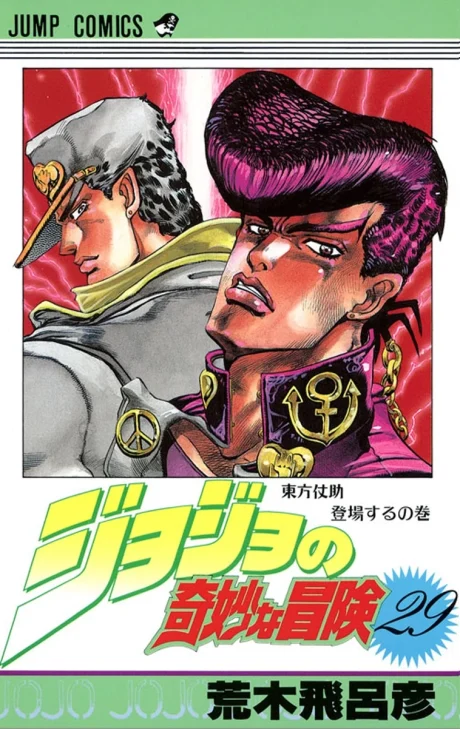
JoJo's Bizarre Adventure Part 4: Diamond is Unbreakable is a manga by Hirohiko Araki, serialized from 1992 to 1995 and collected in eighteen volumes. The story opens in April 1999 in Morioh, a Japanese town far removed from the globe-trotting battles of earlier parts. Jotaro Kujo arrives there searching for Josuke Higashikata, the secret son of Jotaro's grandfather, Joseph Joestar. What begins as a family errand turns strange almost immediately, because Josuke also commands a Stand, the supernatural power that has defined the Joestar bloodline.
With that first meeting behind them, Jotaro and Josuke join forces to look into the town's growing number of unusual Stand users, ordinary neighbors whose abilities range from the menacing to the absurd. The focus widens from one protagonist to an ensemble of local characters, including classmates, rivals, and self-styled investigators drawn into the same mystery. Morioh itself becomes a central presence, a small community where school life, small-town gossip, and a streak of delinquency sit alongside hidden powers.
The primary conflict is investigative and cumulative rather than a single declared war: someone or something is drawing dangerous Stands into Morioh, and the group must identify the source before the town's quiet routines are shattered. Blending action, mystery, and urban fantasy, the part leans on suspense and sudden violence while keeping its humor and its affection for the people of Morioh close to the surface.
Should You Read It?
Read it if you enjoy
- Readers who enjoy supernatural mystery anchored in one small town, where everyday routines turn strange, may find Morioh's school-and-back-alley scale inviting.
- Those who like battles solved by bluffing and improvisation rather than raw strength will appreciate Stands defined by odd, narrow abilities.
- An ensemble-driven arc with classmates, rivals, and self-styled investigators can appeal to readers who want minor figures to leave an impression.
It may not suit you if
- This arc assumes familiarity with the Joestar line and the Stand system, so it may not suit readers seeking a clean entry point.
- Tonal swings between warmth, absurdity, and genuine cruelty can unsettle readers who prefer a steadier register.
- The conflict builds cumulatively through investigation, so those wanting one declared war from the outset may find the opening stretch slow.
This automatic starting point balances the series length, pacing, time commitment, and available Volluble research data. Editors can override it when firsthand knowledge suggests a better entry point.
Why It Connects With Audiences
Why people love it
- The Stand system reaches a creative high, with confrontations that reward attentive reading because solutions tend to be seeded well in advance.
- Morioh works as a central presence, giving the supernatural action a lived-in community that makes the unease land harder.
- Jotaro and Josuke's team-up carries forward an established lineage while handing the lead to a fresh protagonist, balancing continuity and renewal.
Common criticisms
- Some readers may find the narrower, town-bound scope a step down from the globe-trotting spectacle of the preceding arc.
- The tonal mixture of comedy and cruelty can read as erratic to those expecting a single consistent mood.
- Because it is the fourth arc of a long saga, newcomers may feel the weight of assumed backstory before the Morioh mystery takes hold.
Volluble DNA
A quick profile of the title’s dominant storytelling ingredients.
Characters29 characters
Jousuke Higashikata
Main characterYoshikage Kira
Main characterJoutarou Kuujou
Main characterRohan Kishibe
Main character
Shikei Shikkouchuu Datsugoku Shinkouchuu
characterKouichi Hirose
Main character
JORGE JOESTAR
characterOkuyasu Nijimura
Main characterDead Man’s Q
characterJoseph Joestar
Supporting characterMikitaka Hasekura
Supporting characterMarou Shinshi BT
characterShigekiyo Yanguu
Supporting characterAkira Otoishi
Supporting characterYukako Yamagishi
Supporting characterKeichou Nijimura
Supporting characterReimi Sugimoto
Supporting characterTomoko Higashikata
Supporting characterTerunosuke Miyamoto
Supporting characterYoshihiro Kira
Supporting characterAya Tsuji
Supporting characterAnjuurou Katagiri
Supporting characterYuuya Fungami
Supporting characterHayato Kawajiri
Supporting characterMasazou Kinoto
Supporting characterTamami Kobayashi
Supporting characterToshikazu Hazamada
Supporting characterToyohiro Kanedaichi
Supporting characterTonio Trussardi
Supporting characterManga Staff12 credits
View all 11 additional credits
Production Background
JoJo's Bizarre Adventure Part 4: Diamond is Unbreakable is the fourth story arc of Hirohiko Araki's long-running manga, written and illustrated by Araki and published by Shueisha. The part was serialized from April 14, 1992 to November 21, 1995, and its chapters were collected into 18 volumes spanning 174 chapters. It is an original work rather than an adaptation of another source, and it reached completion as a finished serial.
This part appeared during the manga's original run in Shueisha's Weekly Shonen Jump, the shonen magazine that carried the series from 1987 until 2004 before the property later moved to the monthly seinen magazine Ultra Jump in 2005. Diamond is Unbreakable therefore sits within the Weekly Shonen Jump era of the franchise's publication history, and it is the fourth of the nine main story arcs, each of which follows a new protagonist bearing the JoJo nickname.
For English-language readers, the part is distributed through VIZ Media, and it is also available through the MANGA Plus service. Its published profile places it in the action, adventure, mystery, and supernatural genres, with themes including delinquents, an ensemble cast, superpowers, and time manipulation.
Franchise Context
Diamond is Unbreakable is the fourth story arc of Hirohiko Araki's long-running manga JoJo's Bizarre Adventure, following Stardust Crusaders as a continuation rather than a starting point. Each arc of the parent series introduces a fresh protagonist who carries the "JoJo" nickname, and this entry is the installment that hands that role to Josuke Higashikata while carrying forward Jotaro Kujo from the preceding part. It is an original manga work, serialized in Shueisha's Weekly Shonen Jump, not a novelization, spin-off, or adaptation of another medium.
Within the franchise timeline, the arc sits between the globe-trotting conflicts of Part 3 and the later installments that move the story to new settings and new casts. Its self-contained town of Morioh gives the series a smaller, more local stage while still extending the Stand-based battle system established earlier. The series as a whole was later collected across many volumes and eventually adapted for television animation, so readers arriving from other media will find this entry positioned as a mid-series chapter in a larger, still ongoing saga.
Where This Fits in JoJo’s Bizarre Adventure
A spoiler-light guide to where this exact work fits within the broader JoJo’s Bizarre Adventure franchise.
-
Step 1
Begin with Part 1: Phantom Blood and continue through Part 2: Battle Tendency and Part 3: Stardust Crusaders if you want full context, since this arc assumes some familiarity with the Joestar family line and the Stand power system established earlier.
-
Step 2
Treat Part 4: Diamond is Unbreakable as the fourth arc of the main manga storyline, a town-focused mystery with new lead Josuke Higashikata, while Jotaro and Joseph return in supporting roles.
-
Step 3
Read its 174 chapters, serialized from 1992 to 1995 and later collected in 18 volumes, as one continuous arc rather than a detached side story.
-
Step 4
Continue with Part 5: Golden Wind afterward, since the wider saga moves on to a new protagonist once this arc's Morioh storyline wraps up.
Franchise Path
- Part 3: Stardust Crusaders introduces Jotaro, Joseph, and the Stand system this arc builds on.
- Read Part 4: Diamond is Unbreakable as the fourth arc of the main manga, following new lead Josuke Higashikata in Morioh.
- Then continue to Part 5: Golden Wind, where the saga hands the JoJo role to a new protagonist.
After You Finish
Continue with
- Continue with Part 5: Golden Wind, the next arc of the main JoJo manga storyline.
- The Morioh storyline itself concludes within this 174-chapter arc.
- Readers wanting more of this town and cast can revisit Part 4's own chapters rather than a separate sequel.
Community Verdict
Quick reader and viewer signals from the Volluble community.
Would you recommend this?
Did the ending satisfy you?
Would you read it again?
Report an issue
Spot something wrong on this page? Tell us what needs attention.
0 Comments
Be the first to comment.