
Synopsis
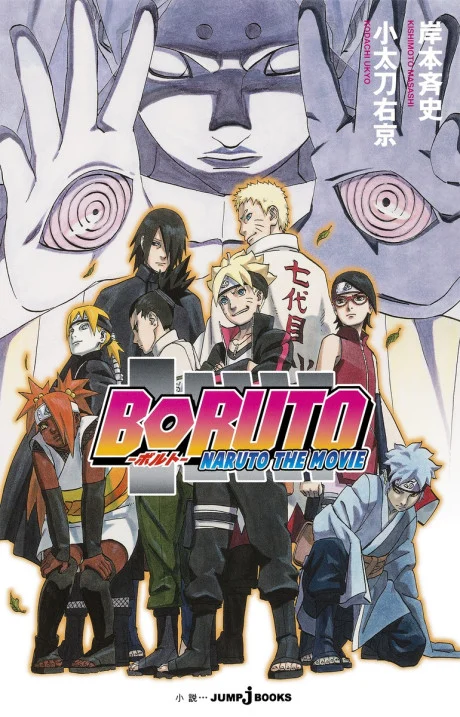
Boruto Uzumaki is the son of Naruto Uzumaki, the Seventh Hokage of the Hidden Leaf Village. Though his father is celebrated as a hero, Boruto sees him mainly as a parent who is almost never home, and the boy's frustration with that distance shapes much of his outlook. He wants to be recognized on his own terms and quietly aims to surpass the man everyone else admires.
His path takes an unexpected turn when Sasuke Uchiha, a legendary shinobi and one of Naruto's oldest comrades, returns to the village. Impressed by Sasuke's skill and independence, Boruto asks to become his apprentice, hoping to gain the strength and guidance he feels he is missing at home.
At the same time, a new danger arrives that threatens the hard-won peace Naruto helped secure after the Fourth Great Ninja War. As Boruto prepares for the Chunin Exams and struggles with his relationship to his father, he is drawn into a conflict far larger than his own ambitions. This novel-length retelling follows the young protagonist as he confronts what it means to be a shinobi, a son, and his own person.
Should You Read It?
Read it if you enjoy
- Read if you want the 2015 Boruto film's story in prose, following Boruto Uzumaki as he resents his father Naruto's absence and asks Sasuke Uchiha to become his mentor.
- Read if you are following the Naruto-to-Boruto transition and want a compact, single-volume version of a canonical postwar turning point.
- Read if you enjoy shounen action-comedy built around the Chunin Exams, threats to hard-won peace, and a young protagonist's drive to surpass a celebrated parent.
It may not suit you if
- May not suit readers wanting an original sequel: this is a prose retelling of the Boruto: Naruto the Movie film, not a separate continuation with new continuity.
- May not suit those who prefer manga or anime presentation; as a seven-chapter novel, it lacks the film's animated action and visual choreography.
- May not suit newcomers to Naruto seeking a starting point, since it assumes familiarity with Naruto, Sasuke, the Hidden Leaf Village, and the postwar era.
- May not satisfy readers who generally dislike film novelizations or condensed retellings.
This automatic starting point balances the series length, pacing, time commitment, and available Volluble research data. Editors can override it when firsthand knowledge suggests a better entry point.
Why It Connects With Audiences
Why people love it
- It centers on Boruto's conflicted view of Naruto as an almost never-present parent and his private wish to surpass him, giving the new generation a personal emotional hook.
- Sasuke's return and decision to take Boruto as an apprentice create a mentor-student thread that may appeal to fans of Naruto and Sasuke's long history.
- As a bridge between the Naruto era and the Boruto generation, it dramatizes the postwar peace secured after the Fourth Great Ninja War and the new danger that tests it.
- The compact seven-chapter volume lets readers revisit the film's Action, Comedy, and Shounen story in prose form.
Common criticisms
- A common limitation of film novelizations is that the plot is already known, so this book may feel like a companion rather than essential new material.
- Because it adapts a film later covered in Boruto: Naruto Next Generations episodes 53-66, it may be seen as an alternate-format telling rather than a unique narrative branch.
- The seven-chapter, single-volume format may make key action and ensemble moments feel more condensed than in the film.
- Readers unfamiliar with the Naruto franchise may find the many references and relationships hard to follow without prior context.
Volluble DNA
A quick profile of the title’s dominant storytelling ingredients.
Characters29 characters
Sasuke Uchiha
Main characterNaruto Uzumaki
Main characterBoruto Uzumaki
Main characterSarada Uchiha
Main characterSakura Haruno
Supporting characterRock Lee
Supporting characterHinata Hyuuga
Supporting characterGaara
Supporting characterSai
Supporting characterShikamaru Nara
Supporting characterTenten
Supporting characterKonohamaru Sarutobi
Supporting characterKurama
Supporting characterChojuro
Supporting characterKiller Bee
Supporting characterKurotsuchi
Supporting characterDarui
Supporting characterInojin Yamanaka
Supporting characterShikadai Nara
Supporting characterTakanami Senka
Supporting characterMitsuki
Supporting characterMakinami Senka
Supporting characterHimawari Uzumaki
Supporting characterSazanami Senka
Supporting characterShinki
Supporting characterMomoshiki Ootsutsuki
Supporting characterKinshiki Ootsutsuki
Supporting characterTono Katasuke
Supporting characterYurui
Supporting characterManga Staff2 credits
Production Background
BORUTO: NARUTO THE MOVIE appeared in print as a single-volume light novel in 2015, published on August 10 of that year and now marked as finished. The book is divided into seven chapters and retells the story of the animated feature released under the same name, carrying Masashi Kishimoto's name as the driving creative force behind the Naruto saga and its new generation. The catalog classifies its source material simply as Other, a nod to the fact that this is a prose adaptation of an animated film rather than a conversion of a manga serial.
The film it adapts was directed by Hiroyuki Yamashita in his directorial debut and was the second movie to belong to the canonical Naruto storyline, positioned as a sequel to the original manga series and set after the finale of the Naruto: Shippuden anime. The novelization therefore preserves a turning point for the franchise in book form, letting readers follow the same material across a compact seven-chapter volume. Its catalog tags place it alongside the parent series in the Action, Comedy, and Shounen categories, aimed at the established readership for the Naruto world.
Because the record identifies this entry as an individual work tied to a larger franchise, its production background centers on the 2015 novelization itself: the single-volume format, the one-day release window, and the direct relationship to the film's scenario. No later reissues, spin-off volumes, or expanded print editions are recorded in the supplied data.
Franchise Context
This entry sits within the wider Naruto franchise as a prose adaptation of the 2015 film Boruto: Naruto the Movie. The film was the second theatrical release counted as part of the canonical Naruto storyline, arriving after the conclusion of the Naruto: Shippuden anime and helping to open the Boruto era. Masashi Kishimoto is credited as the original creator, and Hiroyuki Yamashita made his directorial debut on the movie. The novel-format version retells that same story across seven chapters gathered into a single volume.
Because it adapts the film instead of continuing an ongoing serial, this work functions as a companion to the movie and as a bridge between the Naruto generation and the generation that follows it. The film's events were later adapted into episodes 53 through 66 of the Boruto: Naruto Next Generations anime, so this novel remains an alternate-format telling of the same narrative moment rather than a separate branch with its own continuity. It is not the starting point of the franchise, nor a spin-off standing apart from the main line, but a retelling tied directly to the parent film.
Franchise Path
- Begin with Naruto (manga/anime), then Naruto: Shippuden, then Boruto: Naruto the Movie as the film or this novel retelling.
- The novel covers the same canonical story as the 2015 film, so it fits before the Boruto: Naruto Next Generations era.
After You Finish
Continue with
- This seven-chapter novel is a complete retelling of the film, so no direct sequel novel continues it.
- For the same story in animated form, continue with Boruto: Naruto Next Generations episodes 53–66.
- Then continue with Boruto: Naruto Next Generations manga/anime for the following next-generation arcs.
Community Verdict
Quick reader and viewer signals from the Volluble community.
Would you recommend this?
Did the ending satisfy you?
Would you read it again?
Try Something Similar
Report an issue
Spot something wrong on this page? Tell us what needs attention.
0 Comments
Be the first to comment.