
Overview
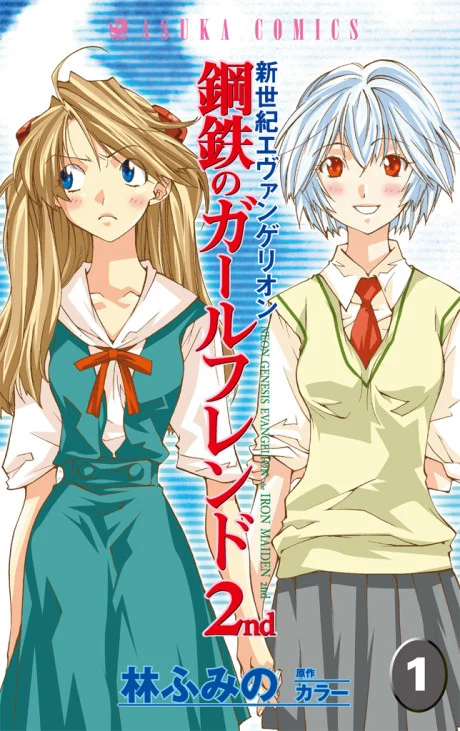
Neon Genesis Evangelion: Angelic Days matters as a deliberately different manga take on a familiar science-fiction property. Rather than treating its mecha and angel elements as the main source of intensity, it shifts the center of gravity toward school life, friendship, romantic uncertainty, and the awkward process of growing up. The result is not a replacement for the better-known Evangelion stories, but a focused alternate reality with its own priorities and emotional rhythm. Its six-volume, 27-chapter run gives that approach room to develop as a complete work.
The experience is lighter and more openly romantic than a conventional Evangelion entry, while still retaining room for drama, speculative ideas, and the appeal of a teenage cast facing situations larger than themselves. Comedy and love-triangle tension make the characters approachable, especially for readers who enjoy expressive relationship dynamics, strong personalities, and a school setting alongside mecha and science fiction. Fans looking for relentless action or the most psychologically severe side of the property may find its emphasis unexpected, but readers interested in alternate-reality reinterpretations should find its contrast rewarding. It is also a welcoming choice for newcomers who prefer character-centered manga and coming-of-age themes over dense mythology, while established fans can appreciate how boldly it rearranges familiar roles and expectations.
Synopsis
Neon Genesis Evangelion: Angelic Days is an alternate-reality manga in which the familiar characters live in a world shaped less by catastrophe and more by ordinary school life. The Second Impact never occurred, and Shinji Ikari and Asuka Langley Soryu have grown up together as childhood friends. Rei Ayanami arrives at their school as a new student, while Misato Katsuragi works there as a teacher. Their relationships and everyday experiences form the heart of this version of the story, giving the manga a comedic, romantic, and coming-of-age tone.
Behind the classroom routines, NERV is only beginning to assemble teenagers for experiments involving mecha and the threat of Angels. Shinji is drawn into this developing project while he, Asuka, and Rei struggle with changing feelings, personal uncertainty, and competing attachments. The central conflict therefore unfolds on two connected fronts: the young characters must face the demands and dangers surrounding NERV, while also navigating a complicated love triangle and the pressures of growing up together. Rather than centering primarily on an apocalyptic battle narrative, Angelic Days emphasizes how friendship, romance, and adolescent identity shape the characters as their seemingly peaceful school life becomes increasingly entangled with NERV's work.
Should You Read It?
Read it if you enjoy
- Read it for a school-centered alternate reality that reframes Evangelion around friendship, romance, and coming of age.
- Choose it if you enjoy a complete six-volume manga with familiar characters in substantially changed roles and relationships.
It may not suit you if
- It may not suit readers seeking the main Evangelion continuity or a primarily action-driven, psychologically severe story.
- The school setting, comedy, and love-triangle focus may feel unexpected if you mainly want mecha and Angel conflict.
This automatic starting point balances the series length, pacing, time commitment, and available Volluble research data. Editors can override it when firsthand knowledge suggests a better entry point.
Why It Connects With Audiences
Why people love it
- The alternate premise gives Shinji, Asuka, Rei, and Misato distinct dynamics, including childhood friendship, a new-student role, and a teacher role.
- Its blend of romance, comedy, drama, mecha, and science fiction offers a lighter, more openly relationship-focused Evangelion experience.
Common criticisms
- The romance and love-triangle emphasis can make the mecha and speculative elements feel less central than in other Evangelion stories.
- Readers attached to the established continuity may find its changed histories and roles limiting rather than complementary.
Volluble DNA
A quick profile of the title’s dominant storytelling ingredients.
Characters11 characters
Rei Ayanami
Main characterShinji Ikari
Main characterAsuka Langley Souryuu
Main characterKensuke Aida
Main characterRitsuko Akagi
Supporting characterHikari Horaki
Supporting characterGendou Ikari
Supporting characterYui Ikari
Supporting characterMisato Katsuragi
Supporting characterKaworu Nagisa
Supporting characterTouji Suzuhara
Supporting characterManga Staff1 credits
Production Background
Neon Genesis Evangelion: Angelic Days is a manga created by Fumino Hayashi, credited in Japanese as 林ふみの. KADOKAWA lists the work under its Asuka Comics label, establishing the publisher and imprint associated with its collected edition. As a manga project, it has no animation studio or television production history attached to the supplied record. Its production identity is instead defined by its reinterpretation of the Evangelion setting through a different premise and cast dynamic.
The work began publication in November 2003 and reached its listed conclusion in 2005. The completed series contains 27 chapters collected in six volumes, including three extra chapters. Its adaptation context is an alternate retelling rather than a straightforward reproduction of the familiar story: Shinji and Asuka are presented as childhood friends, Rei enters as a new student, Misato works as their teacher, and NERV is only beginning to involve teenagers in its experiments. The premise also removes the Second Impact from this version of the setting and shifts the emphasis toward romance, school life, and character relationships while retaining science-fiction and mecha elements. These changes give Angelic Days a distinct production approach within the Evangelion catalog, with the manga format used to build a separate continuity centered on its revised social and romantic setup.
Franchise Context
Neon Genesis Evangelion: Angelic Days is a manga-based alternate version within the broader Neon Genesis Evangelion franchise. It is not a continuation of the franchise’s central storyline or a direct retelling in its established form. Instead, the six-volume work reconfigures the setting and relationships into a separate reality, making it an alternate-universe entry rather than the beginning of the franchise.
The manga places its characters in a school-centered setting and changes their personal histories and roles. Shinji and Asuka are childhood friends, Rei is introduced as a new student, and Misato serves as their teacher, while NERV is still at an early stage of assembling teenagers for its experiments. These changes shift the emphasis toward romance, comedy, and coming-of-age drama while retaining recognizable Evangelion elements, including mecha and Angels. Published from 2003 and completed at 27 chapters, Angelic Days stands as a finished companion-style reinterpretation for readers who want a substantially different take on the franchise’s cast and premise.
Where This Fits in Neon Genesis Evangelion
A spoiler-light guide to where this exact work fits within the broader Neon Genesis Evangelion franchise.
-
Step 1
Start with the main Neon Genesis Evangelion story if you want the franchise’s standard continuity, using its original manga or anime entry point.
-
Step 2
Read Neon Genesis Evangelion: Angelic Days as an optional alternate manga route. No prior Evangelion installment is required to follow its school-centered retelling.
-
Step 3
Continue through all six volumes as a complete story, rather than treating it as a direct sequel to the main manga.
-
Step 4
Afterward, return to the main Evangelion continuity or explore other separate franchise interpretations according to preference.
Franchise Path
- Read the main Neon Genesis Evangelion manga or anime first for the standard continuity; Angelic Days is a separate alternate-reality manga route.
After You Finish
Continue with
- Complete at six volumes and 27 chapters; no same-franchise continuation is needed.
Community Verdict
Quick reader and viewer signals from the Volluble community.
Would you recommend this?
Did the ending satisfy you?
Would you read it again?
Try Something Similar
Report an issue
Spot something wrong on this page? Tell us what needs attention.
0 Comments
Be the first to comment.