
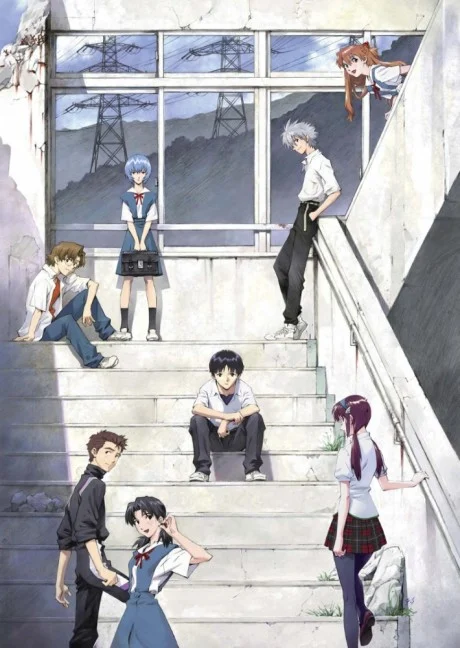
Overview
Evangelion: 2.0 You Can (Not) Advance is where the Rebuild films’ familiar foundations begin to feel substantially reworked. As a 112-minute science-fiction action movie, it combines giant-robot combat, military urgency, apocalyptic stakes, and intensely personal coming-of-age drama without treating any one element as mere decoration. Its importance lies in that balance: the Angels and Evas provide spectacular scale, while the young pilots’ emotional burdens keep the conflict intimate and uneasy.
The experience is energetic, tense, and psychologically charged, moving between urban battles, strained relationships, and a persistent sense that larger forces are pressing in from every direction. New and returning pilots give the film a broader ensemble, including contrasting personalities that make the cockpit drama as compelling as the battles themselves. Viewers who enjoy mecha with a more vulnerable, unsettling edge, or science fiction that connects cosmic danger to adolescent isolation, will find a great deal to engage with. It is most approachable for those who have seen Evangelion: 1.0 You Are (Not) Alone, since this movie continues that version of the story, but its strong visual momentum and clearly defined emotional stakes can also appeal to newcomers willing to enter an already unusual world. An English dub is available, and the film can be watched as a focused, high-impact anime movie rather than as an open-ended television season.
Synopsis
Evangelion: 2.0 You Can (Not) Advance continues the story of young Eva pilot Shinji Ikari as humanity’s struggle against the mysterious Angels grows more dangerous. Working within NERV’s desperate defense effort, Shinji operates an enormous Evangelion machine against creatures whose attacks threaten the survival of the world. Rei Ayanami remains part of this burden, and the pressure placed on both pilots reaches beyond the battlefield as they confront fear, isolation, and the expectations attached to their unusual roles.
The conflict expands with the arrival of two additional Eva pilots. Asuka brings a fiery, forceful presence to the group, while the enigmatic Mari introduces another unpredictable element to NERV’s operations. Together, the four young pilots are drawn into increasingly intense battles as the possibility of the apocalyptic Third Impact looms over their lives. Their missions demand more than technical skill, forcing them to navigate strained relationships, personal uncertainty, and the consequences of relying on giant machines to protect humanity. Against this escalating threat, the film follows their attempt to endure the responsibilities imposed on them while preserving their ability to live as individuals.
Trailer
Should You Watch It?
Watch it if you enjoy
- Watch if you enjoy visually energetic mecha battles paired with psychological coming-of-age drama.
- Start with Evangelion: 1.0 first, since this movie continues the Rebuild continuity and expands its pilot ensemble.
It may not suit you if
- May not suit viewers seeking a fully standalone film, as it is the second entry in a continuing four-film story.
- Its apocalyptic pressure, adolescent isolation, strained relationships, and unsettling psychological tone may be intense for some viewers.
The primary starting work is a movie, so the full film is the natural Volluble Test Drive. This gives you the complete story instead of applying an episodic trial to a feature-length work.
Why It Connects With Audiences
Why people love it
- The film balances spectacular Eva and Angel combat with intimate emotional burdens carried by its young pilots.
- Viewers may appreciate its reworked Evangelion story, broader pilot ensemble, and mix of military urgency with cosmic science fiction.
Common criticisms
- The dense continuity and reliance on the preceding Rebuild film can make the story less approachable for newcomers.
- Its rapid movement between urban battles, personal conflict, and escalating apocalyptic stakes may feel emotionally or tonally demanding.
Volluble DNA
A quick profile of the title’s dominant storytelling ingredients.
Characters and Voice Actors20 characters
Shinji Ikari
Main character- Japanese: Megumi Ogata
- English: Spike Spencer
Misato Katsuragi
Main character- Japanese: Kotono Mitsuishi
- English: Allison Keith-Shipp
Rei Ayanami
Main character- Japanese: Megumi Hayashibara
- English: Brina Palencia
- English: Amanda Winn Lee
Beautiful World
characterAsuka Langley Souryuu
Main character- Japanese: Yuuko Miyamura
- English: Tiffany Grant
Mari Makinami Illustrious
Main character- Japanese: Maaya Sakamoto
- English: Deneen Melody
- English: Trina Nishimura
Kensuke Aida
Supporting character- English: Greg Ayres
- Japanese: Tetsuya Iwanaga
- English: Alejandro Saab
Ritsuko Akagi
Supporting character- English: Mary Faber
- English: Colleen Clinkenbeard
- Japanese: Yuriko Yamaguchi
Shigeru Aoba
Supporting character- English: Phil Parsons
- Japanese: Takehito Koyasu
- English: Jason C. Lee
Kohzou Fuyutsuki
Supporting character- Japanese: Motomu Kiyokawa
- English: Kent Williams
- English: Michael Ross
Hikari Horaki
Supporting character- English: Leah Clark
- Japanese: Junko Iwao
- English: Kimberly Yates
Makoto Hyuuga
Supporting character- Japanese: Hiro Yuuki
- English: Mike McFarland
- English: Joe Fria
Maya Ibuki
Supporting character- English: Caitlin Glass
- Japanese: Miki Nagasawa
- English: Amy Seeley
Gendou Ikari
Supporting character- Japanese: Fumihiko Tachiki
- English: John Swasey
Yui Ikari
Supporting character- English: Stephanie Young
- Japanese: Megumi Hayashibara
Ryouji Kaji
Supporting character- English: J. Michael Tatum
- Japanese: Kouichi Yamadera
- English: Sean Burgos
Kaworu Nagisa
Supporting character- Japanese: Akira Ishida
- English: Daman Mills
- English: Jerry Jewell
Touji Suzuhara
Supporting character- English: Justin Cook
- Japanese: Tomokazu Seki
- English: Brett Weaver
Pen Pen
Supporting character- English: Monica Rial
- Japanese: Megumi Hayashibara
Keel Lorentz
Supporting character- Japanese: Mugihito
- English: Bill Jenkins
- English: Tom Booker
Production and Staff26 credits
View all 14 additional credits
Production Background
Evangelion: 2.0 You Can (Not) Advance is a 2009 Japanese animated science-fiction film written and chiefly directed by Hideaki Anno. It was produced by Anno’s Studio Khara in partnership with Gainax, the studio associated with the original Neon Genesis Evangelion anime. The film is the second entry in the four-part Rebuild of Evangelion project, which uses the earlier television series as its foundation while reshaping its story for a theatrical film series.
The film received its original theatrical release in Japan on June 27, 2009, under the 2.0 version designation. A revised home-video edition, Evangelion: 2.22 You Can (Not) Advance, followed on May 26, 2010, adding scenes and making other adjustments to the film. In adapting material connected to the original series, the production reproduces some scenes and plot elements but also develops new material, including newly designed creatures and the introduction of Mari Illustrious Makinami. These changes distinguish the movie from a straightforward compilation or direct retelling, establishing its place as a reworked theatrical version of the Evangelion story.
Franchise Context
Evangelion: 2.0 You Can (Not) Advance is the second film in the four-part Rebuild of Evangelion cycle. It continues directly from Evangelion: 1.0 You Are (Not) Alone, returning to Shinji Ikari, Rei, NERV, and the escalating battles against the Angels. As a movie sequel, it is a continuation within this specific theatrical version of the story rather than a stand-alone entry.
The Rebuild cycle is based on the original Neon Genesis Evangelion anime, but this film is not a simple scene-for-scene adaptation. It reworks familiar material while adding new developments, redesigned creatures, and new characters, including Mari Illustrious Makinami. The entry’s primary release is the 2009 theatrical version titled 2.0. A later home-video edition, 2.22, contains additional scenes and adjustments, making it an alternate release version of the same film rather than a separate installment. In the broader Evangelion setting, this movie therefore functions as a revised continuation of the franchise’s core premise through the Rebuild continuity.
Where This Fits in Neon Genesis Evangelion
A spoiler-light guide to where this exact work fits within the broader Neon Genesis Evangelion franchise.
-
Step 1
If you are starting the Rebuild sequence, watch Evangelion: 1.0 You Are (Not) Alone first.
-
Step 2
Watch Evangelion: 2.0 You Can (Not) Advance next as the second Rebuild film.
-
Step 3
Choose either the theatrical 2.0 release or the home-video 2.22 version, since they are versions of the same film rather than separate installments.
-
Step 4
Continue with the remaining Rebuild films afterward. The original Neon Genesis Evangelion anime is a separate source route, not required before this film.
Franchise Path
- Watch Evangelion: 1.0 You Are (Not) Alone first; this is the second film in the Rebuild cycle.
- Choose theatrical 2.0 or home-video 2.22; they are versions of the same film, not separate installments.
After You Finish
Continue with
- Continue with the remaining Rebuild of Evangelion films to complete this theatrical continuity.
Community Verdict
Quick reader and viewer signals from the Volluble community.
Would you recommend this?
Did the ending satisfy you?
Would you watch it again?
Report an issue
Spot something wrong on this page? Tell us what needs attention.
0 Comments
Be the first to comment.