
Overview
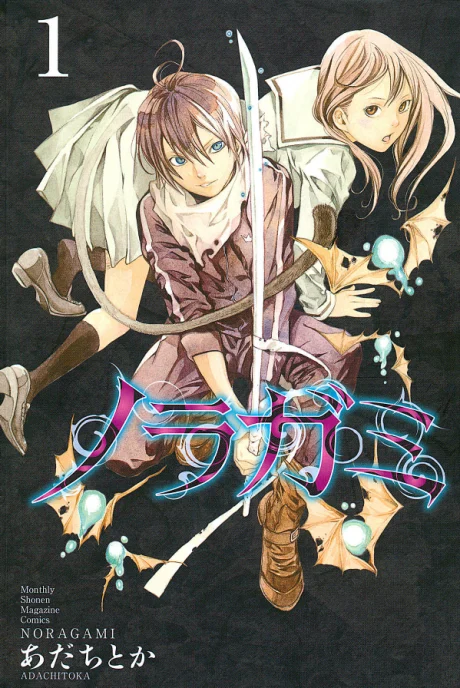
Noragami: Stray God is the main manga of its franchise, an original work by Adachitoka that ran from 2010 to 2024 across 109 chapters and 27 collected volumes. Its premise is disarmingly small: a minor deity with no shrine and no steady worshippers takes whatever odd jobs he can find, from locating lost pets to settling schoolyard disputes, charging a modest fee in the hope of one day building a home of his own. That modest setup matters because it gives the series room to grow. What begins as a charming, episodic urban fantasy gradually becomes a sustained meditation on memory, identity, and what it means to be remembered by anyone at all.
The experience is tonal range rather than a single note. Readers meet comedy, warmth, and found family before the story asks them to sit with grief, revenge, and the uneasy border between the living and the dead. Mythology and exorcism supply spectacle and swordplay, but the emotional weight rests with characters deciding what they owe the people who named them. The art is expressive and the pacing patient, rewarding those who stay for the long arc.
This individual manga is approachable for newcomers. Its early chapters work as self-contained encounters, so mythology-heavy worldbuilding arrives in manageable pieces. Readers who enjoy character-driven shounen, folklore-inflected fantasy, or a long story about belonging may find it a strong fit.
Synopsis
Noragami: Stray God follows Yato, a petty deity with no shrine, no steady worshippers, and a cheap jersey. He scrapes by taking small jobs for five yen, from locating lost pets to easing minor human troubles, hoping to someday afford a grand temple. His routine changes when he meets Hiyori Iki, a girl whose brush with danger leaves her spirit able to slip free from her body. She seeks his help, and their arrangement pulls her into the unseen world of gods and spirits.
Yato also gains a young shinki named Yukine, a wandering soul transformed into his divine weapon. As Yato, Hiyori, and Yukine take on requests, they face dangerous spirits and the strict rules of the heavens. Yato's past as a god of calamity haunts him, and powerful figures like Bishamon regard him with suspicion and hostility. Hiyori tries to balance ordinary life with her new double existence, while Yukine wrestles with the pain and memories that make a shinki vulnerable to corruption.
The primary conflict centers on Yato's struggle to redefine himself, protect his companions, and confront the consequences of his violent history. Hiyori's condition and Yukine's instability complicate every job, and the trio's growing bond is tested by divine politics, old grudges, and enemies who see Yato as a threat. The series blends action, supernatural drama, and found family as Yato works toward a future he can call his own.
Should You Read It?
Read it if you enjoy
- You enjoy supernatural urban fantasy that begins with small five-yen jobs and grows into a larger story about gods, memory, and identity.
- You like found-family dynamics among a minor deity, a spirit-linked girl, and a shinki weapon, with warmth and comedy before heavier arcs.
- You prefer a completed long-form manga: 109 chapters across 27 volumes, readable from volume 1 without prior franchise homework.
It may not suit you if
- You want immediate high-stakes action; early chapters lean on episodic errands and character setup before larger conflicts emerge.
- You dislike tonal shifts; the series moves between humor, warmth, grief, revenge, and tragedy.
- You prefer light mythology; the story involves heavens' rules, shinki corruption, and a god's violent past.
- You need a quick resolution; this finished series builds patiently across 27 volumes.
This automatic starting point balances the series length, pacing, time commitment, and available Volluble research data. Editors can override it when firsthand knowledge suggests a better entry point.
Why It Connects With Audiences
Why people love it
- The modest premise expands into an emotional meditation on memory, identity, and what it means to be remembered.
- Yato, Hiyori, and Yukine's found-family bond gives the supernatural action a warm, character-driven core.
- The mix of mythology, exorcism, swordplay, comedy, and tragedy offers a wide tonal range.
- The complete 109-chapter run gives readers a finished long-form story with expressive art and patient pacing.
Common criticisms
- Some readers may find the early episodic jobs slow before the main conflict and Yato's past take focus.
- The large cast and layered heaven and shinki rules can be hard to track for casual readers.
- The shifting balance between comedy and dark themes may feel uneven for those wanting one consistent tone.
- Its 27-volume length means the payoff requires sustained commitment from readers.
Volluble DNA
A quick profile of the title’s dominant storytelling ingredients.
Characters25 characters
Yato
Main characterHiyori Iki
Main characterYukine
Main characterToto-sama
Main characterBishamon
Supporting characterKazuma
Supporting characterKofuku Ebisu
Supporting characterTenjin
Supporting characterDaikoku
Supporting characterNora
Supporting characterEbisu
Supporting characterAiha
Supporting characterKouto Fujisaki
Supporting characterIzanami
Supporting characterKinuha
Supporting characterKugaha
Supporting characterKuraha
Supporting characterOokuninushi
Supporting characterSuzuha
Supporting characterTsuguha
Supporting characterAimi Tabata
Supporting characterMayu
Supporting characterTakemikazuchi
Supporting characterKiun
Supporting characterSakura
Supporting characterManga Staff9 credits
View all 8 additional credits
Franchise Context
Noragami: Stray God is the main manga installment of the Noragami franchise and its original source work. The record marks its source material as Original and its installment relationship as main_manga. It is not a spin-off, sequel, adaptation of another medium, or alternate version. Instead, it is the foundational narrative from which the franchise takes its title and central premise.
Serialization started in 2010 and concluded in 2024, with 109 chapters gathered into 27 volumes. That complete run gives the property a long-form manga backbone. The official publisher page presents it as a finished serial, and the AniList entry confirms its finished status, Japanese origin, and manga format. Its genres and themes align with the broader supernatural action drama identity associated with Noragami.
Within a franchise hub, this page should be read as the beginning point of the Noragami manga line, not as a later continuation or side story. Related Noragami works, where they exist, relate back to this manga, but this entry remains focused on the individual completed series.
Where This Fits in Noragami
A spoiler-light guide to where this exact work fits within the broader Noragami franchise.
-
Step 1
Start here: Noragami: Stray God is the main manga series, beginning with volume 1.
-
Step 2
No earlier connected work is required by the supplied record; this entry is marked as the main manga, not a side story or alternate version.
-
Step 3
Read sequentially through the complete run of 109 chapters across 27 volumes for the primary story path.
-
Step 4
After the final volume, consult the franchise hub for any additional Noragami works and treat them as optional follow-ups or alternate versions according to their own labels.
Franchise Path
- Begin the Noragami franchise path with Noragami: Stray God, the main manga and original source; no earlier connected work is required.
- Read the complete run in order: 109 chapters across 27 volumes, from volume 1 to volume 27.
- Treat this manga as the franchise foundation; any other Noragami works are optional follow-ups or alternate versions after the main path.
After You Finish
Continue with
- After volume 27, no further Noragami manga continuation is required; the main story is complete.
Community Verdict
Quick reader and viewer signals from the Volluble community.
Would you recommend this?
Did the ending satisfy you?
Would you read it again?
Report an issue
Spot something wrong on this page? Tell us what needs attention.
0 Comments
Be the first to comment.