Overview
Orange stands out among 2016 television anime for the way it folds a quiet science fiction premise into an intimate high school drama. A letter from the future gives its heroine a chance to reconsider ordinary daily choices, and the series treats that device less as spectacle than as a way to examine regret, friendship, and the limits of what hindsight can actually fix. Across thirteen episodes the pacing stays patient and character driven, letting the ensemble's small conversations carry as much weight as the central question of what the letter is trying to prevent.
The experience it offers is emotional rather than action oriented: a shoujo romance with a melancholic edge, shaped by a love triangle and a circle of friends learning to pay closer attention to one another. The time manipulation premise gives the story a clear structure and a thread to follow, while the teen perspective keeps the drama grounded and recognizable. It suits viewers who prefer interiority and mood over plot mechanics.
The series is approachable for newcomers to romance or light science fiction, and it is available with an English dub on Crunchyroll. Its subject matter is heavier than the premise first suggests, with suicide, grief, and loss woven through the story, so viewers sensitive to those themes should be aware before starting. Those seeking a gentle, reflective drama will find one here; those wanting high energy supernatural action may not.
Synopsis
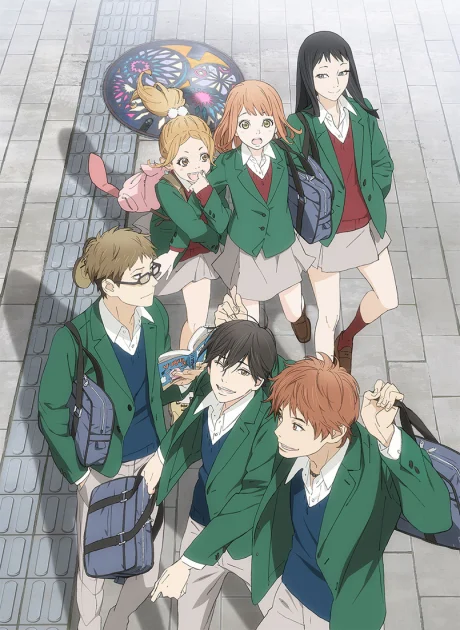
Orange centers on Naho Takamiya, a sixteen-year-old high school student whose ordinary life is unsettled by a letter that claims to have been written by her twenty-seven-year-old self. The letter describes events before they happen and introduces Kakeru Naruse, a transfer student who will soon join her class. It asks Naho to watch over Kakeru and to pay attention to the choices she makes around him. She is skeptical at first, but when details from the letter begin to match reality, she cannot dismiss its warning.
As Kakeru becomes part of Naho's circle of friends, she sees a warm and sociable classmate beneath a lingering sadness connected to a recent family tragedy. The letter urges Naho to act on small opportunities and avoid the regrets her future self carries, yet she is unsure how much she should interfere. Her existing friendships and growing feelings complicate each decision, especially when she cannot know whether her actions will truly help Kakeru or change anything at all.
The central conflict is Naho's struggle to understand the letter's purpose and to respond courageously while navigating school life, friendship, and first love. The story uses its supernatural premise to examine regret, connection, and the difficulty of reaching someone who is hurting.
Promo
Should You Watch It?
Watch it if you enjoy
- If you prefer character-driven high school drama over action, Orange centers on Naho's friendships, first love, and regret.
- If you like light supernatural premises used for emotional stakes, the future-letter device gives the story a clear thread.
- If you want an accessible romance with an English dub, the 2016 TV anime streams on Crunchyroll.
It may not suit you if
- If you avoid stories involving suicide or family tragedy, the premise includes Kakeru's mother's death by suicide.
- If you prefer fast-moving plots, the patient, conversation-heavy pacing may feel slow.
- If you want a definitive fix-it fantasy, the story is more about regret and the limits of hindsight than simple solutions.
This automatic starting point balances the series length, pacing, time commitment, and available Volluble research data. Editors can override it when firsthand knowledge suggests a better entry point.
Why It Connects With Audiences
Why people love it
- The future-letter premise gives the romance a clear emotional structure without turning it into spectacle.
- The ensemble's small conversations carry weight, with friendship and care central to the drama.
- Naho's teen perspective keeps the emotional drama grounded and recognizable.
Common criticisms
- The love triangle and hesitant protagonist can make the central romance feel drawn out.
- Some viewers may find the time-manipulation mechanics secondary to the emotional beats.
- The melancholic subject matter can sit uneasily with the lighter school-life moments.
Volluble DNA
A quick profile of the title’s dominant storytelling ingredients.
Characters and Voice Actors8 characters
Naho Takamiya
Main character- Japanese: Kana Hanazawa
- English: Jill Harris
Kakeru Naruse
Main character- English: Micah Solusod
- Japanese: Seiichirou Yamashita
Hiroto Suwa
Main character- English: Jason Liebrecht
- Japanese: Makoto Furukawa
Takako Chino
Main character- English: Jeannie Tirado
- Japanese: Rika Kinugawa
Azusa Murasaka
Main character- Japanese: Natsumi Takamori
- English: Sarah Wiedenheft
Saku Hagita
Main character- Japanese: Kazuyuki Okitsu
- English: Dave Trosko
Rio Ueda
Supporting character- English: Tia Ballard
- Japanese: Ayane Sakura
Kakeru no Sobo
Supporting character- English: Linda Young
- Japanese: Gara Takashima
Production and Staff26 credits
View all 14 additional credits
Production Background
Orange originated as a manga written and illustrated by Ichigo Takano, serialized from 2012 in Bessatsu Margaret and later in Monthly Action, with Futabasha handling publication. The television anime adaptation was mounted under the orange production committee, whose copyright line credits Takano, Futabasha, and the committee together. The series aired from July 4 to September 26, 2016, across thirteen episodes. Its final episode ran roughly forty minutes rather than the standard twenty-four minute slot, giving the adaptation room to close out its time-skip storyline.
The anime arrived after the property had already begun expanding beyond its original serialization. A live action film of the same name was released in December 2015, before the anime had aired, and a spin-off manga began serialization in Monthly Action in March 2016, the same year the television version premiered in the summer season. The anime was therefore able to build on an established readership rather than introducing the story cold.
Production context for the adaptation also includes its broadcast and distribution life beyond Japan. An English dub was produced for the series, and it remains available for streaming through Crunchyroll. A separate theatrical anime film, Orange: Future, premiered in Japan on November 1 following the television broadcast, extending the animated side of the property while remaining distinct from the thirteen-episode series covered here. The television adaptation itself stands as the primary animated telling of Takano's time-skip story, condensing the manga into a single summer-season run with an extended finale.
Franchise Context
This manga is the source work at the root of the Orange franchise. Ichigo Takano began serializing it in 2012, initially in Bessatsu Margaret before it moved to Monthly Action, and the collected editions run to seven volumes. Every other entry in the franchise traces back to this story of Naho Takamiya and the letter she receives from her future self, so it is the beginning rather than a continuation, sequel, or spin-off.
The manga's popularity produced a wave of adaptations and related works within a few years. A live action film reached theaters in December 2015, an anime television series aired in Japan from July to September 2016, and an anime theatrical film, Orange: Future, followed in November 2016. A spin-off manga also began serialization in Monthly Action in March 2016, expanding the world beyond Takano's original chapters. The 2016 television anime, listed as this franchise's main anime installment, is a direct adaptation of the manga rather than an alternate storyline.
Readers coming to this entry should treat the manga as the primary text and the anime, films, and spin-off as branches from it. The various versions share the same core cast and premise, but they differ in medium, length, and focus.
Where This Fits in Orange
A spoiler-light guide to where this exact work fits within the broader Orange franchise.
Exact position: This is Season 1 and the first main anime entry in the current 1-part Volluble path.
-
Step 1
Start with the 2016 13-episode TV anime if you want the primary anime route through Orange; it adapts the core story from Ichigo Takano's manga.
-
Step 2
If you prefer source-first reading, finish the manga before the TV anime; the anime is an adaptation, not a replacement.
-
Step 3
Treat the live-action film as an alternate adaptation of the same story, so it is optional and not required between anime entries.
-
Step 4
After the TV series, continue to the later anime film Orange: Future if you want the anime continuation; the spin-off manga is optional side material.
Franchise Path
- Orange (current)
After You Finish
Continue with
This is currently the latest main anime entry in Volluble's saved franchise path.
Community Verdict
Quick reader and viewer signals from the Volluble community.
Would you recommend this?
Did the ending satisfy you?
Would you watch it again?
Sources3 sources
Report an issue
Spot something wrong on this page? Tell us what needs attention.
0 Comments
Be the first to comment.