
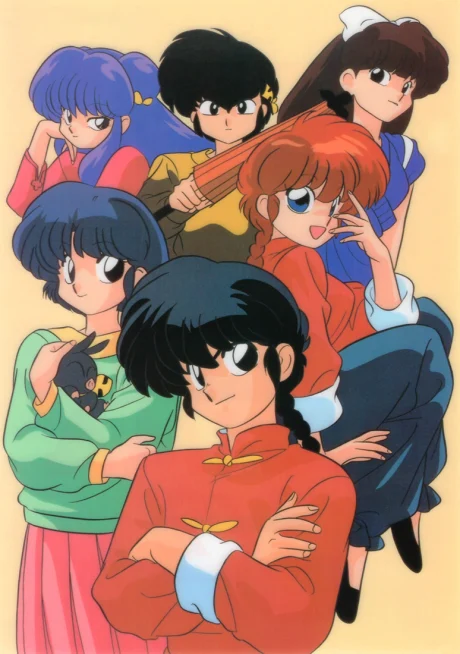
Overview
Ranma ½ (1989) matters as a defining blend of martial-arts spectacle, romantic friction, and transformation comedy. Its central premise turns identity into a constant source of movement: Ranma’s water-triggered change between boy and girl affects battles, rivalries, school life, and an increasingly tangled engagement. The result is an anime less interested in settling its premise than in testing how many comic complications it can generate from it. Across 143 episodes, the series builds an energetic ensemble of suitors, challengers, friends, and relatives whose strong personalities keep even familiar situations lively.
The experience is brisk, playful, and highly episodic, with exaggerated combat techniques sharing space with domestic arguments, competitive schemes, and romantic misunderstandings. Its gender-swap conceit gives the comedy an unusual angle, while the recurring cast supplies both broad farce and a steady emotional rhythm. Mild nudity and old-school comic timing are part of its presentation, so viewers should expect a product of its era rather than a restrained modern rom-com. It is especially approachable for newcomers who enjoy character-driven chaos, martial-arts parody, and stories that can reset after a wild detour without losing their central relationships. Viewers seeking a tightly serialized plot may find its loose structure less immediate, but those willing to settle into its repeating comic engine will find a remarkably durable television adventure.
Synopsis
Ranma Saotome is a teenage martial artist caught in a bizarre curse after an accident during a training journey. Cold water changes him into a girl, while hot water restores his male form, making everyday life a constant struggle of sudden transformations, misunderstandings, and reluctant improvisation. His engagement to Akane places him at the center of an already volatile social circle, where their combative relationship mixes sharp arguments, reluctant cooperation, and romantic tension.
The series follows Ranma and Akane through a lively succession of school-life, household, and martial-arts conflicts. Ranma’s curse attracts attention from admirers and rivals alike, including Shampoo, a Chinese Amazon whose complicated feelings toward Ranma are shaped by the rules of her tribe. Mousse, who loves Shampoo, also treats Ranma as a romantic and martial-arts rival, adding another source of competition to the pair’s difficult engagement. Battles often arise from personal grudges, unusual challenges, or attempts to gain an advantage, but they are driven as much by pride and jealousy as by technique. Across its episodic stories, the anime uses Ranma’s shifting identity and the reactions it provokes to explore romance, rivalry, and the chaos of trying to maintain a normal life while surrounded by extraordinary people.
Trailer
Should You Watch It?
Watch it if you enjoy
- Choose it for energetic martial-arts comedy built around Ranma’s water-triggered transformation.
- A good fit if you enjoy episodic school, household, and romantic conflicts with a large ensemble cast.
It may not suit you if
- The 143-episode run favors recurring comic complications over a tightly serialized progression.
- Mild nudity, gender-swap humor, and old-school comic timing may feel dated or uncomfortable to some viewers.
This automatic starting point balances the series length, pacing, time commitment, and available Volluble research data. Editors can override it when firsthand knowledge suggests a better entry point.
Why It Connects With Audiences
Why people love it
- Ranma’s shifting identity gives battles, rivalries, and everyday misunderstandings an inventive comic engine.
- The lively cast and mix of pride, jealousy, reluctant cooperation, and romantic tension sustain the episodic format.
Common criticisms
- The episodic structure can make the central engagement and transformation premise feel repeatedly reset rather than decisively advanced.
- Frequent admirers, rivals, and misunderstandings may read as broad or repetitive for viewers seeking restrained romance.
Volluble DNA
A quick profile of the title’s dominant storytelling ingredients.
Characters and Voice Actors25 characters
Ranma Saotome
Main character- Japanese: Kappei Yamaguchi
- Japanese: Megumi Hayashibara
- English: Sarah Strange
- English: Venus Terzo
- English: Richard Ian Cox
Akane Tendou
Main character- Japanese: Noriko Hidaka
- English: Myriam Sirois
Ryouga Hibiki
Supporting character- Japanese: Kouichi Yamadera
- English: Michael Donovan
Ukyo Kuonji
Supporting character- Japanese: Hiromi Tsuru
- English: Kelly Sheridan
Shampoo
Supporting character- Japanese: Rei Sakuma
- English: Cathy Weseluck
Nabiki Tendou
Supporting character- Japanese: Minami Takayama
- English: Angela Costain
- English: Elaina Wotten-Costain
Kasumi Tendou
Supporting character- Japanese: Kikuko Inoue
- English: Willow Johnson
Mousse
Supporting character- Japanese: Toshihiko Seki
- English: Brad Swaile
Tatewaki Kunou
Supporting character- Japanese: Hirotaka Suzuoki
- English: Ted Cole
Soun Tendou
Supporting character- Japanese: Ryuusuke Oobayashi
- English: David Kaye
Azusa Shiratori
Supporting character- Japanese: Naoko Matsui
- English: Cathy Weseluck
Genma Saotome
Supporting character- Japanese: Kenichi Ogata
- English: Robert O Smith
Kodachi Kunou
Supporting character- Japanese: Saeko Shimazu
- English: Teryl Rothery
Hikaru Gosunkugi
Supporting character- Japanese: Issei Futamata
- English: Michael Benyaer
Nodoka Saotome
Supporting character- Japanese: Masako Ikeda
- English: Lisa Bunting
Tsubasa Kurenai
Supporting character- Japanese: Eiko Yamada
- English: Saffron Henderson
Orihime
Supporting character- Japanese: Yuuko Iguchi
- English: Moneca Stori
Yotarou
Supporting character- Japanese: Naoko Matsui
- English: Christopher Turner
Happousai
Supporting character- Japanese: Ichirou Nagai
- English: Paul Dobson
Toufuu Ono
Supporting character- Japanese: Yuuji Mitsuya
- English: Ian James Corlett
Pansuto Tarou
Supporting character- Japanese: Shinnosuke Furumoto
- English: Matt Hill
Satori
Supporting character- Japanese: Kazue Ikura
- English: Rhys Huber
Cologne
Supporting character- Japanese: Miyoko Asou
- English: Elan Ross Gibson
Sasuke Sarugakure
Supporting character- Japanese: Shigeru Chiba
- English: Robert O Smith
Maomolin
Supporting character- Japanese: You Yoshimura
- English: Sam Khouth
Production and Staff26 credits
View all 14 additional credits
Production Background
Ranma ½ (1989) is a television anime adaptation of the manga created by Rumiko Takahashi. Takahashi wrote and illustrated the source series, which was serialized in Shogakukan’s Weekly Shōnen Sunday from August 1987 through March 1996 and later collected in 38 tankōbon volumes. That publication history places the anime within an established manga property while distinguishing this entry as the 1989 television production rather than the source manga itself or another installment in the broader Ranma ½ franchise.
The series began broadcasting in Japan on October 20, 1989, and concluded on September 25, 1992. It was produced as a 143-episode TV run, with episodes listed at approximately 23 minutes each. A notable scheduling detail concerns episodes 7 through 9: they were originally intended to be viewed between episodes 13 and 14 of the original series. This unusual placement is important when considering the anime’s release history, since the numbered broadcast sequence does not fully reflect the viewing order initially planned for those episodes. The finished series adapts the manga’s martial-arts comedy and transformation premise into a long-form episodic television format, with its production history defined primarily by its role as a sustained screen adaptation of Takahashi’s manga.
Franchise Context
Ranma ½ (1989) is the main television anime adaptation of Rumiko Takahashi’s Ranma ½ manga. The manga began serialization in 1987, while this animated version premiered in 1989 and presents the franchise’s central story in episodic TV form. It is therefore an adaptation of the source manga rather than a separate spin-off or an unrelated stand-alone work.
This entry covers the completed 143-episode television series, which aired from 1989 to 1992. Its identity is distinct from the manga because it is an anime production with its own episode-based format, while the source was published in 38 collected volumes. The record identifies it as the main anime installment, not a movie, remake, or alternate version, making it the principal TV adaptation associated with the original Ranma ½ manga.
Where This Fits in Ranma ½
A spoiler-light guide to where this exact work fits within the broader Ranma ½ franchise.
Exact position: This is Main anime entry 2 and main anime entry 2 of 5. It follows Ranma ½.
-
Step 1
Use this 143-episode TV anime as a suitable starting point for the anime route; no prior franchise entry is supplied.
-
Step 2
Watch the numbered episodes in sequence. Episodes 7-9 have a viewing-placement note indicating they were originally intended between episodes 13 and 14.
-
Step 3
The manga is the source material and offers an alternate way to experience the story, rather than something required before this anime.
-
Step 4
No separate sequel or follow-up is identified in the supplied record, so the manga is the only listed next route after finishing this series.
Franchise Path
After You Finish
Continue with
Community Verdict
Quick reader and viewer signals from the Volluble community.
Would you recommend this?
Did the ending satisfy you?
Would you watch it again?
Sources2 sources
Report an issue
Spot something wrong on this page? Tell us what needs attention.
0 Comments
Be the first to comment.