Overview
The Vision of Escaflowne is a 1996 original television series from Sunrise, shaped by Shōji Kawamori, and it remains a distinctive meeting point for fantasy, mecha, and romance. Its premise sends a high school girl, Hitomi, from Earth to the world of Gaea, where a young king named Van commands a mystical armored machine against an expansionist empire. That setup could have yielded a simple adventure, but the series uses its twenty-six episodes to braid fortune-telling, prophecy, politics, and a love triangle into the conflict, so the stakes feel personal as well as strategic.
What makes the show worth visiting is its tonal range. It moves between court intrigue, large-scale mecha combat, and quieter passages about fate and longing, with a visual style that sets floating ships and dragon-haunted landscapes against recognizably human anxieties. Hitomi is not merely a passenger in Van's war; her growing abilities give her an active role in how events unfold, and the series is interested in the cost of those gifts.
This individual series is approachable for viewers new to either mecha or fantasy, since it explains its world through Hitomi's outsider perspective. Content is mild, and the English dub offers an easy entry point. Those who prefer brisk, action-first pacing may find the romantic and prophetic threads slower, but audiences drawn to ambitious genre mixing and a heroine at the center will find it rewarding.
Synopsis
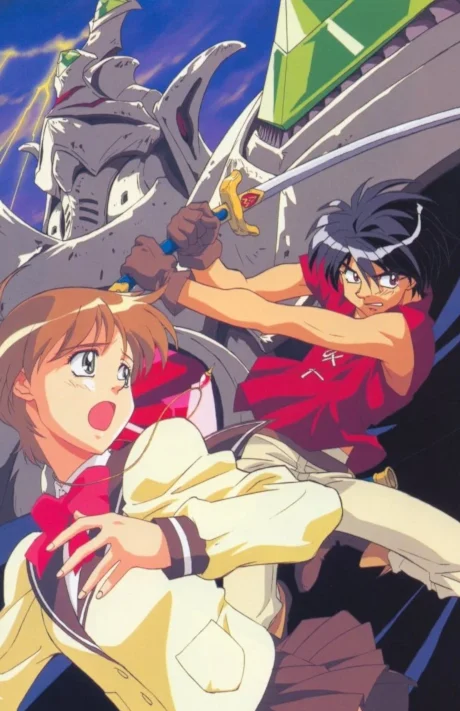
The Vision of Escaflowne centers on Hitomi Kanzaki, a Japanese high school student whose ordinary concerns about track and school life are interrupted when a young man named Van Fanel appears on her world, locked in combat with a dragon. The clash pulls Hitomi off Earth and onto the planet Gaea, a world of kingdoms, old legends, and ongoing warfare. Stranded far from home, she is drawn into the aftermath of Van's battle and into the political struggles that surround him.
Van is a prince of Fanelia, a young ruler who commands a formidable armored machine called Escaflowne, whose unusual power is tied closely to dragons and to Gaea's deeper mysteries. As the Zaibach Empire pushes its campaign to dominate the planet, Van sets out to bring together the divided nations of Gaea against that threat. His path crosses with Allen Schezar, a knight of Asturia, and the two men become important figures in the widening conflict. Hitomi's own fortune telling abilities begin to strengthen on Gaea, marking her as someone of unexpected significance.
The primary conflict follows the fragile effort to resist Zaibach while Van wrestles with the weight of his lineage and the responsibilities of leadership. Hitomi, caught between loyalty to her new companions and the pull of home, becomes an observer and participant in a war shaped by prophecy, technology, and personal devotion. The series blends fantasy adventure, giant machines, and romance as its characters search for a way to protect Gaea without losing themselves to the struggle.
Should You Watch It?
Watch it if you enjoy
- Try it if you want a completed 26-episode fantasy that mixes mecha combat, court intrigue, and romance.
- Best suited to viewers who enjoy an isekai setup seen through an Earth outsider learning Gaea's rules.
- A good fit for fans of 1990s Sunrise originals with prophecy, politics, and a young ruler's coming-of-age.
It may not suit you if
- May not suit viewers who prefer grounded science fiction without fortune-telling, prophecy, or mystical machines.
- The love-triangle and destined-romance elements could frustrate those seeking a war story with no romantic focus.
- Those who avoid older TV animation may find the 1996 production style less immediately appealing.
This automatic starting point balances the series length, pacing, time commitment, and available Volluble research data. Editors can override it when firsthand knowledge suggests a better entry point.
Why It Connects With Audiences
Why people love it
- The series is valued for balancing large-scale mecha battles with quieter passages about fate, longing, and leadership.
- Hitomi's growing fortune-telling ability gives her an active role rather than leaving her a passive traveler.
- Gaea's floating ships, dragons, and divided kingdoms give the adventure a distinctive fantasy-mecha identity.
Common criticisms
- Some viewers may find the mix of fantasy, mecha, and romance tonally uneven across the 26 episodes.
- The crowded blend of prophecy, politics, and a love triangle can make the war plot feel diffuse to some.
- The 1996 animation may read as dated to viewers accustomed to more recent series.
Volluble DNA
A quick profile of the title’s dominant storytelling ingredients.
Characters and Voice Actors21 characters
Hitomi Kanzaki
Main character- Japanese: Maaya Sakamoto
- English: Caitlin Glass
- English: Kelly Sheridan
Van Fanel
Main character- Japanese: Tomokazu Seki
- English: Aaron Dismuke
- English: Kirby Morrow
- English: Andrew Francis
Allen Schezar
Main character- Japanese: Shinichirou Miki
- English: Sonny Strait
- English: Brian Drummond
Dilandau Albatou
Supporting character- Japanese: Minami Takayama
- English: Andrew Francis
- English: Joel Mcdonald
Folken Fanel
Supporting character- English: Vic Mignogna
- Japanese: Jouji Nakata
- English: Paul Dobson
Merle
Supporting character- Japanese: Ikue Ootani
- English: Jocelyne Loewen
- English: Alexis Tipton
Dryden Fassa
Supporting character- Japanese: Juurouta Kosugi
- English: Eric Vale
- English: Michael Dobson
Millerna Sara Aston
Supporting character- Japanese: Mayumi Iizuka
- English: Venus Terzo
- English: Colleen Clinkenbeard
Dornkirk
Supporting character- English: Richard Newman
- Japanese: Masato Yamanouchi
- English: Jeremy Schwartz
Balgus Ganesha
Supporting character- Japanese: Tesshou Genda
- English: Don Brown
- English: Chris Guerrero
Chid Ouji
Supporting character- Japanese: Minami Takayama
- English: Alex Doduk
- English: Bryn Apprill
Mogura Otoko
Supporting character- English: Mike McFarland
- Japanese: Chafuurin
- English: Terry Klassen
Shikikan
Supporting character- English: Ted Cole
- Japanese: Takurou Kitagawa
Naria
Supporting character- Japanese: Yuri Amano
- English: Saffron Henderson
- English: Michelle Rojas
Eriya
Supporting character- English: Saffron Henderson
- Japanese: Narumi Hidaka
- English: Felecia Angelle
Chesta
Supporting character- Japanese: Kappei Yamaguchi
- English: Brian Drummond
- English: Ellen Kennedy
- English: Chris Cason
Jajuka
Supporting character- English: Chuck Huber
- Japanese: Kouji Tsujitani
- English: Scott McNeil
Gaddes
Supporting character- Japanese: Tooru Ookawa
- English: Ian Sinclair
- English: Ward Perry
Zongi
Supporting character- English: Christopher Sabat
- Japanese: Kaneto Shiozawa
- English: Brian Dobson
Varie Fanel
Supporting character- Japanese: Yoshiko Sakakibara
- English: Lisa Ann Beley
- English: Tia Ballard
Plaktu
Supporting character- English: Christopher Sabat
- Japanese: Fumihiko Tachiki
- English: Michael Dobson
Production and Staff26 credits
View all 14 additional credits
Production Background
The Vision of Escaflowne is a 26-episode television anime created by Shōji Kawamori and produced by Sunrise. It is an original work rather than an adaptation of an existing manga or novel, meaning its story, characters, and world of Gaea were developed for animation from the outset. Kawamori's involvement places the series within a lineage of mecha-focused projects, while the premise of a Japanese high school girl drawn into a war-torn fantasy world gives the show its distinctive blend of isekai adventure, romance, and giant-machine combat.
The series premiered in Japan on TV Tokyo on 2 April 1996 and concluded its broadcast run on 24 September 1996. Each episode ran roughly 24 minutes, with the finished season totaling 26 installments. Sunrise handled production, and the show aired during the spring 1996 season before continuing into the summer months. Its original Japanese title is 天空のエスカフローネ, rendered in English as The Vision of Escaflowne, a title that also appears in variant forms such as Vision of Escaflowne.
For English-speaking audiences, Bandai Entertainment licensed the series for Region 1 release, and an English dub was produced. The show's central premise follows Hitomi, a high school student pulled from Earth to Gaea, where she becomes entangled in the conflict against the Zaibach Empire alongside the young king Van and his knight ally Allen. Her developing fortune-telling abilities and her link to the machine Escaflowne drive the narrative. This individual series, released in 1996, stands as the originating television work of its title, separate from later retellings and related projects.
Franchise Context
The Vision of Escaflowne is the originating anime television series of the Escaflowne franchise, not a sequel, spin-off, or adaptation of another primary work. Its source material is listed as original, and the 26-episode 1996 series establishes the franchise's core premise: Hitomi's transport from Earth to Gaea, Van Fanel's struggle against Zaibach, and the Escaflowne itself. The catalog identifies this title as the main anime installment, making it the foundational point of entry for the franchise rather than a side story.
Because it is an individual television entry, this page covers the series itself and should be read alongside the broader franchise hub for the full range of related works. Later Escaflowne projects stem from the world and characters introduced here, whether they continue, revisit, or present alternate versions of the material. The original 1996 broadcast remains the primary reference point for those works and for viewers approaching the franchise for the first time.
Where This Fits in The Vision of Escaflowne
A spoiler-light guide to where this exact work fits within the broader The Vision of Escaflowne franchise.
Exact position: This is Season 1 and the first main anime entry in the current 1-part Volluble path.
-
Step 1
Start with the 1996 television series, which is the original animated telling and requires no earlier viewing.
-
Step 2
Watch the 26 episodes in broadcast order, since the world of Gaea, the cast, and the conflict are built across the full run rather than in standalone installments.
-
Step 3
Treat the series as a finished, self-contained story with a conclusive ending; this record lists no sequel series or follow-up installment that must be watched afterward.
Franchise Path
- Vision of Escaflowne (current)
After You Finish
Continue with
This is currently the latest main anime entry in Volluble's saved franchise path.
Community Verdict
Quick reader and viewer signals from the Volluble community.
Would you recommend this?
Did the ending satisfy you?
Would you watch it again?
Report an issue
Spot something wrong on this page? Tell us what needs attention.
0 Comments
Be the first to comment.