
Overview
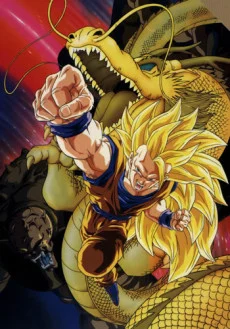
Dragon Ball Z: Wrath of the Dragon is a 1995 theatrical feature that sits near the end of the original Dragon Ball Z movie run, and it stands out within that group by telling a tight, self-contained story. At roughly fifty-one minutes it wastes little time on setup, moving quickly toward its central problem: a monster sealed inside a music box, a brooding swordsman named Tapion, and a schemer determined to release what should have stayed locked away.
The film's appeal is its focus. Rather than juggling the entire cast, it keeps its attention on Goku, Tapion, and the escalating struggle against Hirudegarn, building toward a new technique Goku must master before the fight is lost. Tapion, designed by series creator Akira Toriyama, brings an unusual melancholy to the material, and the swordplay and large-scale monster battles give the movie a lively, physical energy for viewers who like martial arts action with a fantasy edge.
Because the plot closes on itself and demands little prior knowledge, this is one of the easier Dragon Ball Z films to try on its own, and its mild content level makes it approachable for younger or newer viewers as well. An English dub is available, and it streams on Crunchyroll and Bilibili TV. Longtime fans get a brisk theatrical outing built around one of the franchise's stronger guest characters, while newcomers can treat it as a compact adventure with a surprisingly somber hero at its center.
Synopsis
Dragon Ball Z: Wrath of the Dragon is a 1995 feature film set within the Dragon Ball Z storyline, arriving after the defeat of Kid Buu. When the Z Warriors come into possession of an ancient music box that no amount of force can open, a stranger named Hoi urges them to use the Dragon Balls to break its seal. What they release instead is Tapion, a warrior who had bound himself inside the box together with a monstrous creature called Hirudegarn.
Tapion proves to be a guarded, sorrowful swordsman, and he becomes the emotional center of the story as Goku, Gohan, and the rest of the fighters try to understand who he is and what he has been guarding against. The ensemble cast of familiar Z Warriors provides the ensemble backdrop, while Tapion's presence introduces a new figure whose past is tied directly to the danger now threatening the planet.
The primary conflict centers on Hoi's motives and the looming possibility that Hirudegarn will be set loose on Earth. Since ordinary attacks cannot stop such a creature, Goku works toward perfecting a new technique that might be able to finish it, and Tapion's knowledge of the monster becomes essential to the heroes' efforts to protect the world.
Trailer
Should You Watch It?
Watch it if you enjoy
- Watch if you want a self-contained Dragon Ball Z movie with a clear monster threat and a new Goku technique.
- Try it if you enjoy martial arts fantasy built around a brooding swordsman, Tapion, and large-scale monster battles.
- A good pick if you are following the Z movies in release order or want an easy side story after the Majin Buu arc.
- Watch if you appreciate Akira Toriyama-designed characters and a film that demands little prior movie knowledge.
It may not suit you if
- May not suit viewers who prefer the serialized Dragon Ball Z arcs; this is an optional side story, not a required chapter.
- May not appeal if you want deep ensemble focus, since the film keeps attention on Goku, Tapion, and Hirudegarn.
- May feel slight if you dislike short, standalone theatrical adventures with a quick setup and a single main threat.
- May not suit those seeking a direct manga arc adaptation; this is an original screen story created for the movie.
The primary starting work is a movie, so the full film is the natural Volluble Test Drive. This gives you the complete story instead of applying an episodic trial to a feature-length work.
Why It Connects With Audiences
Why people love it
- Tapion's melancholy presence gives the movie an unusual emotional center for a Dragon Ball Z feature.
- The focus on swordplay and escalating monster battles can be a draw for martial arts action fans.
- Its self-contained plot and roughly 51-minute runtime make it easy to enjoy without prior movie viewing.
- Akira Toriyama's designs for Tapion and Minotia are a notable franchise-specific highlight.
Common criticisms
- Some viewers may find the story slight or predictable, with one main monster threat and limited setup.
- The film may be criticized for keeping most Z Warriors in supporting roles while Goku and Tapion dominate.
- Because it is an original side story, it may feel non-essential to the larger Dragon Ball Z continuity.
- Those wanting deeper worldbuilding or a manga-faithful arc may find it limited by its short runtime.
Volluble DNA
A quick profile of the title’s dominant storytelling ingredients.
Characters and Voice Actors17 characters
Gokuu Son
Main character- Japanese: Masako Nozawa
- English: Sean Schemmel
Gohan Son
Main character- English: Kyle Hebert
- Japanese: Masako Nozawa
Trunks
Main character- Japanese: Takeshi Kusao
- English: Laura Bailey
Tapion
Main character- Japanese: Hiro Yuuki
- English: Jason Liebrecht
Bulma
Supporting character- Japanese: Hiromi Tsuru
- English: Tiffany Vollmer
Vegeta
Supporting character- English: Christopher Sabat
- Japanese: Ryou Horikawa
Videl
Supporting character- Japanese: Yuuko Minaguchi
- English: Kara Edwards
Sharpner
Supporting character- Japanese: Hiro Yuuki
Kuririn
Supporting character- Japanese: Mayumi Tanaka
- English: Sonny Strait
Goten Son
Supporting character- Japanese: Masako Nozawa
- English: Kara Edwards
Shen Long
Supporting character- English: Christopher Sabat
- Japanese: Shin Aomori
Muten Roushi
Supporting character- English: Mike McFarland
- Japanese: Masaharu Satou
Minosha
Supporting character- Japanese: Mayumi Tanaka
- English: Aaron Dismuke
Hoi
Supporting character- English: Troy Baker
- Japanese: Juuji Matsuda
Hildegarn
Supporting character- English: Robert McCollum
- Japanese: Shin Aomori
Oolong
Background character- English: Bradford Jackson
- Japanese: Naoki Tatsuta
Narrator
Background character- Japanese: Jouji Yanami
Production and Staff12 credits
Production Background
Dragon Ball Z: Wrath of the Dragon is a 1995 Japanese theatrical anime film and the thirteenth feature in the Dragon Ball Z movie line. It opened in Japan on July 15, 1995 as part of the Toei Anime Fair, running roughly 51 minutes. In the franchise's film sequence it arrived after Dragon Ball Z: Fusion Reborn and before Dragon Ball Z: Battle of Gods. Its Japanese title, rendered as Dragon Fist Explosion!! If Goku Won't Do It, Who Will?, points directly to the new technique that drives the movie's climax.
The film draws on the manga as its source material, but its story is built around characters created specifically for this theatrical entry. Series creator Akira Toriyama designed both Tapion and Minotia, the warrior and his counterpart introduced here. The plot follows the magician Hoi and his attempt to unleash the monster Hirudegarn on Earth, which pushes Goku and the other Z Warriors to seek Tapion's help and to develop the means of defeating the creature. Tapion's arrival from a sealed music box, opened with the dragon balls, gives the movie its central setup.
Wrath of the Dragon remains a standalone theatrical chapter rather than a continuation of the broadcast series arcs, and it has stayed available to international viewers through an English dub and streaming on Crunchyroll and Bilibili TV.
Franchise Context
This entry is a single theatrical feature within the Dragon Ball Z anime line, the thirteenth Dragon Ball Z film, released in Japan on July 15, 1995 as part of the Toei Anime Fair. It belongs to the wider Dragon Ball franchise that grew out of Akira Toriyama's manga and expanded into television anime, feature films and later revival productions. It is neither the starting point of that franchise nor a retelling of it, but one self-contained movie installment in a long running series of films.
In terms of source relationship, the movie is an original story written for the screen rather than a direct adaptation of a specific manga arc, although the franchise as a whole draws its source material from the manga. Its events are positioned after the defeat of Kid Buu in the Dragon Ball Z television continuity, placing it late in that era of the story. It stands apart from the serialized episodes as a side story, introducing characters of its own such as the warrior Tapion and his brother Minotia, both designed by series creator Akira Toriyama, alongside the monster Hirudegarn.
Within release order, the film follows Dragon Ball Z: Fusion Reborn and precedes the later theatrical entry Dragon Ball Z: Battle of Gods, which arrived years afterward. Because it is a stand-alone theatrical work rather than a numbered continuation of the television episodes, it functions as a companion piece to the main Dragon Ball Z narrative instead of an essential step in it, and it remains available with an English dub on streaming services.
Where This Fits in Dragon Ball
A spoiler-light guide to where this exact work fits within the broader Dragon Ball franchise.
-
Step 1
Start with the core Dragon Ball and Dragon Ball Z anime, reaching at least the end of the Majin Buu arc. This film is set after Kid Buu's defeat, so that background supplies the character context and power scale without requiring prior movie viewing.
-
Step 2
If you are following the Dragon Ball Z movies in release order, watch Dragon Ball Z: Fusion Reborn before this film. Wrath of the Dragon is the thirteenth Dragon Ball Z feature and was originally preceded by Fusion Reborn.
-
Step 3
Watch Dragon Ball Z: Wrath of the Dragon as an optional, self-contained movie. It is not required for the main story and can be skipped, but it fits naturally as a side adventure after the Buu Saga.
-
Step 4
After this film, the Dragon Ball Z film line continues with Dragon Ball Z: Battle of Gods. That later movie begins a revival era and is not a direct continuation of this movie's standalone plot.
Franchise Path
- Watch after Dragon Ball Z's Majin Buu arc; this self-contained movie is set after Kid Buu's defeat.
- In the Dragon Ball Z film line, it follows Dragon Ball Z: Fusion Reborn and precedes Dragon Ball Z: Battle of Gods.
- No prior movie viewing is required; it works as the thirteenth standalone Dragon Ball Z feature.
After You Finish
Continue with
- No direct sequel continues Wrath of the Dragon; its conflict resolves within the film.
- For the next Dragon Ball Z film in release order, continue with Dragon Ball Z: Battle of Gods, a later revival-era entry.
Community Verdict
Quick reader and viewer signals from the Volluble community.
Would you recommend this?
Did the ending satisfy you?
Would you watch it again?
Try Something Similar
0 Comments
Be the first to comment.