
Overview
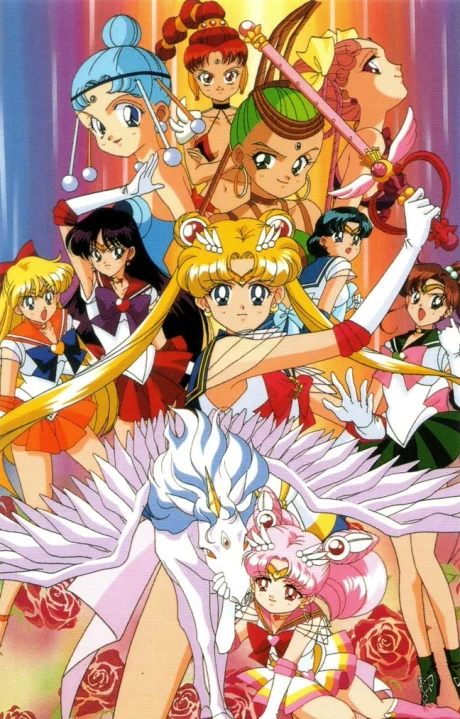
Sailor Moon SuperS is a finished 39-episode TV anime that turns its magical-girl formula toward dreams, imagination, and a more playful everyday rhythm. Its circus imagery, animal and mythological motifs, and supernatural conflicts give the season a distinctive storybook quality, while comedy and romance keep the atmosphere approachable. The result is an experience that can move from bright ensemble banter to genuine danger without abandoning its sense of wonder.
What makes SuperS matter as an individual work is its attention to Chibi-usa and the emotional world of the Sailor Team. The season favors character relationships, recurring personal challenges, and the strength of a found family, giving its battles an intimate purpose rather than treating spectacle as the main attraction. Its female-led cast and coming-of-age concerns remain central, with each heroine contributing to the group’s identity and momentum. Viewers who enjoy episodic fantasy, magical transformations, female warriors, and a balance of action, comedy, and romance may find it especially welcoming. It is also a gentle entry point for audiences drawn to colorful 1990s anime, provided they are comfortable with a serialized setting and an ensemble whose bonds are part of the appeal.
Synopsis
Sailor Moon SuperS follows Chibi-usa as she takes a more prominent role alongside Usagi Tsukino and the other Sailor Guardians. While the team continues balancing school, friendships, romance, and everyday city life, a mysterious new threat disrupts the peace. The season combines the Guardians’ supernatural battles with a lighter, more comedic look at their lives, while keeping Chibi-usa’s growth and changing relationship with the team at its center.
The danger comes from the Dead Moon Circus, an enemy force seeking the Golden Dream Mirror, an object that could grant them power to rule the world. To locate it, the circus targets innocent people and searches their dreams for hidden potential, turning ordinary encounters into unsettling attacks. Chibi-usa is also connected to Pegasus, a mysterious ally who appears within her dreams and asks for protection. As Usagi, Chibi-usa, and the Sailor Guardians investigate the circus’s activities, they face opponents tied to dreams, ambition, and revenge while working to defend both their community and the people whose inner hopes are under threat. New abilities strengthen the team, but the conflict also challenges the Guardians to understand their own aspirations and the importance of standing together.
Trailer
Should You Watch It?
Watch it if you enjoy
- Choose this if you enjoy magical-girl action, colorful transformations, and a female-led ensemble.
- It suits viewers interested in Chibi-usa’s growth, Pegasus, and the Dream arc’s circus-and-dream imagery.
- Start after the earlier Sailor Moon seasons, since this is the fourth season and continues their story.
It may not suit you if
- The lighter, more comedic slice-of-life emphasis may not suit viewers seeking the previous season’s more serious tone.
- Its episodic structure and strong focus on Chibi-usa may be less appealing if you prefer a tightly serialized Usagi-centered story.
This automatic starting point balances the series length, pacing, time commitment, and available Volluble research data. Editors can override it when firsthand knowledge suggests a better entry point.
Why It Connects With Audiences
Why people love it
- The season gives Chibi-usa and the Sailor Team added emotional focus within a found-family framework.
- Dead Moon Circus, dream powers, Pegasus, and mythological motifs create a distinctive storybook atmosphere.
- Comedy, romance, everyday school life, and supernatural battles are balanced across its 39-episode run.
Common criticisms
- The episodic format can make the central conflict feel less consistently urgent than a more tightly serialized approach.
- The shift toward lighter comedy and slice-of-life material may feel uneven for viewers expecting a darker continuation.
Volluble DNA
A quick profile of the title’s dominant storytelling ingredients.
Characters and Voice Actors25 characters
Usagi Tsukino
Main character- Japanese: Kotono Mitsuishi
- English: Stephanie Sheh
- English: Linda Ballantyne
Ami Mizuno
Main character- Japanese: Aya Hisakawa
- English: Kate Higgins
- English: Liza Balkan
Rei Hino
Main character- Japanese: Michie Tomizawa
- English: Cristina Vee
- English: Katie Griffin
Makoto Kino
Main character- Japanese: Emi Shinohara
- English: Susan Roman
- English: Amanda Celine Miller
Minako Aino
Main character- Japanese: Rica Fukami
- English: Emilie-Claire Barlow
- English: Cherami Leigh
Chibiusa
Main character- Japanese: Kae Araki
- English: Sandy Fox
- English: Stephanie Beard
Mamoru Chiba
Main character- Japanese: Tooru Furuya
- English: Vincent Corazza
- English: Robbie Daymond
Helios
Main character- Japanese: Taiki Matsuno
- English: Chris Niosi
- English: Robert Bockstael
Joou Nehellenia
Main character- Japanese: Yoshiko Sakakibara
- English: Laura Post
- English: Lisa Dalbello
Zirconia
Main character- English: Barbara Goodson
- Japanese: Hisako Kyouda
- English: Robert Bockstael
Luna
Supporting character- English: Michelle Ruff
- Japanese: Keiko Han
- English: Jill Frappier
Artemis
Supporting character- English: Johnny Yong Bosch
- Japanese: Yasuhiro Takato
- English: Ron Rubin
Naru Oosaka
Supporting character- English: Danielle Judovits
- English: Mary Long
- Japanese: Shino Kakinuma
Gurio Umino
Supporting character- Japanese: Keiichi Nanba
- English: Benjamin Isaac Diskin
- English: Roland Parliament
Motoki Furuhata
Supporting character- Japanese: Yuuki Satou
- English: Lucien Dodge
Unazuki Furuhata
Supporting character- English: Veronica Taylor
- Japanese: Miyako Endou
- English: Daniela Olivieri
Yuuichirou Kumada
Supporting character- English: Wally Wingert
- Japanese: Bin Shimada
- English: Steven Bednarski
Tiger’s Eye
Supporting character- Japanese: Ryoutarou Okiayu
- English: Jason Barr
- English: John Eric Bentley
Diana
Supporting character- Japanese: Kumiko Nishihara
- English: Debi Derryberry
- English: Loretta Jafelice
Grandpa Hino
Supporting character- English: Michael Sorich
- Japanese: Tomomichi Nishimura
- English: David Fraser
Fish Eye
Supporting character- Japanese: Akira Ishida
- English: Erik Scott Kimerer
- English: Deborah Drakeford
Hawk’s Eye
Supporting character- Japanese: Toshio Furukawa
- English: Michael Yurchak
- English: Benji Plener
CereCere
Supporting character- Japanese: Yuri Amano
- English: Cassandra Morris
- English: Daniela Olivieri
PallaPalla
Supporting character- English: Jennifer Gould
- Japanese: Machiko Toyoshima
- English: Xanthe Huynh
JunJun
Supporting character- Japanese: Kumiko Watanabe
- English: Mary Long
- English: Erika Ishii
Production and Staff26 credits
View all 14 additional credits
Production Background
Sailor Moon SuperS is a 39-episode television anime produced by Toei Animation and directed by Kunihiko Ikuhara. It adapts the Dream arc of Naoko Takeuchi’s Sailor Moon manga, placing Chibi-usa and the Sailor Team at the center of its story. The production shifts toward a lighter, more comedic slice-of-life tone while continuing the series’ magical-girl action and romance framework. Its central conflict involves the Dead Moon Circus, Queen Nehelenia, and the search for the Golden Dream Mirror, while Helios takes refuge within Chibi-usa’s dreams as Pegasus.
The series began broadcasting in Japan on TV Asahi on March 4, 1995, and concluded on March 2, 1996. It was originally released under the title Pretty Soldier Sailor Moon SuperS, with the Japanese title 美少女戦士セーラームーン Super S, and was later also known as Pretty Guardian Sailor Moon SuperS. As an adaptation of Takeuchi’s manga, this television production presents the Dream arc in an episodic format and gives particular emphasis to Chibi-usa, the Sailor Guardians’ developing powers, and the conflict surrounding the Dead Moon Circus.
Franchise Context
Sailor Moon SuperS is the fourth television season in the Sailor Moon anime, making it a continuation of the preceding Sailor Moon installments rather than a remake, spin-off, or stand-alone production. This individual series was produced as a finished 39-episode anime that began in 1995, continuing the ongoing story of Usagi Tsukino and the Sailor Guardians within the established television continuity.
The season is also an adaptation of the Dream arc from Naoko Takeuchi’s Sailor Moon manga. Its franchise role is therefore that of a later anime adaptation, not an original side story or a separate version of the characters. SuperS places greater emphasis on Chibi-usa and the wider Sailor team, while introducing the Dead Moon Circus conflict, Pegasus, and further power developments for the Sailor Guardians. These elements distinguish this season’s arc and tone while keeping it connected to the larger anime sequence.
Where This Fits in Sailor Moon
A spoiler-light guide to where this exact work fits within the broader Sailor Moon franchise.
Exact position: This is Main anime entry 4 and main anime entry 4 of 6. It follows Sailor Moon S.
-
Step 1
Begin with the earlier Sailor Moon anime seasons, since SuperS is identified as the fourth season and continues the established story of Usagi and the Sailor Guardians.
-
Step 2
Watch Sailor Moon SuperS as the Dream arc, with its focus on Chibi-usa, Pegasus, and the Dead Moon Circus.
-
Step 3
Afterward, continue with the next anime installment in the franchise. This is a main-series season rather than an optional side story or an alternate remake.
Franchise Path
After You Finish
Continue with
Community Verdict
Quick reader and viewer signals from the Volluble community.
Would you recommend this?
Did the ending satisfy you?
Would you watch it again?
Sources2 sources
Report an issue
Spot something wrong on this page? Tell us what needs attention.
0 Comments
Be the first to comment.