
Trailer
Should You Watch It?
Watch it if you enjoy
- You want a direct anime continuation of Season 1 that expands the U.A. school and its hero-training rivalries.
- You enjoy shonen action-comedy built around a superhero academy, tournaments, and ensemble cast battles.
- You are interested in the U.A. Sports Festival, Hero Killer, and Final Exams arcs from the manga's volumes 3–8.
- You prefer to watch with an English dub or via multiple streaming outlets such as Hulu, Crunchyroll, or Netflix.
It may not suit you if
- You have not seen My Hero Academia Season 1; this season opens directly after its finale and assumes its Quirk and school setup.
- You dislike tournament-style school competitions or superhero stories with a large teen ensemble and many rivals.
- You want a fully stand-alone story; this is a middle franchise chapter that continues into later seasons or manga volume 9 onward.
- You prefer low-stakes slice-of-life; the season includes fighting, revenge-themed conflict, and hero-villain confrontations.
This automatic starting point balances the series length, pacing, time commitment, and available Volluble research data. Editors can override it when firsthand knowledge suggests a better entry point.
Why It Connects With Audiences
Why people love it
- The season adapts three manga arcs—Sports Festival, Vs. Hero Killer, and Final Exams—offering a mix of competition, confrontation, and school tests.
- Studio Bones returns with director Kenji Nagasaki, series composer Yōsuke Kuroda, character designer Yoshihiko Umakoshi, and composer Yuki Hayashi.
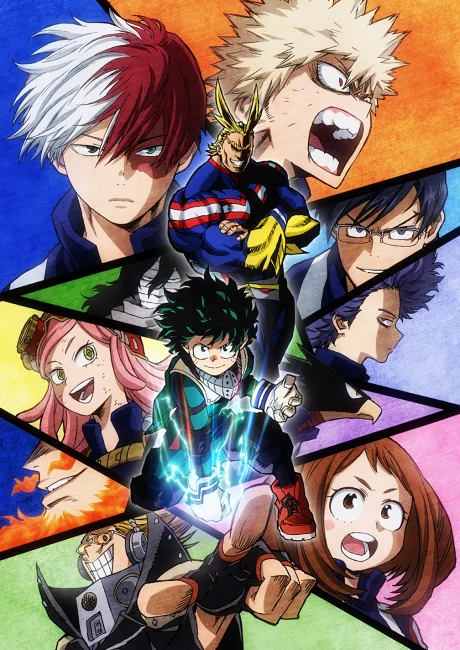
- The ensemble cast lets many U.A. classes and hero-course students compete, with Midoriya getting a public chance to show his Quirk.
- The season follows directly from Season 1 and is available with an English dub on multiple streaming services.
Common criticisms
- The three-arc structure may feel uneven to viewers who prefer one continuous storyline rather than shifting between school event, villain hunt, and exams.
- The Sports Festival's multi-round tournament format can feel lengthy for those who want the main hero-villain plot to advance faster.
- Newcomers may find the large cast and prior-season assumptions difficult to follow without watching Season 1 first.
- A recap episode numbered 13.5 falls outside the season's main arcs and may interrupt the binge flow for some viewers.
Volluble DNA
A quick profile of the title’s dominant storytelling ingredients.
Characters and Voice Actors25 characters
Izuku Midoriya
Main character- Japanese: Daiki Yamashita
- English: Justin Briner
Katsuki Bakugou
Main character- Japanese: Nobuhiko Okamoto
- English: Clifford Chapin
Shouto Todoroki
Main character- English: David Matranga
- Japanese: Yuuki Kaji
- Japanese: Kei Shindou
Ochako Uraraka
Main character- Japanese: Ayane Sakura
- English: Luci Christian
Tenya Iida
Main character- Japanese: Kaito Ishikawa
- English: J. Michael Tatum
Toshinori Yagi
Main character- Japanese: Kenta Miyake
- English: Christopher Sabat
Tsuyu Asui
Supporting character- English: Monica Rial
- Japanese: Aoi Yuuki
Shouta Aizawa
Supporting character- English: Christopher Wehkamp
- Japanese: Junichi Suwabe
Tomura Shigaraki
Supporting character- Japanese: Kouki Uchiyama
- English: Eric Vale
Momo Yaoyorozu
Supporting character- Japanese: Marina Inoue
- English: Colleen Clinkenbeard
Hitoshi Shinsou
Supporting character- English: Jarrod Greene
- Japanese: Wataru Hatano
Eijirou Kirishima
Supporting character- Japanese: Toshiki Masuda
- English: Justin Cook
Minoru Mineta
Supporting character- Japanese: Ryou Hirohashi
- English: Brina Palencia
Mina Ashido
Supporting character- Japanese: Eri Kitamura
- English: Caitlin Glass
Mei Hatsume
Supporting character- Japanese: Shiori Sakurai
- English: Alexis Tipton
Denki Kaminari
Supporting character- Japanese: Tasuku Hatanaka
- English: Kyle Phillips
Hanta Sero
Supporting character- Japanese: Kiyotaka Furushima
- English: Christopher Bevins
Mashirao Ojiro
Supporting character- Japanese: Kousuke Miyoshi
- English: Mike McFarland
Kyouka Jirou
Supporting character- English: Trina Nishimura
- Japanese: Kei Shindou
Fumikage Tokoyami
Supporting character- Japanese: Yoshimasa Hosoya
- English: Jessie James Grelle
Mezou Shouji
Supporting character- Japanese: Masakazu Nishida
- English: Ian Sinclair
Tooru Hagakure
Supporting character- Japanese: Kaori Nazuka
- English: Felecia Angelle
Kouji Kouda
Supporting character- Japanese: Takuma Nagatsuka
- English: Greg Ayres
Rikidou Satou
Supporting character- English: Cris George
- Japanese: Tooru Nara
Yuu Takeyama
Supporting character- Japanese: Kaori Nazuka
- English: Jamie Marchi
Production and Staff26 credits
View all 14 additional credits
Production Background
My Hero Academia Season 2 was animated at Studio Bones, continuing with much of the team assembled for the show's first season. Kenji Nagasaki returned as director, with Yōsuke Kuroda handling series composition, Yoshihiko Umakoshi providing character designs, and Yuki Hayashi composing the music. The season draws on Kōhei Horikoshi's original manga, adapting material from the remainder of the third volume through the close of the eighth.
The broadcast run began on April 1, 2017 and finished on September 30, 2017, spanning 25 episodes of roughly 24 minutes each, aired in Japan on ytv and NTV. Its story is built around three arcs from the source: the U.A. Sports Festival, the confrontation with the Hero Killer, and the final exams, matching chapters 22 through 69. A recap episode numbered 13.5 falls outside those arcs, as does chapter 70, which belongs to a separate storyline.
An English dub was produced for this season, and it has been carried by several streaming outlets, among them Hulu, Crunchyroll, Netflix, iQ, and FunimationNow.
Franchise Context
My Hero Academia Season 2 is the second television season of the My Hero Academia anime franchise, continuing the story that began in the first season. It is not a spin-off, reboot, or stand-alone entry. Rather, it is a direct continuation of the anime adaptation of Kohei Horikoshi's manga. The season first aired in Japan in 2017 and was produced by Bones, with Kenji Nagasaki directing and Yosuke Kuroda overseeing series composition.
Within the larger franchise, this season functions as an adaptation of a specific stretch of the source manga. It draws from the remainder of the third volume through the end of the eighth volume, covering the U.A. Sports Festival, the Hero Killer, and final exam storylines. It sits between the first anime season and the seasons that follow, serving as a middle chapter in the ongoing anime timeline. Viewers who want the full franchise experience can treat it as a sequel season that expands the world and cast rather than as a separate work.
Where This Fits in My Hero Academia
A spoiler-light guide to where this exact work fits within the broader My Hero Academia franchise.
Exact position: This is Season 2 and main anime entry 2 of 8. It follows My Hero Academia.
-
Step 1
Begin with My Hero Academia Season 1, since this season opens directly after that finale and assumes its school, class, and Quirk setup.
-
Step 2
Watch My Hero Academia Season 2 next as a mainline continuation, not an optional side story or alternate retelling.
-
Step 3
Expect this season to adapt the U.A. Sports Festival, Vs. Hero Killer, and Final Exams arcs, covering roughly manga volumes 3 through 8.
-
Step 4
After finishing, continue with the next anime season or move to the manga from volume 9 onward if you prefer reading ahead.
Franchise Path
After You Finish
Continue with
Community Verdict
Quick reader and viewer signals from the Volluble community.
Would you recommend this?
Did the ending satisfy you?
Would you watch it again?
Report an issue
Spot something wrong on this page? Tell us what needs attention.
0 Comments
Be the first to comment.