
Synopsis
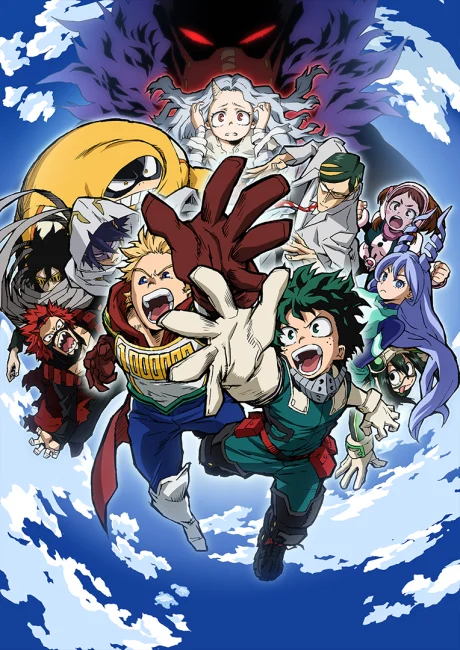
My Hero Academia Season 4 picks up with Izuku Midoriya and his classmates stepping out of the classroom and into full hero work-studies. Izuku joins the agency of the foresight hero Sir Nighteye, where he works alongside third-year student Mirio Togata, a cheerful and remarkably capable upperclassman whose skill gives Izuku a daunting standard to measure himself against. The internship draws the pair into an investigation of the Shie Hassaikai, a yakuza organization led by the masked and methodical Overhaul, who is pursuing a drug capable of erasing Quirks. A young girl named Eri sits at the center of that operation, and reaching her becomes the driving objective of the season's main arc.
Meanwhile, the criminal underworld remains unsettled in the wake of All For One's downfall. Tomura Shigaraki and the League of Villains move to expand their own influence, putting them in direct competition with the yakuza over control of the shadows. That rivalry unfolds alongside the heroes' mission and adds a second front of pressure, as shifting loyalties among villains close in around the students without their full awareness.
Across its run the season balances that tense operation with lighter school material, including a remedial training arc for students who need to sharpen their public image and a school festival that gives the ensemble cast room for comedy. Later episodes widen the view toward the professional hero world, showing how the students' training intersects with the duties and dangers faced by working heroes. The result is a stretch of the story that mixes large-scale conflict with quieter character moments for Izuku, Mirio, and their classmates.
Opening
Should You Watch It?
Watch it if you enjoy
- You're following My Hero Academia in order and want Season 4's hero work-studies, Shie Hassaikai operation, and League of Villains rivalry.
- You enjoy shounen action with school-life breaks, ensemble teen heroes, and a yakuza crime plot centered on a Quirk-erasing drug and a rescue mission.
- You want a 25-episode continuation that adapts manga arcs from late volume 14 through early volume 21 without rebooting the premise.
It may not suit you if
- You haven't seen earlier seasons; this assumes returning characters, the hero internship system, and the fallout from All For One's downfall.
- You prefer self-contained stories, since the season continues a larger narrative and sets up later seasons rather than resolving everything.
- You dislike darker crime arcs involving yakuza, drugs, terrorism, and a young girl at the center of a dangerous operation, despite lighter school festival material.
This automatic starting point balances the series length, pacing, time commitment, and available Volluble research data. Editors can override it when firsthand knowledge suggests a better entry point.
Why It Connects With Audiences
Why people love it
- The season pairs a high-stakes yakuza investigation with Mirio's standout upperclassman presence, giving Izuku a daunting standard to measure against.
- Overhaul is framed as a methodical masked antagonist, and the League of Villains' parallel power struggle adds a second front of pressure.
- The arc structure mixes tense operation material with lighter U.A. School Festival and remedial course episodes, offering tonal variety.
- Bones' production and the 25-episode run adapt a substantial block of Horikoshi's manga, from late volume 14 into volume 21.
Common criticisms
- The season's multiple arcs and large ensemble can feel uneven, with the main operation interrupted by lighter school-focused episodes.
- Viewers who want immediate progression after All For One's downfall may find the League of Villains' expanded role develops slowly.
- Because it begins mid-story, newcomers may struggle with assumed knowledge and the large returning cast.
- Some may feel the 25-episode adaptation stretches certain manga material or shifts focus between heroes and villains.
Volluble DNA
A quick profile of the title’s dominant storytelling ingredients.
Characters and Voice Actors25 characters
Izuku Midoriya
Main character- Japanese: Daiki Yamashita
- English: Justin Briner
Mirio Togata
Main character- Japanese: Tarusuke Shingaki
- English: Ricco Fajardo
Eri
Main character- English: Emily Neves
- Japanese: Seiran Kobayashi
Kai Chisaki
Main character- Japanese: Kenjirou Tsuda
- English: Kellen Goff
Mirai Sasaki
Main character- Japanese: Shinichirou Miki
- English: Brandon McInnis
Katsuki Bakugou
Supporting character- Japanese: Nobuhiko Okamoto
- English: Clifford Chapin
Shouto Todoroki
Supporting character- English: David Matranga
- Japanese: Yuuki Kaji
Ochako Uraraka
Supporting character- English: Luci Christian
- Japanese: Ayane Sakura
Tenya Iida
Supporting character- English: J. Michael Tatum
- Japanese: Kaito Ishikawa
Tsuyu Asui
Supporting character- English: Monica Rial
- Japanese: Aoi Yuuki
Toshinori Yagi
Supporting character- English: Christopher Sabat
- Japanese: Kenta Miyake
Shouta Aizawa
Supporting character- Japanese: Junichi Suwabe
- English: Christopher Wehkamp
Tomura Shigaraki
Supporting character- English: Eric Vale
- Japanese: Kouki Uchiyama
Momo Yaoyorozu
Supporting character- Japanese: Marina Inoue
- English: Colleen Clinkenbeard
Eijirou Kirishima
Supporting character- English: Justin Cook
- Japanese: Toshiki Masuda
Minoru Mineta
Supporting character- Japanese: Ryou Hirohashi
- English: Brina Palencia
Mina Ashido
Supporting character- English: Caitlin Glass
- Japanese: Eri Kitamura
Mei Hatsume
Supporting character- English: Alexis Tipton
- Japanese: Shiori Sakurai
Denki Kaminari
Supporting character- Japanese: Tasuku Hatanaka
- English: Kyle Phillips
Jin Bubaigawara
Supporting character- Japanese: Daichi Endou
- English: Newton Pittman
Hanta Sero
Supporting character- Japanese: Kiyotaka Furushima
- English: Christopher Bevins
Mashirao Ojiro
Supporting character- English: Mike McFarland
- Japanese: Kousuke Miyoshi
Kyouka Jirou
Supporting character- Japanese: Kei Shindou
- English: Trina Nishimura
Fumikage Tokoyami
Supporting character- English: Jessie James Grelle
- Japanese: Yoshimasa Hosoya
Mezou Shouji
Supporting character- English: Ian Sinclair
- Japanese: Masakazu Nishida
Production and Staff26 credits
View all 14 additional credits
Production Background
My Hero Academia Season 4 was produced by the studio Bones, with Kenji Nagasaki credited as chief director and Masahiro Mukai as director. The season adapts Kōhei Horikoshi's original My Hero Academia manga, drawing its material from the second half of the fourteenth volume through the opening chapters of the twenty-first volume. Across its 25 episodes, the season covers the Shie Hassaikai arc (chapters 125 to 162), the Remedial Course arc (chapters 163 to 168), the U.A. School Festival arc (chapters 169 to 183), and the first part of the Pro Hero arc (chapters 184 to 190), while partially including chapters 191 to 193.
The season aired from October 12, 2019 to April 4, 2020 on ytv and NTV, placing it in the Fall 2019 broadcast season. Each episode runs roughly 24 minutes, and the finished season consists of 25 episodes. An English dub was produced, and the season has been made available through multiple streaming services, including Crunchyroll, Hulu, Amazon Prime Video, iQ, Netflix, and FunimationNow.
Franchise Context
My Hero Academia Season 4 is the fourth television installment in the My Hero Academia anime franchise, continuing the adaptation of Kōhei Horikoshi's manga. It picks up where the previous season left off, functioning as a direct continuation rather than a reboot, spin-off, or stand-alone entry, and it retains the same core cast and production studio, Bones, as the earlier seasons.
This entry remains an adaptation of the source manga rather than an original story. Its twenty-five episodes adapt material spanning from roughly the second half of the fourteenth manga volume into the opening chapters of the twenty-first, arranged into several story arcs. As a numbered season, it is one component of a much larger franchise that also includes films and further seasons, and it assumes viewers already know the characters and events established beforehand.
Within the franchise's viewing order, Season 4 sits on the main narrative line with no alternate-continuity status. Later seasons carry the story forward from its conclusion, so it serves as a bridge between what precedes it and what follows.
Where This Fits in My Hero Academia
A spoiler-light guide to where this exact work fits within the broader My Hero Academia franchise.
Exact position: This is Season 4 and main anime entry 4 of 8. It follows My Hero Academia Season 3.
-
Step 1
Begin with the earlier My Hero Academia anime seasons, watched in their original order, so the returning cast, the school setting, and the hero internship system are already familiar before this season begins.
-
Step 2
Move on to this fourth season only after those earlier seasons, since it continues the same ongoing storyline and adapts a later stretch of the source manga rather than restarting the premise.
-
Step 3
Treat this as a mainline, non-optional installment, not a recap, filler, or alternate version; it carries a full 25-episode arc that later seasons build upon.
-
Step 4
Once this season is finished, continue with the following seasons in release order to follow the storylines that grow out of the events established here.
Franchise Path
After You Finish
Continue with
Community Verdict
Quick reader and viewer signals from the Volluble community.
Would you recommend this?
Did the ending satisfy you?
Would you watch it again?
Report an issue
Spot something wrong on this page? Tell us what needs attention.
0 Comments
Be the first to comment.