
Overview
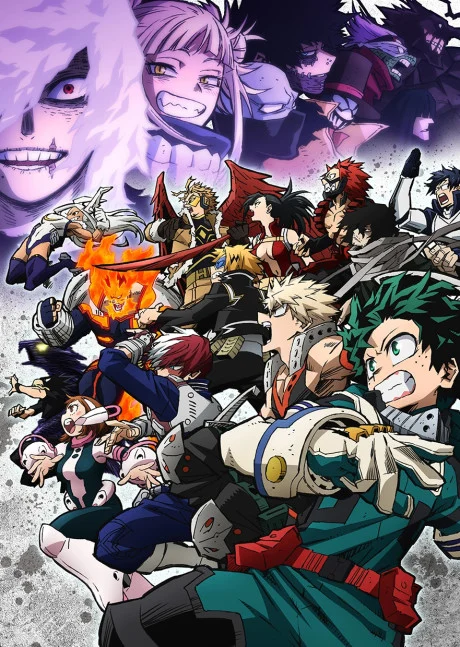
My Hero Academia Season 6 is a pivotal television season that pushes the long-running story into a darker, more expansive mode. Its 25-episode run focuses on a large-scale confrontation and the emotional fallout that follows, giving established character arcs room to collide and mature. For viewers already invested in the journey, this is where earlier build-up pays off in sustained action, moral strain, and a noticeably more serious tone.
The experience is best described as ensemble superhero drama crossed with war-story urgency. The season balances spectacle with consequences, and its moderate content level includes intense combat, tragedy, and terrorism-related themes. It is not a lighthearted school adventure, though the U.A. students remain central to the emotional core.
Because it continues an established narrative, My Hero Academia Season 6 is most approachable for those who have followed the anime or manga up to this point. Newcomers will likely feel lost without prior context. Fans of action-driven shounen, large casts, and stories that let heroism carry real cost will find it especially rewarding. English dub and subtitled streaming options are available.
Synopsis
This sixth season of the My Hero Academia anime adapts the Paranormal Liberation War arc and the Dark Hero arc from Kohei Horikoshi's manga. The story opens with the former Liberation Army reorganized into the Paranormal Liberation Front under Tomura Shigaraki, an organized criminal force whose size, reach, and powerful Quirks make it a direct threat to the Hero Association's ability to maintain order.
Izuku Midoriya and his classmates at U.A. High School are drawn into the response, fighting alongside professional heroes who commit nearly all of their available strength to a surprise raid on the villains' headquarters. Intelligence gathered by the undercover hero Hawks shapes the operation, while figures such as Twice and Gigantomachia give the villains formidable staying power. The central conflict sets a determined hero force against an enemy that must regroup and push back.
The season's later stretch turns to the aftermath of that confrontation, examining a society whose confidence in heroes has been badly shaken and following Midoriya as the pressures of his role intensify. Classmates, mentors, and former rivals all factor into how the heroes respond to a public that is no longer sure whom to trust.
Trailer
Should You Watch It?
Watch it if you enjoy
- You have followed My Hero Academia through earlier seasons and want the payoff of long-building character arcs and confrontations.
- You enjoy ensemble superhero action with a darker, war-story tone and consequences for the heroes.
- You appreciate large-cast shounen stories where heroism carries real cost and moral strain.
It may not suit you if
- You are new to the series; this season continues directly from season 5 and expects prior knowledge of earlier arcs.
- You prefer lighthearted school adventures; this season shifts to a darker, more serious war narrative.
- You are sensitive to intense combat, tragedy, terrorism-related themes, or moderate gore.
This automatic starting point balances the series length, pacing, time commitment, and available Volluble research data. Editors can override it when firsthand knowledge suggests a better entry point.
Why It Connects With Audiences
Why people love it
- The season balances large-scale spectacle with emotional consequences, giving earlier build-up a satisfying payoff.
- It lets established character arcs collide and mature, with the U.A. students remaining central to the emotional core.
- The war-story urgency and darker tone add stakes to the ensemble superhero drama.
Common criticisms
- Because it adapts two arcs and continues an ongoing story, some viewers might find it less satisfying as a stand-alone entry.
- Some may feel the darker, war-focused tone departs from the series' earlier school-adventure feel.
- The season's reliance on prior seasons can make it difficult to follow for newcomers.
Volluble DNA
A quick profile of the title’s dominant storytelling ingredients.
Characters and Voice Actors25 characters
Izuku Midoriya
Main character- Japanese: Daiki Yamashita
- English: Justin Briner
- Japanese: Akeno Watanabe
Tomura Shigaraki
Main character- Japanese: Kouki Uchiyama
- English: Eric Vale
Katsuki Bakugou
Supporting character- Japanese: Nobuhiko Okamoto
- English: Clifford Chapin
- Japanese: Sachi Kokuryuu
Shouto Todoroki
Supporting character- Japanese: Yuuki Kaji
- English: David Matranga
- English: Mikaela Krantz
Ochako Uraraka
Supporting character- Japanese: Ayane Sakura
- English: Luci Christian
Tenya Iida
Supporting character- Japanese: Kaito Ishikawa
- English: J. Michael Tatum
Tsuyu Asui
Supporting character- Japanese: Aoi Yuuki
- English: Monica Rial
Toshinori Yagi
Supporting character- Japanese: Kenta Miyake
- English: Christopher Sabat
Shouta Aizawa
Supporting character- Japanese: Junichi Suwabe
- English: Christopher Wehkamp
Momo Yaoyorozu
Supporting character- Japanese: Marina Inoue
- English: Colleen Clinkenbeard
Eijirou Kirishima
Supporting character- Japanese: Toshiki Masuda
- English: Justin Cook
Minoru Mineta
Supporting character- Japanese: Ryou Hirohashi
- English: Brina Palencia
Mina Ashido
Supporting character- Japanese: Eri Kitamura
- English: Caitlin Glass
Denki Kaminari
Supporting character- Japanese: Tasuku Hatanaka
- English: Kyle Phillips
Jin Bubaigawara
Supporting character- Japanese: Daichi Endou
- English: Newton Pittman
Hanta Sero
Supporting character- Japanese: Kiyotaka Furushima
- English: Christopher Bevins
Kyouka Jirou
Supporting character- Japanese: Kei Shindou
- English: Trina Nishimura
Fumikage Tokoyami
Supporting character- Japanese: Yoshimasa Hosoya
- English: Jessie James Grelle
Mezou Shouji
Supporting character- Japanese: Masakazu Nishida
- English: Ian Sinclair
Tooru Hagakure
Supporting character- Japanese: Kaori Nazuka
- English: Felecia Angelle
Kouji Kouda
Supporting character- Japanese: Takuma Nagatsuka
- English: Greg Ayres
Yuu Takeyama
Supporting character- Japanese: Kaori Nazuka
- English: Jamie Marchi
Mirio Togata
Supporting character- Japanese: Tarusuke Shingaki
- English: Ricco Fajardo
Himiko Toga
Supporting character- Japanese: Misato Fukuen
- English: Leah Clark
Tamaki Amajiki
Supporting character- Japanese: Yuuto Uemura
- English: Aaron Dismuke
Production and Staff26 credits
View all 14 additional credits
Production Background
My Hero Academia Season 6 is the sixth television season of the anime adaptation of Kōhei Horikoshi's manga. It was produced by the studio Bones, with Kenji Nagasaki serving as chief director and Masahiro Mukai as director. The season adapts material from the final chapter of the manga's 26th volume through the end of the 33rd volume, covering the Paranormal Liberation War arc and the Dark Hero arc.
The season aired from October 1, 2022 to March 25, 2023 on ytv and NTV. It ran for 25 episodes across two consecutive cours, with each episode having a runtime of 24 minutes. The first episode partially adapts remaining content from the previous season's manga chapters, while the rest of the season continues the Paranormal Liberation War arc. The anime is available with an English dub on streaming services including Crunchyroll, Hulu, YouTube, and Bilibili TV.
Franchise Context
My Hero Academia Season 6 is the sixth television season in the main anime adaptation of Kōhei Horikoshi's manga, produced by Bones with Kenji Nagasaki as chief director and Masahiro Mukai directing. It continues the story established across the earlier seasons rather than serving as a spin-off, reboot, or stand-alone side story, and it sits within the franchise's primary animated line alongside the manga and the theatrical features.
The season adapts the Paranormal Liberation War and Dark Hero arcs, drawing on material from the end of the manga's 26th volume through the end of the 33rd. Because it follows directly from season 5, viewers are expected to know the earlier arcs, and its events set up the season that follows. Within the wider franchise, this entry marks the point where the long-running school-era storyline gives way to a larger, more consequential conflict, making it a key installment for anyone following the manga-to-anime progression.
Where This Fits in My Hero Academia
A spoiler-light guide to where this exact work fits within the broader My Hero Academia franchise.
Exact position: This is Season 6 and main anime entry 6 of 8. It follows My Hero Academia Season 5.
-
Step 1
Start with My Hero Academia Season 1 and proceed in order through the earlier anime seasons, since this sixth season continues the main storyline rather than resetting it.
-
Step 2
Watch My Hero Academia Season 6 after finishing Season 5. It is a mainline continuation, not an optional spinoff or alternate retelling.
-
Step 3
After this season, continue with the later My Hero Academia anime seasons or pick up the manga from volume 34 onward to follow the story beyond the arcs adapted here.
Franchise Path
After You Finish
Continue with
Community Verdict
Quick reader and viewer signals from the Volluble community.
Would you recommend this?
Did the ending satisfy you?
Would you watch it again?
Try Something Similar
Report an issue
Spot something wrong on this page? Tell us what needs attention.
0 Comments
Be the first to comment.