
Synopsis
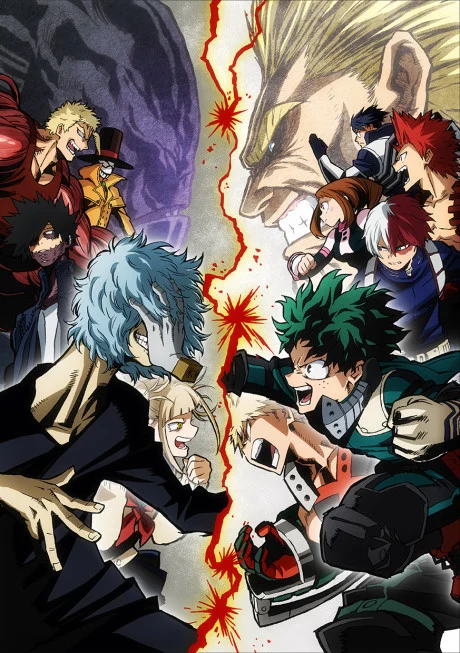
My Hero Academia Season 3 follows Izuku Midoriya and his classmates at U.A. High, a school where young heroes train to use their Quirks. This season places Class 1-A and Class 1-B in a summer training camp led by experienced professional heroes, who push the students to expand their abilities and work together under demanding conditions.
The camp is designed to forge stronger heroes, but the students soon find their exercises overshadowed by an unexpected and dangerous threat. Izuku and his friends must draw on their training, their growing powers, and their bonds with one another as they face a conflict that tests whether they are ready for the realities of hero work.
Opening
Should You Watch It?
Watch it if you enjoy
- Watch if you are continuing the My Hero Academia anime in order and want the next mainline arc after Season 2.
- Watch if you enjoy superhero school stories that mix Quirk training, ensemble classmates, and escalating action.
- Watch if you want Class 1-A and Class 1-B pushed through a demanding summer camp and license exam.
- Read the manga around volume 14 if you prefer to continue past the Shie Hassaikai arc opening after this season.
It may not suit you if
- May not suit viewers seeking a standalone entry; this third season assumes prior knowledge of Seasons 1 and 2.
- May not suit those who prefer self-contained story arcs, since it bridges a larger serialized franchise.
- May not suit viewers looking for a pure school comedy; training turns into a survival conflict.
- May not suit anyone avoiding superhero action, teen-cast drama, or franchise-length commitment.
This automatic starting point balances the series length, pacing, time commitment, and available Volluble research data. Editors can override it when firsthand knowledge suggests a better entry point.
Why It Connects With Audiences
Why people love it
- The season continues the manga adaptation with the Forest Training Camp, Hideout Raid, and Provisional Hero License Exam arcs.
- Bones returns with Kenji Nagasaki directing and Yuki Hayashi composing, keeping the established production team.
- Class 1-A and Class 1-B share the spotlight, expanding the ensemble and Quirk-driven teamwork.
- It builds on Izuku's growth and the bonds among U.A. students while raising the stakes of hero training.
Common criticisms
- As a middle chapter, it may feel less accessible to newcomers who lack prior series context.
- Covering several consecutive arcs can make the season's focus shift between training, rescue conflict, and exams.
- Its role as a bridge in a long franchise may leave some long-running threads unresolved by season's end.
- The darker turn after the camp setup may not match viewers expecting lighter school-life comedy.
Volluble DNA
A quick profile of the title’s dominant storytelling ingredients.
Characters and Voice Actors25 characters
Izuku Midoriya
Main character- Japanese: Daiki Yamashita
- English: Justin Briner
- Japanese: Akeno Watanabe
Katsuki Bakugou
Main character- Japanese: Nobuhiko Okamoto
- English: Clifford Chapin
- Japanese: Sachi Kokuryuu
Toshinori Yagi
Main character- Japanese: Kenta Miyake
- English: Christopher Sabat
Shouto Todoroki
Supporting character- English: David Matranga
- Japanese: Yuuki Kaji
Ochako Uraraka
Supporting character- Japanese: Ayane Sakura
- English: Luci Christian
Tenya Iida
Supporting character- Japanese: Kaito Ishikawa
- English: J. Michael Tatum
Tsuyu Asui
Supporting character- Japanese: Aoi Yuuki
- English: Monica Rial
Shouta Aizawa
Supporting character- English: Christopher Wehkamp
- Japanese: Junichi Suwabe
Tomura Shigaraki
Supporting character- Japanese: Kouki Uchiyama
- English: Eric Vale
Momo Yaoyorozu
Supporting character- English: Colleen Clinkenbeard
- Japanese: Marina Inoue
Eijirou Kirishima
Supporting character- Japanese: Toshiki Masuda
- English: Justin Cook
Minoru Mineta
Supporting character- English: Brina Palencia
- Japanese: Ryou Hirohashi
Mina Ashido
Supporting character- English: Caitlin Glass
- Japanese: Eri Kitamura
Mei Hatsume
Supporting character- Japanese: Shiori Sakurai
- English: Alexis Tipton
Denki Kaminari
Supporting character- Japanese: Tasuku Hatanaka
- English: Kyle Phillips
Jin Bubaigawara
Supporting character- Japanese: Daichi Endou
- English: Newton Pittman
Hanta Sero
Supporting character- Japanese: Kiyotaka Furushima
- English: Christopher Bevins
Mashirao Ojiro
Supporting character- English: Mike McFarland
- Japanese: Kousuke Miyoshi
Kyouka Jirou
Supporting character- English: Trina Nishimura
- Japanese: Kei Shindou
Fumikage Tokoyami
Supporting character- Japanese: Yoshimasa Hosoya
- English: Jessie James Grelle
Mezou Shouji
Supporting character- Japanese: Masakazu Nishida
- English: Ian Sinclair
Tooru Hagakure
Supporting character- Japanese: Kaori Nazuka
- English: Felecia Angelle
Kouji Kouda
Supporting character- Japanese: Takuma Nagatsuka
- English: Greg Ayres
Rikidou Satou
Supporting character- English: Cris George
- Japanese: Tooru Nara
Yuu Takeyama
Supporting character- Japanese: Kaori Nazuka
- English: Jamie Marchi
Production and Staff26 credits
View all 14 additional credits
Production Background
My Hero Academia Season 3 was produced by the animation studio Bones, continuing the television adaptation of Kohei Horikoshi's original manga. Kenji Nagasaki directed the season, with Yosuke Kuroda serving as series composition writer, Yoshihiko Umakoshi handling character designs, and Yuki Hayashi composing the music. The season ran for 25 episodes with a runtime of roughly 24 minutes each, and it aired in Japan from April 7 to September 29, 2018 on ytv and NTV.
The season draws its material from Horikoshi's manga, adapting content that begins partway through the eighth collected volume and continues into the start of the fourteenth. Its episodes cover the Forest Training Camp arc, the Hideout Raid arc, the Provisional Hero License Exam arc, and the opening portion of the Shie Hassaikai arc. This places the season as a direct continuation of the anime's earlier adaptation of the same source manga.
The finished season was made available with an English dub, and it has been distributed through several streaming services including Crunchyroll, Hulu, Netflix, FunimationNow, and iQ. Its genres span action, adventure, comedy, and drama, reflecting the series' blend of superhero conflict and school life.
Franchise Context
My Hero Academia Season 3 sits in the middle of the anime franchise's first long run, arriving after two earlier television seasons and before the fourth. It is neither a reboot nor a side story: it continues the story of Izuku Midoriya and Class 1-A in direct sequence, picking up the threads left open at the close of the previous season and carrying them into a new school term.
Like its predecessors, this entry is a manga adaptation rather than an original story. Studio Bones produced it with much of the same core creative team returning, and it draws on the middle stretch of Kohei Horikoshi's ongoing manga, working through several consecutive arcs. That makes it a serialized continuation of a larger adaptation project rather than a self-contained work that can be watched in isolation.
The broader franchise extends well beyond this season, encompassing feature films, spin-off manga, and further television seasons. Within that structure, Season 3 functions as a bridging chapter that advances long-running character arcs and widens the supporting cast while remaining one installment of a much larger whole. It is best approached as a middle step in the sequence, not as an entry point.
Where This Fits in My Hero Academia
A spoiler-light guide to where this exact work fits within the broader My Hero Academia franchise.
Exact position: This is Season 3 and main anime entry 3 of 8. It follows My Hero Academia Season 2.
-
Step 1
Start at the front of the franchise. This is the third numbered television season of the My Hero Academia anime, so watch Season 1 and then Season 2 before starting here. Nothing in this season is designed as an entry point.
-
Step 2
Treat this season as a mainline, non-optional installment rather than a recap, spin-off, or alternate retelling. It continues the same U.A. High storyline and class roster established by the earlier seasons.
-
Step 3
Know what it covers so you can plan around it. The season adapts the manga from the rest of volume 8 through the beginning of volume 14, taking in the Forest Training Camp, Hideout Raid, and Provisional Hero License Exam arcs, then opening the Shie Hassaikai arc.
-
Step 4
Decide your medium after finishing. Continue with the next anime season to carry on from the Shie Hassaikai arc opening, or switch to the manga around the middle of volume 14 if you would rather read ahead.
Franchise Path
After You Finish
Continue with
Community Verdict
Quick reader and viewer signals from the Volluble community.
Would you recommend this?
Did the ending satisfy you?
Would you watch it again?
Try Something Similar
Report an issue
Spot something wrong on this page? Tell us what needs attention.
0 Comments
Be the first to comment.