
Synopsis
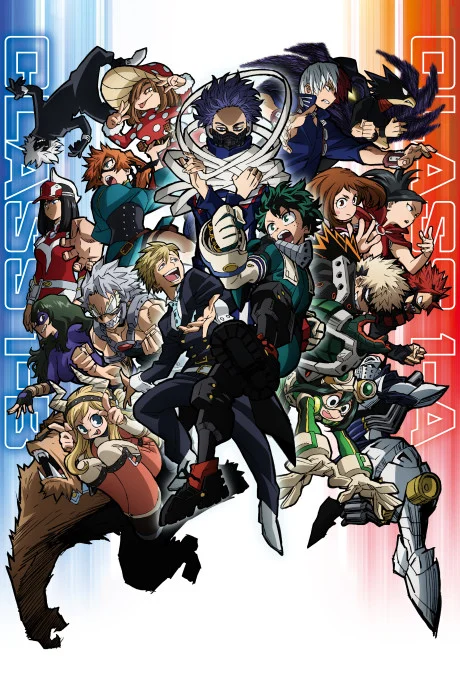
The fifth season of My Hero Academia continues the story of Izuku Midoriya and his classmates at U.A. High School as they work toward becoming professional heroes. The hero course's two first-year classes, Class 1-A and Class 1-B, are set against each other in a joint training exercise, and each student is eager to prove what they have learned. Hitoshi Shinso, a general studies student who hopes to transfer into the hero course, is assigned to compete alongside both sides as part of his evaluation.
The training battles become a test of teamwork and self-knowledge as much as raw power. Midoriya and his friends experiment with new ways of using their abilities, while their rivals in Class 1-B push them to adapt and reconsider their assumptions about one another. The exercise forces every participant to confront personal weaknesses and to find strengths they had not relied on before, and the outcome stays uncertain as the matches unfold.
Later, the season widens its view beyond the classroom. Midoriya and several of his peers take on work-study placements with professional heroes, gaining direct experience of the pressures and responsibilities that come with the job. A parallel storyline follows Tomura Shigaraki and the League of Villains as they come into conflict with a rival criminal organization, adding another front to the larger struggle between heroes and villains.
Trailer
Should You Watch It?
Watch it if you enjoy
- Watch if you follow the main My Hero Academia anime and want the Joint Training exercise, work-study placements, and villain-side developments.
- Watch if you enjoy ensemble superhero school stories where Class 1-A and Class 1-B test teamwork and new applications of their powers.
- Watch if you want Shinso's hero-course evaluation and the season's shift toward professional hero responsibilities and broader conflicts.
It may not suit you if
- May not suit viewers new to My Hero Academia; this fifth season assumes familiarity with earlier seasons and ongoing manga conflicts.
- May not suit those who prefer a single focused arc, since the season moves from a class training exercise to work-study and villain-focused material.
- May not suit viewers seeking a standalone story; it is a middle chapter in the main animated continuity.
This automatic starting point balances the series length, pacing, time commitment, and available Volluble research data. Editors can override it when firsthand knowledge suggests a better entry point.
Why It Connects With Audiences
Why people love it
- The Joint Training arc gives many Class 1-A and Class 1-B students moments to reveal new techniques and teamwork under pressure.
- Shinso's evaluation adds a compelling outsider perspective as he competes alongside both classes for a hero-course transfer.
- The later work-study and villain-side sections expand the world beyond U.A. and deepen established hero and villain conflicts.
Common criticisms
- Some viewers may find the Joint Training arc's match-by-match structure slower or less urgent than prior conflicts.
- The season's shifts between school training, agency work, and villain material can make its pacing feel uneven to some.
- Because it adapts a middle stretch of the manga, the season may feel like setup for later events rather than a complete narrative.
Volluble DNA
A quick profile of the title’s dominant storytelling ingredients.
Characters and Voice Actors25 characters
Izuku Midoriya
Main character- Japanese: Daiki Yamashita
- English: Justin Briner
Katsuki Bakugou
Main character- Japanese: Nobuhiko Okamoto
- English: Clifford Chapin
Shouto Todoroki
Main character- Japanese: Yuuki Kaji
- English: David Matranga
Tomura Shigaraki
Main character- English: Eric Vale
- Japanese: Kouki Uchiyama
Hitoshi Shinsou
Supporting character- Japanese: Wataru Hatano
- English: Jarrod Greene
Ochako Uraraka
Supporting character- Japanese: Ayane Sakura
- English: Luci Christian
Tenya Iida
Supporting character- Japanese: Kaito Ishikawa
- English: J. Michael Tatum
Tsuyu Asui
Supporting character- Japanese: Aoi Yuuki
- English: Monica Rial
Toshinori Yagi
Supporting character- Japanese: Kenta Miyake
- English: Christopher Sabat
Shouta Aizawa
Supporting character- Japanese: Junichi Suwabe
- English: Christopher Wehkamp
Momo Yaoyorozu
Supporting character- Japanese: Marina Inoue
- English: Colleen Clinkenbeard
Eijirou Kirishima
Supporting character- Japanese: Toshiki Masuda
- English: Justin Cook
Minoru Mineta
Supporting character- Japanese: Ryou Hirohashi
- English: Brina Palencia
Mina Ashido
Supporting character- Japanese: Eri Kitamura
- English: Caitlin Glass
Denki Kaminari
Supporting character- Japanese: Tasuku Hatanaka
- English: Kyle Phillips
Hanta Sero
Supporting character- Japanese: Kiyotaka Furushima
- English: Christopher Bevins
Mashirao Ojiro
Supporting character- Japanese: Kousuke Miyoshi
- English: Mike McFarland
Kyouka Jirou
Supporting character- Japanese: Kei Shindou
- English: Trina Nishimura
Fumikage Tokoyami
Supporting character- Japanese: Yoshimasa Hosoya
- English: Jessie James Grelle
Mezou Shouji
Supporting character- Japanese: Masakazu Nishida
- English: Ian Sinclair
Tooru Hagakure
Supporting character- Japanese: Kaori Nazuka
- English: Felecia Angelle
Kouji Kouda
Supporting character- Japanese: Takuma Nagatsuka
- English: Greg Ayres
Rikidou Satou
Supporting character- Japanese: Tooru Nara
- English: Cris George
Mirio Togata
Supporting character- Japanese: Tarusuke Shingaki
- English: Ricco Fajardo
Neito Monoma
Supporting character- Japanese: Kouhei Amasaki
- English: Austin Tindle
Production and Staff26 credits
View all 14 additional credits
Production Background
My Hero Academia Season 5 was produced by the animation studio Bones, continuing the television adaptation of Kohei Horikoshi's original manga. Kenji Nagasaki served as chief director, with Masahiro Mukai directing the season itself. The production drew its material from the twenty-first through twenty-sixth collected volumes of Horikoshi's manga, covering chapters 190 through 258.
The season ran for twenty-five episodes, each about twenty-four minutes long, and was broadcast in two consecutive cours from March 27 to September 25, 2021, on ytv and NTV. Its adaptation order moved through the closing stretch of the Pro Hero arc, the Joint Training arc, the Meta Liberation Army arc, the Endeavor Agency arc, and the opening of the Paranormal Liberation War arc. The Meta Liberation Army portion temporarily carried the alternate title My Villain Academia.
An English dubbed version was produced, and the season was made available through streaming services including Crunchyroll, Hulu, iQ, and Netflix. It remains a self-contained entry within the larger My Hero Academia anime run rather than a standalone franchise.
Franchise Context
My Hero Academia Season 5 is a mainline continuation of the My Hero Academia anime franchise rather than its starting point, a spin-off, or a stand-alone story. It follows the earlier television seasons and adapts Kōhei Horikoshi's manga, drawing from roughly the twenty-first through twenty-sixth volumes. Produced by Bones, the 2021 season consists of 25 episodes and remains part of the primary anime continuity.
Within the broader franchise, this season is one installment in the ongoing adaptation of the manga. It covers several connected story sections, including the Joint Training arc, a villain-focused portion sometimes promoted as My Villain Academia, and material involving the Endeavor Agency. Because it assumes familiarity with prior seasons, it is best understood as a middle chapter that advances established characters and conflicts.
The season also leads into later anime entries that continue the manga's narrative, so it neither resets the franchise nor serves as an alternate version. Its place in the franchise is as a continuation that expands the hero school and villain-side perspectives while staying within the main animated timeline.
Franchise Path
After You Finish
Continue with
Community Verdict
Quick reader and viewer signals from the Volluble community.
Would you recommend this?
Did the ending satisfy you?
Would you watch it again?
Report an issue
Spot something wrong on this page? Tell us what needs attention.
0 Comments
Be the first to comment.