
Overview
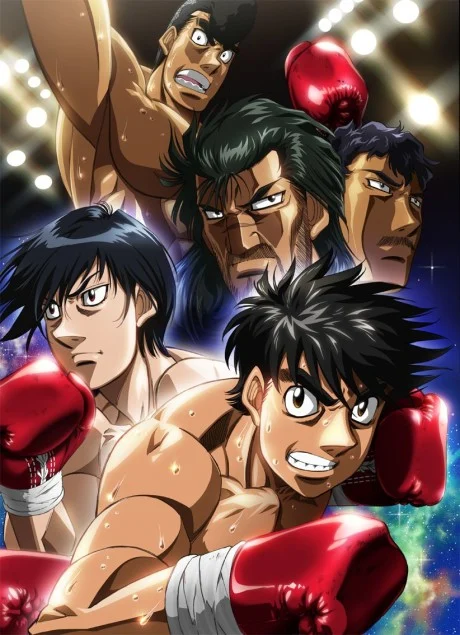
Hajime no Ippo: The Fighting! New Challenger is a self-contained twenty-six episode television series from 2009, and for many viewers it is where this boxing drama finds its most confident rhythm. It builds on the foundation of the earlier adaptation while standing on its own as a stretch of story about ambition pressing forward: fighters who have already proven something now have to prove it again against opponents who studied them closely. The ring is treated as a place where character is revealed rather than merely settled, so even bouts with predictable outcomes carry real weight.
The experience is generous. Comedy sits comfortably beside genuine tension, and the ensemble format keeps the camera moving between Ippo's progress and the parallel struggles of his gymmates, each chasing a different definition of success. Viewers who come for tactics and technique get plenty of both, but the emotional currency here is persistence, the daily grind of training and the small decisions that separate a contender from a champion.
It is approachable for newcomers willing to begin midstream, though those who started with the earlier series will get more from the returning faces. Fans of sports drama, ensemble casts, and long-form shounen storytelling should settle in easily. The series is available on Netflix.
Should You Watch It?
Watch it if you enjoy
- You want a boxing drama where ring tactics and character growth share the spotlight.
- You enjoy ensemble sports stories following Ippo alongside Takamura, Aoki, and Kimura.
- You are open to continuing after the earlier 2000–2002 series or starting mid-franchise with context.
It may not suit you if
- You prefer fresh standalone stories; this is the second TV series and a direct main-story continuation.
- You avoid sports narratives built around training, persistence, and repeated bouts.
- You want a consistently grim tone; comedy and earnest tension sit side by side here.
This automatic starting point balances the series length, pacing, time commitment, and available Volluble research data. Editors can override it when firsthand knowledge suggests a better entry point.
Why It Connects With Audiences
Why people love it
- The 2009 series is noted for a confident rhythm, balancing comedy with genuine ring tension.
- Its ensemble format moves between Ippo's progress and his gymmates' parallel struggles, each chasing different success.
- Bouts are framed as character revelation, so even predictable outcomes can carry emotional weight.
- Tactics and technique are given attention alongside the daily grind that separates contender from champion.
Common criticisms
- As the second TV adaptation, it can be less rewarding without the earlier series' context.
- It is a middle chapter of a long franchise rather than a fresh start or complete ending.
- Viewers seeking a finished story may need to continue to Rising or the manga for the fuller arc.
Volluble DNA
A quick profile of the title’s dominant storytelling ingredients.
Characters and Voice Actors25 characters
Ippo Makunouchi
Main character- Japanese: Kouhei Kiyasu
Mamoru Takamura
Main character- Japanese: Rikiya Koyama
Masaru Aoki
Main character- Japanese: Wataru Takagi
Tatsuya Kimura
Main character- Japanese: Keiji Fujiwara
Manabu Itagaki
Main character- Japanese: Daisuke Namikawa
Genji Kamogawa
Main character- Japanese: Kenji Utsumi
Kumi Mashiba
Supporting character- Japanese: Yuka Hirata
Takeshi Sendo
Supporting character- Japanese: Masaya Onosaka
Naomichi Yamada
Supporting character- Japanese: Daisuke Sakaguchi
Ichirou Miyata
Supporting character- Japanese: Tomokazu Seki
Eiji Date
Supporting character- Japanese: Masaki Aizawa
Masahiko Umezawa
Supporting character- Japanese: Mitsuaki Madono
Ricardo Martinez
Supporting character- Japanese: Masashi Sugawara
Haruhiko Yagi
Supporting character- Japanese: Toshihiko Nakajima
Bryan Hawk
Supporting character- Japanese: Akio Ootsuka
Mari Iimura
Supporting character- Japanese: Emi Shinohara
Jikkyou Announcer
Supporting character- Japanese: Jin Horikawa
Ginpachi Nekota
Supporting character- Japanese: Ichirou Nagai
Miyata no Chichi
Supporting character- Japanese: Unshou Ishizuka
Minoru Fujii
Supporting character- Japanese: Kenichi Ono
Kyousuke Imai
Supporting character- Japanese: Yuuichi Nakamura
Hachinoe Coach
Supporting character- Japanese: Issei Futamata
Tomiko
Supporting character- Japanese: Shouko Tsuda
Aiko Date
Supporting character- Japanese: Sakiko Tamagawa
Yuuji Date
Supporting character- Japanese: Naomi Wakabayashi
Production and Staff24 credits
View all 12 additional credits
Production Background
Hajime no Ippo: The Fighting! New Challenger adapts the long-running boxing manga written and illustrated by George Morikawa. That manga has appeared in Kodansha's Weekly Shonen Magazine since October 1989, and the saved record for this series lists manga as its source material. As the second television adaptation of Morikawa's story, New Challenger continues the boxing career of Ippo Makunouchi and his gym mates, including Takamura, Aoki, and Kimura, each of whom pursues individual goals in the ring.
The series aired in Japan from January 6 to June 30, 2009, as a Winter 2009 broadcast, and it ran for 26 episodes of roughly 23 minutes each. It followed the earlier 76-episode adaptation that aired from October 2000 to March 2002, along with the television film and original video animation released in 2003. A later television series, Hajime no Ippo: Rising, aired from October 2013 to March 2014, placing New Challenger in the middle of the animated television run.
In English-speaking markets this installment is also known under titles such as Fighting Spirit: New Challenger and Hajime no Ippo Season II, and it is available for streaming on Netflix. The record classifies it as a completed television series with comedy, drama, and sports genres and an ensemble cast theme.
Franchise Context
Hajime no Ippo: The Fighting! New Challenger sits within the long-running Hajime no Ippo franchise, which started as George Morikawa's boxing manga and has been serialized in Kodansha's Weekly Shonen Magazine since 1989. Inside that franchise, this entry is a continuation rather than a fresh start or a retelling. It is the second television series, arriving after the earlier 76-episode adaptation that aired from 2000 to 2002 and after a 2003 television film and OVA.
This 2009 series runs 26 episodes and draws on the manga as its source material, which keeps it in line with the franchise's established path rather than presenting an alternate version. It precedes Hajime no Ippo: Rising, the third television series, which aired from 2013 to 2014.
Because it is sometimes labeled as a second season, viewers may treat it as a direct follow-up to the first adaptation. It is an individual installment within a much larger franchise, not a spin-off and not a stand-alone work, and it stays part of the continuous anime lineage that carries the main story forward.
Where This Fits in Hajime no Ippo
A spoiler-light guide to where this exact work fits within the broader Hajime no Ippo franchise.
Exact position: This is Main anime entry 2 and main anime entry 2 of 3. It follows Hajime no Ippo: The Fighting!.
-
Step 1
Begin with the original 2000-2002 Hajime no Ippo TV anime to establish Ippo Makunouchi, his gym, and his early boxing career.
-
Step 2
After that first series, the 2003 TV film and OVA are optional side material and can be watched before New Challenger if available.
-
Step 3
Watch Hajime no Ippo: The Fighting! New Challenger as the second TV series and a direct main-story continuation, not an alternate retelling.
-
Step 4
Continue with Hajime no Ippo: Rising, the third TV series, for the next stage of the anime adaptation.
-
Step 5
For the fuller ongoing story, read George Morikawa's manga from the beginning or from where the anime leaves off.
Franchise Path
After You Finish
Community Verdict
Quick reader and viewer signals from the Volluble community.
Would you recommend this?
Did the ending satisfy you?
Would you watch it again?
Report an issue
Spot something wrong on this page? Tell us what needs attention.
0 Comments
Be the first to comment.