
Overview
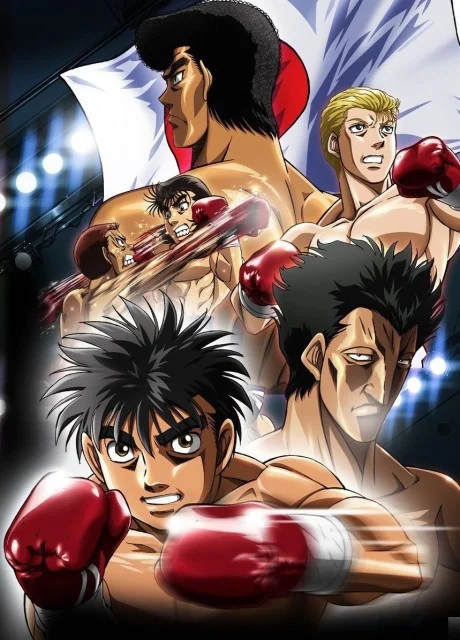
Hajime no Ippo: The Fighting! - Rising - is the third television anime drawn from George Morikawa's long-running boxing manga, and it matters most as a consolidation piece. After a four-year gap in television animation, the series returns to the ring with a wider lens. Rather than tracking a single championship arc, this 25-episode run splits its attention across several careers at once, following Ippo Makunouchi's featherweight title defenses while Takamura pursues another world title and Aoki takes his own shot at a lightweight belt. That structure gives the season its distinctive rhythm, treating the gym as an ensemble rather than one hero's vehicle.
The experience is fight-driven but patient. Bouts unfold across multiple episodes, with tactics, conditioning, and ring psychology given as much room as punches, and the comedy threaded through training camps and gym banter keeps the tone from turning grim. Viewers who enjoy sports drama that earns its payoffs through accumulation will find the pacing rewarding, and the ensemble framing keeps the spotlight moving before any single storyline wears thin.
Because this is a later chapter, newcomers may prefer to start with the earlier adaptations, since rivalries and character history carry forward into these episodes. Returning fans can step straight in. Availability on Crunchyroll and Netflix makes sampling easy, and the mainstream sports action keeps it approachable for general audiences.
Synopsis
This third animated series continues the boxing saga of Ippo Makunouchi, who has grown from a meek, bullied student into the reigning Japanese Featherweight champion. Having taken the belt in the previous series, Ippo now faces the harder job of keeping it, stepping into the ring against a steady stream of hungry contenders determined to claim his title and build their own reputations at his expense. Training under Coach Kamogawa at the Kamogawa Boxing Gym, he works to sharpen his relentless pressure style while opponents study his habits for weaknesses to exploit.
Although Ippo's title defenses drive the story, the season widens its view across the gym's tight-knit roster. Masaru Aoki, the gangly and wildly unpredictable lightweight, pursues a shot at the Japanese Lightweight title, while the ferocious Mamoru Takamura sets his sights on a second WBC middleweight championship. Familiar rivals and teammates from earlier arcs round out an ensemble of grown men chasing professional ambitions from very different positions in their careers.
Mixing hard-hitting fight sequences with broad comedy and the quieter personal stakes behind each bout, the series examines what it costs to stay at the top and what a championship truly means to those still climbing toward one.
Opening
Should You Watch It?
Watch it if you enjoy
- Watch if you enjoy sports drama where bouts unfold across multiple episodes, with tactics, conditioning and ring psychology given as much room as punches.
- Watch for the gym as an ensemble: Ippo's featherweight title defenses run alongside Takamura's next world-title bid and Aoki's lightweight shot.
- Best started after the 2000-2002 series and New Challenger, since Rising is a direct continuation rather than a reboot.
It may not suit you if
- May not suit viewers wanting one focused championship arc; this 25-episode run spreads attention across several fighters' careers.
- May not suit those who prefer quick, self-contained fights, as key bouts stretch over multiple episodes.
- Newcomers may feel under-briefed, since the season assumes familiarity with the cast, gym and earlier continuity.
This automatic starting point balances the series length, pacing, time commitment, and available Volluble research data. Editors can override it when firsthand knowledge suggests a better entry point.
Why It Connects With Audiences
Why people love it
- The ensemble framing keeps the spotlight moving before any single storyline wears thin.
- Comedy threaded through training camps and gym banter keeps the tone from turning grim.
- Payoffs tend to feel earned through patient accumulation rather than sudden finishes.
Common criticisms
- Some viewers may find the multi-episode fight pacing slow across a 25-episode season.
- Those arriving without the earlier series may find the continuity hard to follow.
- Some may read it as a consolidation chapter rather than a major new leap for the franchise.
Volluble DNA
A quick profile of the title’s dominant storytelling ingredients.
Characters and Voice Actors24 characters
Ippo Makunouchi
Main character- Japanese: Kouhei Kiyasu
Mamoru Takamura
Main character- Japanese: Rikiya Koyama
Masaru Aoki
Main character- Japanese: Wataru Takagi
Tatsuya Kimura
Main character- Japanese: Keiji Fujiwara
Manabu Itagaki
Main character- Japanese: Daisuke Namikawa
Genji Kamogawa
Main character- Japanese: Mamoru Miyano
- Japanese: Shouzou Iizuka
Ryou Mashiba
Supporting character- Japanese: Masahiko Tanaka
Kumi Mashiba
Supporting character- Japanese: Saori Hayashi
Takeshi Sendo
Supporting character- Japanese: Masaya Onosaka
Ichirou Miyata
Supporting character- Japanese: Tomokazu Seki
Eiji Date
Supporting character- Japanese: Masaki Aizawa
Alexander Volg Zangief
Supporting character- Japanese: Toshiyuki Morikawa
Masahiko Umezawa
Supporting character- Japanese: Mitsuaki Madono
Ryuhei Sawamura
Supporting character- Japanese: Shinichirou Miki
Haruhiko Yagi
Supporting character- Japanese: Toshihiko Nakajima
Mari Iimura
Supporting character- Japanese: Emi Shinohara
Ginpachi Nekota
Supporting character- Japanese: Kouichi Yamadera
- Japanese: Hiroyuki Yoshino
- Japanese: Ichirou Nagai
Minoru Fujii
Supporting character- Japanese: Kenichi Ono
Tomiko
Supporting character- Japanese: Shouko Tsuda
Nanako Itagaki
Supporting character- Japanese: Yuu Kobayashi
David Eagle
Supporting character- Japanese: Hidenobu Kiuchi
Iwao Shimabukuro
Supporting character- Japanese: Hisao Egawa
Yuki
Supporting character- Japanese: Fumiko Orikasa
Ralph Anderson
Supporting character- Japanese: Juurouta Kosugi
Production and Staff16 credits
View all 4 additional credits
Production Background
Hajime no Ippo: The Fighting! - Rising - is a Japanese television anime series released under the native title はじめの一歩 Rising. It aired from October 5, 2013 through March 29, 2014 as part of the Fall 2013 season, and the finished production consists of 25 episodes with a per-episode runtime of about 23 minutes. The work is also catalogued under the alternate titles Hajime no Ippo 3 and Fighting Spirit: Rising, marking it as a distinct entry rather than a remake of earlier material.
The series adapts George Morikawa's boxing manga Hajime no Ippo, which has been serialized in Kodansha's Weekly Shōnen Magazine since October 1989. Rising is the third television anime adaptation drawn from that manga. The first adaptation, a 76-episode series produced by Madhouse, aired on Nippon TV from October 2000 to March 2002. A television film and an original video animation followed in 2003, and a second series, Hajime no Ippo: New Challenger, aired from January to June 2009. Rising continues this established adaptation lineage, with the source material for the series officially credited as manga.
In terms of distribution, the series has been made available through the streaming services Crunchyroll and Netflix, while information about an English dub remains undocumented in the catalog. It is classified with the genres Comedy, Drama, and Sports, and carries the themes Ensemble Cast, Primarily Adult Cast, and Shounen, reflecting the large roster of boxers and supporting figures that populate the story across its 25-episode run.
Franchise Context
Within the Hajime no Ippo franchise, Rising is the third television anime series and a direct continuation rather than a reboot or an alternate telling. It follows the 2000 to 2002 series and Hajime no Ippo: New Challenger from 2009, picking up the animated storyline at a later point in George Morikawa's long-running manga. Viewers coming from either earlier series find the same gym, cast, and continuity carried forward, while newcomers are better served starting at the beginning of the franchise.
The franchise spans a manga serialized in Kodansha's Weekly Shonen Magazine since 1989, multiple television series, a 2003 television film, and an original video animation. Rising adapts the manga rather than telling an original story, and it also circulates under alternate titles such as Hajime no Ippo 3 and Fighting Spirit: Rising, which mark it as a distinct entry. It is not a remake of earlier material and does not reset the franchise.
Rising stands as the most recent completed television chapter of the animated branch, leaving Morikawa's ongoing manga as the continuing home of the story. The series is available through Crunchyroll and Netflix.
Where This Fits in Hajime no Ippo
A spoiler-light guide to where this exact work fits within the broader Hajime no Ippo franchise.
Exact position: This is Main anime entry 3 and main anime entry 3 of 3. It follows Hajime no Ippo: The Fighting! New Challenger.
-
Step 1
Begin with the original Hajime no Ippo television anime from 2000 to 2002 (76 episodes), which introduces Ippo Makunouchi, his gym, and his earliest rivals and sets up everything later.
-
Step 2
Continue with the second series, Hajime no Ippo: New Challenger, from 2009, since its events lead directly into this third series and cover the stretch of the story that comes just before it.
-
Step 3
Treat the 2003 television film and OVA as optional side material rather than required viewing; they can be slotted in around the early series without disrupting the main progression into Rising.
-
Step 4
Watch Hajime no Ippo: The Fighting! - Rising - here as the third animated series, following Ippo's title defenses alongside Takamura's next title challenge and Aoki's own championship attempt.
-
Step 5
After finishing this 25-episode series, move to George Morikawa's ongoing manga for the continuation, since the story keeps running well past the point the anime leaves off.
Franchise Path
After You Finish
Continue with
This is currently the latest main anime entry in Volluble's saved franchise path.
Community Verdict
Quick reader and viewer signals from the Volluble community.
Would you recommend this?
Did the ending satisfy you?
Would you watch it again?
Report an issue
Spot something wrong on this page? Tell us what needs attention.
0 Comments
Be the first to comment.