
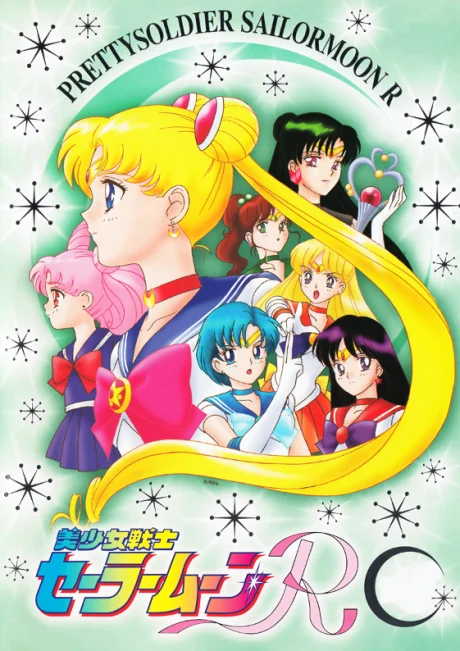
Overview
Sailor Moon R matters as a confident expansion of the magical-girl formula, bringing superhero spectacle, romance, school-life comedy, and cosmic fantasy into the same 43-episode television experience. Rather than treating its young heroines as interchangeable defenders, the series gives its primarily female ensemble room to express friendship, jealousy, loyalty, grief, and growing responsibility. Its appeal comes from that balance: bright transformations and monster battles sit alongside more personal uncertainty, making the emotional stakes feel as important as the supernatural ones.
The season is especially notable for its changing scale. One arc leans into restored memories, alien motives, and the search for renewed purpose, while another opens the story toward the future through time travel, family bonds, and threats aimed at reshaping the world. That structure offers both familiar episodic comfort and a gradually more mythic sense of danger. Viewers who enjoy character-driven team stories, shoujo romance, found-family dynamics, or classic anime with a strong female point of view may find it approachable. Its straightforward heroic framework also makes the show inviting for newcomers, while its mixture of tragedy, unrequited feeling, comedy, and spectacle gives longtime magical-girl audiences plenty to revisit.
Synopsis
Sailor Moon R follows Usagi Tsukino and the other Sailor Senshi as they return to their lives as students while recovering the memories and responsibilities connected to their earlier battles. Their efforts to protect ordinary people are complicated by Mamoru Chiba’s failure to regain his own memories. In his place, the mysterious Moonlight Knight appears, adding uncertainty to Usagi’s feelings and to the team’s struggle to understand the forces threatening them.
The story begins with the arrival of the alien pair Ail and Ann, who target human energy in an attempt to restore their life tree. After that conflict, a little girl named Chibi-Usa arrives from the future while searching for the Silver Crystal. Her appearance draws the Sailor Senshi into a larger confrontation with the Black Moon Clan, whose members also seek the crystal and intend to seize control of the future. Across both arcs, Usagi and her allies face monsters, divided loyalties, and enemies whose personal motives are tied to survival, revenge, and power. The series combines magical-girl action with romance, friendship, and the pressure of growing into roles that affect both the present and the future.
Trailer
Should You Watch It?
Watch it if you enjoy
- Watch if you enjoy classic magical-girl action with transformations, monsters, and a primarily female team.
- A strong fit for viewers who value friendship, romance, found-family bonds, and coming-of-age themes.
- Begin with the original Sailor Moon anime, since this 43-episode season continues its story and character relationships.
It may not suit you if
- May not suit viewers seeking a self-contained entry, as it directly continues the original television anime.
- Its two-arc structure shifts from restored memories and alien motives toward future-focused conflict and time travel.
- The episodic school-life and monster-battle framework may be less appealing if you prefer tightly serialized storytelling.
This automatic starting point balances the series length, pacing, time commitment, and available Volluble research data. Editors can override it when firsthand knowledge suggests a better entry point.
Why It Connects With Audiences
Why people love it
- The ensemble gives its young heroines room for loyalty, jealousy, grief, humor, and growing responsibility.
- Its blend of superhero spectacle, shoujo romance, school comedy, and cosmic fantasy creates varied appeal.
- The season expands the mythology through Chibi-Usa, future-related material, and the Black Moon Clan.
Common criticisms
- Some viewers may find the transition between its two major arcs uneven because the scale and focus of the conflict change.
- The straightforward heroic framework and episodic structure may feel familiar or repetitive to viewers seeking greater narrative complexity.
- The romance and interpersonal uncertainty sometimes share focus with the supernatural action rather than remaining secondary.
Volluble DNA
A quick profile of the title’s dominant storytelling ingredients.
Characters and Voice Actors25 characters
Usagi Tsukino
Main character- Japanese: Kotono Mitsuishi
- Japanese: Kae Araki
- English: Stephanie Sheh
- English: Terri Hawkes
Ami Mizuno
Main character- Japanese: Aya Hisakawa
- English: Kate Higgins
- English: Karen Bernstein
Rei Hino
Main character- Japanese: Michie Tomizawa
- English: Cristina Vee
- English: Katie Griffin
- English: Emilie-Claire Barlow
Makoto Kino
Main character- Japanese: Emi Shinohara
- English: Susan Roman
- English: Amanda Celine Miller
Minako Aino
Main character- Japanese: Rica Fukami
- English: Stephanie Morgenstern
- English: Cherami Leigh
Chibiusa
Main character- Japanese: Kae Araki
- English: Sandy Fox
- English: Tracey Hoyt
Mamoru Chiba
Main character- Japanese: Tooru Furuya
- English: Toby Proctor
- English: Vincent Corazza
- English: Robbie Daymond
Setsuna Meiou
Supporting character- English: Veronica Taylor
- English: Sabrina Grdevich
- Japanese: Chiyoko Kawashima
Luna
Supporting character- English: Michelle Ruff
- Japanese: Keiko Han
- English: Jill Frappier
Artemis
Supporting character- English: Johnny Yong Bosch
- Japanese: Yasuhiro Takato
- English: Ron Rubin
Naru Oosaka
Supporting character- English: Danielle Judovits
- English: Mary Long
- Japanese: Shino Kakinuma
Gurio Umino
Supporting character- Japanese: Keiichi Nanba
- English: Benjamin Isaac Diskin
- English: Roland Parliament
Green Esmeraude
Supporting character- Japanese: Mami Koyama
- English: Kirsten Bishop
- English: Rena Strober
Crimson Rubeus
Supporting character- Japanese: Wataru Takagi
- English: Steve Staley
- English: Robert Tinkler
Cooan
Supporting character- Japanese: Wakana Yamazaki
- English: Mary Long
- English: Eden Riegel
- English: Alice Poon
Berthier
Supporting character- Japanese: Yuri Amano
- English: Cindy Robinson
- English: Kathleen Laskey
Calaveras
Supporting character- Japanese: Akiko Hiramatsu
- English: Cassandra Morris
- English: Jennifer Griffiths
Petz
Supporting character- Japanese: Megumi Ogata
- English: Jessica Gee George
- English: Norma Dell’Agnese
Saphir
Supporting character- Japanese: Tsutomu Kashiwakura
- English: Lyon Smith
- English: Greg Felden
Prince Dimande
Supporting character- Japanese: Kaneto Shiozawa
- English: Matthew Mercer
- English: Robert Bockstael
Wiseman
Supporting character- Japanese: Eiji Maruyama
- English: Steve Kramer
- English: Tony Daniels
Motoki Furuhata
Supporting character- Japanese: Yuuki Satou
- English: Colin O’Meara
- English: Lucien Dodge
Unazuki Furuhata
Supporting character- English: Veronica Taylor
- English: Sabrina Grdevich
- Japanese: Eriko Hara
- Japanese: Miyako Endou
Yuuichirou Kumada
Supporting character- English: Wally Wingert
- Japanese: Bin Shimada
- English: Steven Bednarski
Ail
Supporting character- Japanese: Hikaru Midorikawa
- English: Brian Beacock
- English: Vincent Corazza
Production and Staff25 credits
View all 13 additional credits
Production Background
Sailor Moon R is a finished 43-episode television anime released in Japan in 1993, with a listed start date of March 6, 1993. It was produced by Toei Animation as an adaptation of Naoko Takeuchi's Sailor Moon manga, which was published in Nakayoshi from 1991 to 1997. The record identifies this work specifically as the R installment of the anime, distinguishing it from the source manga and from other productions in the broader Sailor Moon property. Its format is television, rather than a theatrical film or a manga publication.
The anime is structured in two arcs across its 43 episodes. The first lasts 13 episodes and centers on Usagi and her companions recovering their memories, while the second introduces Chibi-Usa and the Black Moon Clan. This division gives Sailor Moon R a distinct two-part adaptation structure, with the latter arc involving future-oriented material and the Silver Crystal. The entry is marked finished and records an English dub, with availability listed through Hulu and YouTube. These release and availability details apply to this television anime entry, not to the manga or to other Sailor Moon productions.
Franchise Context
Sailor Moon R is a continuation of the original Sailor Moon television anime, rather than a separate franchise or a remake. It is the next 43-episode TV installment in the 1990s adaptation produced from Naoko Takeuchi’s manga, following the first season’s introduction of Usagi Tsukino and the Sailor Soldiers. As an anime entry, it is distinct from the manga source and should be read as part of the television series’ ongoing adaptation.
The season is structured in two connected stages. Its opening portion resumes the established story after the first season, while the larger later portion expands the setting with Chibi-Usa, future-related material, and the Black Moon Clan. This makes Sailor Moon R both a direct narrative continuation and a point where the anime broadens its cast, mythology, and conflict. It is not a spin-off, alternate version, or stand-alone film, but a mainline television chapter that carries the Sailor Moon anime forward from its initial season.
Where This Fits in Sailor Moon
A spoiler-light guide to where this exact work fits within the broader Sailor Moon franchise.
Exact position: This is Main anime entry 2 and main anime entry 2 of 6. It follows Sailor Moon.
-
Step 1
Begin with the original Sailor Moon television series to establish Usagi, the Sailor Soldiers, and the events leading into this season.
-
Step 2
Watch Sailor Moon R next. Its opening arc follows the restored memories from the first season, while its later arc introduces Chibi-Usa and the Black Moon Clan.
Franchise Path
After You Finish
Continue with
Community Verdict
Quick reader and viewer signals from the Volluble community.
Would you recommend this?
Did the ending satisfy you?
Would you watch it again?
Sources2 sources
Report an issue
Spot something wrong on this page? Tell us what needs attention.
0 Comments
Be the first to comment.