
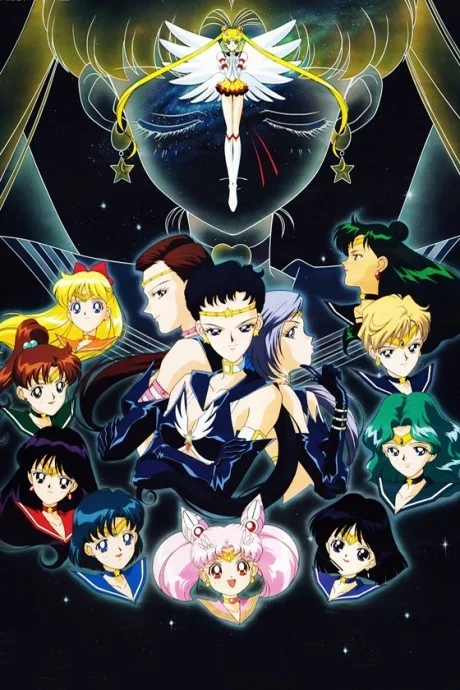
Overview
Sailor Moon Sailor Stars matters as a bold closing chapter for the classic Sailor Moon television anime, bringing its magical-girl formula into a wider, more cosmic register. The familiar balance of comedy, romance, friendship, and transformation remains, but the scale expands toward alien visitors, interstellar conflict, sacrifice, and questions about power and identity. Its two-part structure gives the season a distinctive rhythm: an anime-original return to an earlier threat leads into a more dramatic spacefaring storyline, allowing the series to feel both connected to its past and willing to change its emotional temperature.
The experience is lively, theatrical, and often bittersweet. Usagi’s optimism anchors a large ensemble of female warriors, whose loyalty and disagreements make the battles feel like tests of a found family rather than simple contests of strength. The idol trio and Sailor Starlights add a playful layer of performance, romance, and uncertainty, while the increasingly tragic stakes reward viewers who enjoy character-driven fantasy with a strong sense of emotional commitment. Newcomers may find the dense cast and ongoing relationships easier to approach if they already enjoy ensemble magical-girl stories, coming-of-age adventures, or melodramatic anime with humor alongside its darker turns. With 34 television episodes and an English dub, it offers a substantial, accessible experience for viewers ready for a grander and more reflective Sailor Moon adventure.
Synopsis
Usagi Tsukino and the Sailor Guardians face a new period of upheaval while continuing to protect Earth and the people close to them. The returning Outer Senshi, Haruka, Michiru, Setsuna, and the newly reborn Hotaru, join the group as they confront renewed danger connected to Queen Nehelenia. Alongside battles against supernatural threats, the Guardians must manage the strains of growing up, changing relationships, and the responsibilities that come with defending their world.
The story then turns toward a conflict that reaches far beyond Earth. Mamoru leaves to study in America, and the idol trio known as the Three Lights, Seiya, Taiki, and Yaten, arrives in his absence. Their public lives as performers conceal a deeper purpose, bringing them into contact with Usagi and the other Guardians. They are connected to the Sailor Starlights, warriors seeking to oppose the growing threat of Sailor Galaxia, a powerful figure determined to collect human Star Seeds and rule the galaxy. As the two groups pursue different ways to resist this enemy, Usagi is drawn into a struggle involving alien visitors, divided loyalties, and the fate of countless lives.
Trailer
Should You Watch It?
Watch it if you enjoy
- Watch if you enjoy classic magical-girl action combining comedy, romance, transformations, and female-warrior teamwork.
- Best approached after the earlier original Sailor Moon TV seasons, especially SuperS, as this is their fifth and final season.
It may not suit you if
- May not suit if you prefer self-contained anime, since it continues an established five-season story with a dense returning cast.
- The shift from an anime-original six-episode arc to a more dramatic space conflict may feel uneven if you want one consistent tone.
This automatic starting point balances the series length, pacing, time commitment, and available Volluble research data. Editors can override it when firsthand knowledge suggests a better entry point.
Why It Connects With Audiences
Why people love it
- Viewers may enjoy the balance of lively performances, friendship, romance, and increasingly cosmic stakes.
- Usagi’s optimism and the Guardians’ loyalty give the battles an emotional found-family focus beyond simple power contests.
Common criticisms
- The large ensemble and ongoing relationships can make the season difficult to follow without familiarity with earlier episodes.
- Some viewers may find the two-part structure and tonal move from Queen Nehelenia to Sailor Galaxia less cohesive.
Volluble DNA
A quick profile of the title’s dominant storytelling ingredients.
Characters and Voice Actors25 characters
Usagi Tsukino
Main character- Japanese: Kotono Mitsuishi
- English: Stephanie Sheh
Ami Mizuno
Main character- Japanese: Aya Hisakawa
- English: Kate Higgins
Rei Hino
Main character- Japanese: Michie Tomizawa
- English: Cristina Vee
Makoto Kino
Main character- Japanese: Emi Shinohara
- English: Amanda Celine Miller
Minako Aino
Main character- Japanese: Rica Fukami
- English: Cherami Leigh
Setsuna Meiou
Main character- English: Veronica Taylor
- Japanese: Chiyoko Kawashima
Michiru Kaiou
Main character- Japanese: Masako Katsuki
- English: Lauren Landa
Haruka Tenou
Main character- Japanese: Megumi Ogata
- English: Erica Mendez
Hotaru Tomoe
Main character- Japanese: Yuuko Minaguchi
- English: Christine Cabanos
Seiya Kou
Main character- Japanese: Shiho Niiyama
- English: Melissa Hutchison
Taiki Kou
Main character- Japanese: Narumi Tsunoda
- English: Erika Harlacher
Yaten Kou
Main character- Japanese: Chika Sakamoto
- English: Sarah Williams
Chibiusa
Supporting character- Japanese: Kae Araki
- English: Sandy Fox
Chibi Chibi
Supporting character- Japanese: Kotono Mitsuishi
- English: Stephanie Sheh
Mamoru Chiba
Supporting character- Japanese: Tooru Furuya
- English: Robbie Daymond
Sailor Galaxia
Supporting character- Japanese: Mitsuko Horie
- English: Carolyn Keranen
Luna
Supporting character- English: Michelle Ruff
- Japanese: Keiko Han
Artemis
Supporting character- English: Johnny Yong Bosch
- Japanese: Yasuhiro Takato
Souichi Tomoe
Supporting character- Japanese: Akira Kamiya
- English: Keith Silverstein
Diana
Supporting character- Japanese: Kumiko Nishihara
- English: Debi Derryberry
Kakyuu Koujo
Supporting character- Japanese: Sakiko Tamagawa
- English: Allegra Clark
Joou Nehellenia
Supporting character- Japanese: Yoshiko Sakakibara
- Japanese: Wakana Yamazaki
- English: Laura Post
Chaos
Supporting character- Japanese: Mitsuko Horie
Sailor Iron Mouse
Supporting character- Japanese: Eriko Hara
- English: Katie Leigh
Sailor Aluminum Siren
Supporting character- Japanese: Kikuko Inoue
- English: Faye Mata
Production and Staff25 credits
View all 13 additional credits
Production Background
Sailor Moon Sailor Stars is a 34-episode television anime based on Naoko Takeuchi’s Sailor Moon manga. Takuya Igarashi directed the season, which was produced by Toei Animation. Its broadcast ran in Japan from March 9, 1996, through February 8, 1997, placing the series within the 1996 television anime season and making it the fifth and final season of the Sailor Moon anime.
The adaptation was structured in two distinct parts. The opening six episodes form a self-contained story created exclusively for the anime, bringing the Sailor Guardians into another confrontation with Queen Nehelenia. The remaining 28 episodes adapt the manga’s Stars arc, shifting the story toward Usagi’s separation from Mamoru, the arrival of the idol trio Three Lights, and the conflict with Sailor Galaxia. This combination of anime-original material and manga adaptation gives Sailor Moon Sailor Stars a notable production profile: it first resolves an animated continuation of earlier events before moving into the source material’s concluding storyline.
Franchise Context
Sailor Moon Sailor Stars is the fifth and final season of the original Sailor Moon television anime, so it is a direct continuation rather than a remake, spin-off, or stand-alone story. It carries forward Usagi Tsukino and the Sailor Guardians after the preceding seasons. Its opening six episodes form an anime-original bridge that revisits the conflict with Queen Nehelenia and brings the Outer Guardians, Haruka, Michiru, Setsuna, and the reborn Hotaru, back into the ongoing narrative.
The remaining 28 episodes adapt the Stars arc from Naoko Takeuchi's Sailor Moon manga. This portion expands the setting beyond Earth through the arrival of the Three Lights and the Sailor Starlights, while introducing Sailor Galaxia as the central threat. As a result, the season combines material created specifically for the television version with the concluding major storyline from the manga. It is therefore best placed after the earlier Sailor Moon TV seasons and read as the original anime's concluding installment, not as an alternate version of the franchise or a separate entry.
Where This Fits in Sailor Moon
A spoiler-light guide to where this exact work fits within the broader Sailor Moon franchise.
Exact position: This is Main anime entry 5 and main anime entry 5 of 6. It follows Sailor Moon SuperS.
-
Step 1
Begin with the earlier seasons of the original Sailor Moon TV anime so Usagi, the Sailor Guardians, and their ongoing conflicts are established.
-
Step 2
Watch Sailor Moon SuperS before this season, since Sailor Stars opens by resolving part of that season's story and restoring the Outer Senshi.
-
Step 3
Watch Sailor Moon Sailor Stars as the fifth and final season of this TV continuity. Its opening six episodes form an anime-original Nehelenia arc, followed by the main Stars storyline featuring the Sailor Starlights and Sailor Galaxia.
-
Step 4
Afterward, treat this season as the conclusion of the original television run rather than a prerequisite for a later season in the same continuity; other franchise entries are separate adaptations or versions.
Franchise Path
After You Finish
Community Verdict
Quick reader and viewer signals from the Volluble community.
Would you recommend this?
Did the ending satisfy you?
Would you watch it again?
Report an issue
Spot something wrong on this page? Tell us what needs attention.
0 Comments
Be the first to comment.