
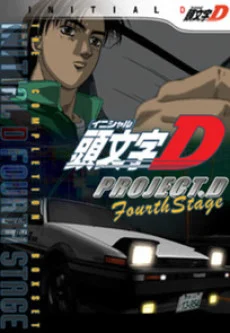
Overview
Initial D 4th Stage is a 2004 television anime that stands as a focused, high-energy entry in a long-running racing saga. Across 24 episodes, it turns competitive mountain driving into a serialized sport, where preparation, vehicle setup, and split-second decisions carry as much weight as raw speed. For viewers who enjoy action and drama grounded in mechanical detail, this stage offers a tense, methodical kind of excitement.
What sets this work apart is its commitment to racing as a tactical puzzle. The series treats each matchup like a chess game played at speed, with rival teams, scouting, and reputation feeding into every run. The primarily adult cast and seinen tone give the story a more seasoned feel than a typical high school sports anime, and the English dub plus streaming availability on Hulu and Crunchyroll make it easy to sample.
Newcomers do not need encyclopedic knowledge of the wider franchise to follow the central rivalries, though returning fans will recognize the ongoing character arcs. If you appreciate sports anime that values strategy, atmosphere, and the slow build of a driver's confidence, this stage is an approachable and rewarding watch. It is a distinct chapter, not the whole saga, and it works best as part of a larger journey.
Synopsis
Initial D 4th Stage follows Takumi Fujiwara and the Takahashi brothers, Keisuke and Ryousuke, as they take their racing ambitions beyond the mountain roads of their home prefecture. The three have organized themselves into Project D, a team built around the goal of pushing each driver's skill as far as it will go. Ryousuke serves as the team's manager and strategist, handling logistics and deciding which challenges are worth accepting.
Project D operates as a traveling outfit that issues challenges to racing teams in other regions and then publicizes the results of those matches through the internet. Within this structure, Takumi takes on downhill races in his AE86, while Keisuke handles the uphill runs. The format gives each driver a defined role and turns every outing into a test of preparation, vehicle setup, and nerve on unfamiliar roads.
The central conflict grows out of the constant stream of rivals who answer Project D's call. Opposing teams such as Seven-Star Leaf and Todo-juku bring their own local specialists and home-course advantages, forcing Takumi and Keisuke to adapt quickly to new terrain and unfamiliar driving styles. What began as a personal pursuit becomes a sustained campaign in which the team's reputation is on the line with every race.
Trailer
Should You Watch It?
Watch it if you enjoy
- Watch if you enjoy sports anime where mountain racing is treated as a tactical puzzle of vehicle setup, scouting, and split-second decisions.
- Watch if you want a seinen-toned racing story with a primarily adult cast and Project D's downhill/uphill team structure.
- Watch if you are following the Initial D saga and want the 24-episode Project D season, available dubbed on Hulu and Crunchyroll.
It may not suit you if
- May not suit viewers who want a fully standalone racing story; this is a later main-line sequel that assumes earlier stages and character groundwork.
- May not suit viewers uninterested in mechanical detail or race-by-race competition, since Project D's circuit drives the season's structure.
- May not suit viewers who prefer fast plot reinvention; the show builds tension through repeated challenges on unfamiliar courses.
This automatic starting point balances the series length, pacing, time commitment, and available Volluble research data. Editors can override it when firsthand knowledge suggests a better entry point.
Why It Connects With Audiences
Why people love it
- The Project D setup gives each race a clear tactical frame, with Ryousuke managing strategy and Takumi and Keisuke handling downhill and uphill roles.
- Its seinen tone and primarily adult cast offer a more seasoned feel than a typical high school sports anime.
- Rival teams like Seven-Star Leaf and Todo-juku bring local specialists and home-course advantages, keeping matchups varied.
Common criticisms
- As a later stage in a long franchise, it can feel dependent on prior familiarity rather than reintroducing the premise from scratch.
- The race-by-race Project D circuit may strike some viewers as repetitive if they want larger narrative turns between matches.
- The catalog tags CGI, so its vehicle animation style may feel dated or visually uneven to some viewers.
Volluble DNA
A quick profile of the title’s dominant storytelling ingredients.
Characters and Voice Actors25 characters
Takumi Fujiwara
Main character- Japanese: Shinichirou Miki
- English: Joel Mcdonald
Ryousuke Takahashi
Main character- Japanese: Takehito Koyasu
- English: J. Michael Tatum
Keisuke Takahashi
Main character- Japanese: Tomokazu Seki
- English: Todd Haberkorn
Bunta Fujiwara
Supporting character- Japanese: Unshou Ishizuka
- English: Kent Williams
Kyouichi Sudou
Supporting character- English: Christopher Sabat
- Japanese: Masahiko Tanaka
Itsuki Takeuchi
Supporting character- Japanese: Mitsuo Iwata
- English: Jessie James Grelle
Kyouko Iwase
Supporting character- Japanese: Megumi Toyoguchi
- English: Caitlin Glass
Kouichirou Iketani
Supporting character- Japanese: Kazuki Yao
- English: Eric Vale
Natsuki Mogi
Supporting character- Japanese: Ayako Kawasumi
- English: Brina Palencia
Atsuro Kawai
Supporting character- Japanese: Seiji Sasaki
- English: Scott Freeman
Wataru Akiyama
Supporting character- Japanese: Yasunori Matsumoto
- English: Robert McCollum
Tomoyuki Tachi
Supporting character- Japanese: Kazuhiro Nakata
- English: Jeff Johnson
Nobuhiko Akiyama
Supporting character- English: Justin Pate
- Japanese: Jin Horikawa
Kazumi Akiyama
Supporting character- Japanese: Ryouka Yuzuki
- English: Cherami Leigh
Yuuichi Tachibana
Supporting character- English: Chuck Huber
- Japanese: Tomomichi Nishimura
Sakai
Supporting character- Japanese: Akimitsu Takase
- English: Anthony Bowling
Tooru Suetsugu
Supporting character- English: Chris Patton
- Japanese: Daiki Nakamura
Sakamoto
Supporting character- Japanese: Hiroyuki Yoshino
- English: Orion Pitts
Seiji Iwaki
Supporting character- English: Jason Douglas
- Japanese: Kazuhisa Kawahara
Kenta Nakamura
Supporting character- English: Greg Ayres
- Japanese: Kousuke Okano
Toushiya Joushima
Supporting character- Japanese: Masashi Ebara
- English: R. Bruce Elliott
Hiroshi Fumihiro
Supporting character- English: Chris Cason
- Japanese: Osamu Hosoi
Shuichi Matsumoto
Supporting character- English: Mike McFarland
- Japanese: Rintarou Nishi
Kouzou Hoshino
Supporting character- Japanese: Ryuuzaburou Ootomo
- English: John Swasey
Toudou
Supporting character- Japanese: Takaya Hashi
- English: Newton Pittman
Production and Staff26 credits
View all 14 additional credits
Production Background
Initial D 4th Stage is an anime television series listed in the catalog as an individual work with 24 episodes. Each episode runs about 27 minutes. The series is classified as an adaptation of a manga, and its genres include action, drama, and sports, with auto racing as a major theme.
The show aired from April 17, 2004 to February 18, 2006, placing its original broadcast in the mid-2000s. An English dubbed version is available, and the series can be streamed on Hulu and Crunchyroll. The catalog record does not include creator, studio, or publisher credits for this specific entry, so production background here is limited to the documented release and adaptation details.
Franchise Context
Initial D 4th Stage is not the starting point of the Initial D saga. It is a later television installment in the anime adaptation of Shuichi Shigeno's long-running street-racing manga, following the earlier Initial D anime stages and continuing the same narrative continuity. It is therefore a sequel season and main-line anime entry, not a reboot, alternate version, spin-off, or stand-alone work.
Within the larger franchise, this entry covers the Project D period, with Takumi Fujiwara and the Takahashi brothers already established from prior installments. That placement matters because the season assumes familiarity with earlier rivals, races, and character relationships rather than reintroducing the premise from scratch. The source manga provides the ongoing story material, while this 24-episode series presents it as a 2004 television season. Other anime entries, the manga, and later franchise works sit around it, making Fourth Stage one part of an extended multi-stage property.
Where This Fits in Initial D
A spoiler-light guide to where this exact work fits within the broader Initial D franchise.
Exact position: This is Main anime entry 3 and main anime entry 3 of 5. It follows Initial D 2nd Stage.
-
Step 1
Begin with Initial D First Stage, the original television anime, which introduces Takumi Fujiwara, the AE86, and the Mount Akina racing scene that everything later builds on.
-
Step 2
Continue through Second Stage and the Third Stage film before starting this one. 4th Stage opens with Project D already formed and assumes the earlier team rivalries and character groundwork are in place.
-
Step 3
Treat 4th Stage as a main-line continuation rather than a side story or a reboot. Its 24 episodes follow Project D's challenge circuit, placing it between the earlier stages and the ones that come after.
-
Step 4
Once this season is finished, move on to Fifth Stage and Final Stage to complete the Project D storyline. The Legend film trilogy retells the opening arc in a different style and works as an alternate entry point, not a substitute for the stage order.
-
Step 5
Optional extras such as the Extra Stage OVAs and the Battle Stage compilations add side character material and race recaps, and can be skipped without losing the main thread.
Franchise Path
After You Finish
Continue with
Community Verdict
Quick reader and viewer signals from the Volluble community.
Would you recommend this?
Did the ending satisfy you?
Would you watch it again?
Sources1 sources
Report an issue
Spot something wrong on this page? Tell us what needs attention.
0 Comments
Be the first to comment.